 Reading Ants

The Red and the Black
Original title: Le Rouge et le Noir
A clever carpenter's son in France tries to rise through love, religion and ambition, and in the end his pride and passion destroy him.
Overview
The Red and the Black is a novel by the French writer Stendhal, published in 1830. It is set in France in the years after Napoleon’s fall, when the old aristocracy and the Church had regained power. The hero, Julien Sorel, is young, poor and brilliant, and he dreams of the glory that Napoleon once offered to men of talent. The “red” and the “black” are often understood as the army and the Church, the two paths open to an ambitious young man. The book asks what a person must sacrifice to succeed in an unfair society.
Main Characters
- Julien Sorel: a young man from a small town, proud, intelligent and ambitious.
- Madame de Renal: the wife of the town mayor, who falls in love with Julien.
- Mathilde de la Mole: the proud, willful daughter of a Parisian marquis.
- Marquis de la Mole: a powerful nobleman who employs Julien.
- Abbe Pirard: a stern priest who helps Julien.
- Monsieur de Renal: the mayor, vain and class-conscious.
Full Summary
The Tutor
Julien is the son of a carpenter who owns a sawmill in the small town of Verrieres. He is physically weak, and his father and brothers despise him because he reads books. He has memorized the whole New Testament in Latin, and he secretly admires Napoleon. The mayor, Monsieur de Renal, hires him as a tutor for his children.
Julien is cold and calculating in his approach, and he thinks that he should win Madame de Renal as a conquest. Instead, the two fall truly in love. Their affair lasts for some time, though they live in fear of being found out.
The Seminary
When the affair threatens to become public, Julien leaves and enters a seminary to train as a priest. There he finds that the other students are mostly crude, and that success depends on flattery and cunning, not on faith. He wins the respect of the director, Abbe Pirard, who has a reputation for honesty.
The older priest in Verrieres, who first taught Julien Latin and believed in him, remains his quiet supporter, but the seminary is full of rivalry and spying, and Julien has to hide his intelligence to avoid making enemies. He learns that to rise in the Church, one must please the powerful.
Pirard is forced to leave after a quarrel with the church authorities, and he finds Julien a position in Paris as the secretary of the Marquis de la Mole, a rich and influential nobleman.
Paris
In Paris, Julien moves among the high aristocracy. He works hard, and the marquis comes to trust him. He meets Mathilde, the marquis’s daughter, who is bored with the young men of her class and attracted to Julien’s pride. Their relationship is a battle of wills, in which each tries to avoid showing too much feeling.
The marquis grows to respect Julien so much that he sends him on a secret political errand, and he also arranges a military commission for him, together with a noble-sounding name. Eventually, Mathilde becomes pregnant and tells her father. After a fit of anger, the marquis agrees to the marriage, and he arranges a title and an income for Julien. It seems that Julien’s ambitions have been met, and that the carpenter’s son has reached the top.
The Letter
Just then, the marquis asks for information about Julien’s past, and he receives a letter from Madame de Renal, written under the influence of her priest, in which she describes Julien as a cunning fortune hunter who seduces women to rise in the world. The marquis withdraws his consent, and the marriage is off.
Furious, Julien rides back to Verrieres, enters the church where Madame de Renal is praying, and shoots her. She is wounded but not killed. Julien is arrested at once and does not try to escape.
The Trial
Julien is put on trial. Though his lawyers could argue for leniency, he gives a bitter speech in which he accuses the court of punishing him because he is a low-born man who dared to rise. He is condemned to death.
Madame de Renal, who has recovered, visits him in prison, and the two make peace. Julien understands at last that he truly loves her. He first refuses to appeal, then agrees at her request, but the appeal does not save him and he is executed. Madame de Renal dies a few days later, and Mathilde arranges his burial.
Why It Matters
The Red and the Black is one of the founding novels of the nineteenth-century realist tradition, and Stendhal is seen as a pioneer of psychological fiction. He shows his characters’ inner thoughts, doubts and self-deceptions with unusual honesty. The book also paints a sharp picture of French society in the 1820s, showing how birth and connections mattered more than ability. Julien Sorel became a model for later ambitious young heroes in fiction. Stendhal himself was little appreciated in his lifetime, and he is now counted among the greatest French novelists, a writer who looked at the human heart with clear, ironic eyes and who saw that politics, money and love are always tangled together.
Key Takeaways
- Ambition can blind us. Julien chases success and nearly misses what matters.
- Society can be unfair. Talent from a low background faces many obstacles.
- Hypocrisy is common. Success often rewards pretending, not honesty.
- Pride can be self-destructive. Julien’s pride leads him to act against his own interest.
- Love can break through calculation. His true feelings emerge only at the end.
What We Can Learn
Julien teaches us that ambition is not a bad thing, but it needs a purpose beyond itself. He spends so much time performing a role that he almost forgets what he truly wants. In our own lives, it is useful to ask whether what we are chasing will make us happy.
The book also reminds us to be honest with ourselves, and to notice when we are acting from pride and fear rather than from our values. Finally, it shows that the people who help us, such as friends and mentors, deserve to be treated with honesty and respect.
Criticism and Counterpoints
Some readers find Julien unlikable, as he is vain, calculating and sometimes cruel. The long political passages about the France of the period can be hard to follow for modern readers, and the plot has some sudden turns. The female characters, particularly Mathilde, are seen by some as exaggerated. Others point out that Stendhal’s open sympathy for his hero makes the book less critical than it could be. The sudden shift in the final chapters, when Julien shoots the woman he loves and then calmly accepts death, has puzzled readers for generations, and some feel that it is not fully explained.
Who Should Read It
This is a good book for readers who like classic novels, character studies and stories about ambition and social class. It is long and is set in a world that is far from ours, so it may feel slow at first. Fans of Great Expectations or Madame Bovary will find a lot to enjoy here.
Want the whole book?
A summary is a taste, not the meal. Here is where to find the full book.
You reached the end 🎉
Nicely done. Mark this one as read, and we will suggest what to read next.
Read this next

Madame Bovary
Gustave Flaubert
A romantic young woman, bored by her provincial marriage to a kind but dull doctor, seeks excitement in love affairs and luxury, and is crushed by debt and disillusion.
🌍 World Literature
Great Expectations
Charles Dickens
A poor orphan boy suddenly receives a fortune from a secret benefactor and becomes a gentleman in London, but he learns that wealth and status mean nothing without loyalty, kindness and gratitude.
📜 Classics
The Count of Monte Cristo
Alexandre Dumas
A young sailor, betrayed by jealous rivals and thrown into a dungeon for fourteen years, escapes with the help of a fellow prisoner, finds a vast treasure and returns as a mysterious, powerful count to take elaborate revenge on those who ruined him.
🌍 World Literature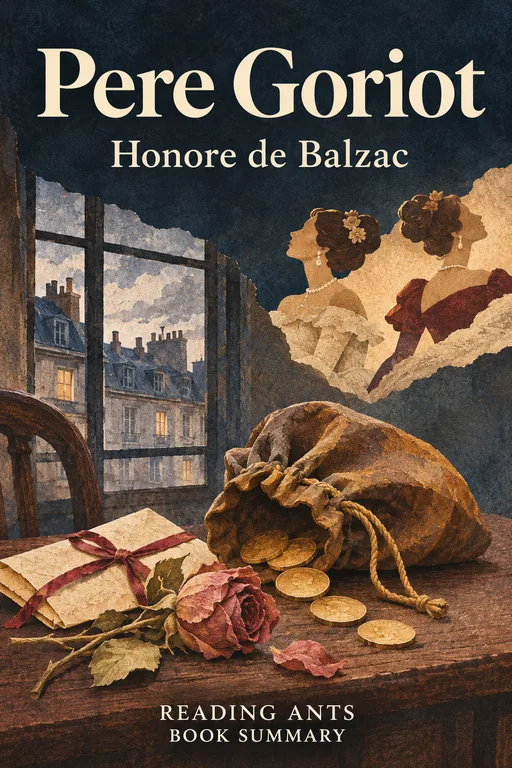
Pere Goriot
Honore de Balzac
In a shabby Paris boarding house, a poor student learns how ruthless the city is by watching an old man ruin himself for two selfish daughters.
🌍 World Literature
Crime and Punishment
Fyodor Dostoevsky
A poor former student in St. Petersburg murders an old pawnbroker to prove he is an extraordinary man above ordinary morality, then is tormented by guilt until love and confession offer him a path to redemption.
🌍 World Literature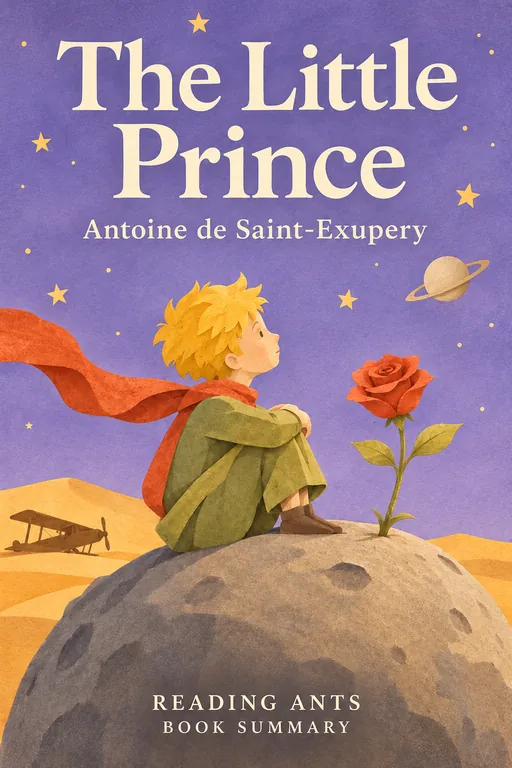
The Little Prince
Antoine de Saint-Exupery
A pilot stranded in the desert meets a small boy from a tiny planet, who teaches him that the most important things in life, like love and friendship, can only be seen with the heart.
🌍 World LiteratureWant something different?
Pick another topic and we will show you three books to start with.