 Reading Ants
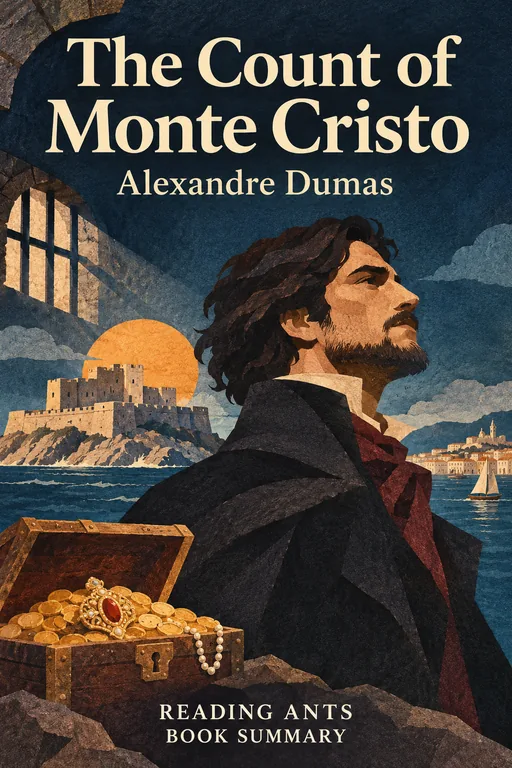
The Count of Monte Cristo
Original title: Le Comte de Monte-Cristo
A young sailor, betrayed by jealous rivals and thrown into a dungeon for fourteen years, escapes with the help of a fellow prisoner, finds a vast treasure and returns as a mysterious, powerful count to take elaborate revenge on those who ruined him.
Overview
The Count of Monte Cristo, by Alexandre Dumas, was published as a serial between 1844 and 1846 and is one of the most popular adventure novels ever written. It is set in France between 1815 and 1838, during the turbulent years after Napoleon’s fall. The hero is Edmond Dantès, a cheerful, honest young sailor who is about to be promoted to captain and to marry his sweetheart, Mercédès. Three men, each for his own selfish reasons, falsely accuse him of treason, and he is imprisoned without trial in the Château d’If, a fortress island prison. Dumas wrote the story with extraordinary pace, full of twists, disguises, secrets and slowly unfolding revenge, and it remains a model of the revenge thriller.
Main Characters
- Edmond Dantès: a young, honest sailor who becomes the Count of Monte Cristo.
- Mercédès: his fiancée, who later marries another man.
- Abbé Faria: a learned priest and fellow prisoner who becomes Edmond’s teacher.
- Fernand Mondego: a rival for Mercédès, later Count de Morcerf.
- Danglars: a ship’s accountant, later a rich banker.
- Gérard de Villefort: the prosecutor who imprisons Edmond to protect himself.
- Caderousse: a neighbor who knows the truth and does nothing.
- Haydée: a young Greek woman who becomes the Count’s ward.
- Albert de Morcerf: Mercédès’s son.
Full Summary
Betrayal
In 1815, Edmond Dantès, nineteen, returns to Marseille aboard the Pharaon, expecting to be named its captain. The old captain has died, and on his deathbed he asked Edmond to deliver a letter to a man in Paris, a favor that will ruin him. Three men resent Edmond’s good fortune: Danglars, the ship’s accountant, who wants to be captain; Fernand, a fisherman who loves Mercédès; and Caderousse, a drunken tailor. Danglars writes an anonymous letter accusing Edmond of being a Bonapartist agent, and Fernand posts it.
At his engagement party, Edmond is arrested. The prosecutor, Villefort, realizes that the letter Edmond was carrying is addressed to his own father, a Bonapartist. To protect his career, he burns the letter, and secretly sends Edmond to the Château d’If without a trial.
The Château d’If
For years, Edmond sits in a dark cell, nearly mad with despair. Then he hears scratching. A fellow prisoner, Abbé Faria, has been digging a tunnel to escape, and has accidentally dug into Edmond’s cell. Faria, a man of vast learning, teaches Edmond languages, science, history and philosophy, and helps him work out who betrayed him. He also tells him the secret of a huge treasure hidden on the island of Monte Cristo.
When Faria dies, Edmond takes the place of the abbé’s body in the burial sack. The prison guards throw the sack into the sea, and Edmond cuts himself free and swims to safety. He has spent fourteen years in prison.
The Treasure
Edmond is rescued by smugglers, and soon reaches the island of Monte Cristo, where he finds the treasure, jewels, gold and coins, beyond imagining. He returns to Marseille in disguise and learns what has happened: his father died of starvation, Mercédès married Fernand, Danglars became a wealthy banker, and Villefort is a respected judge. Edmond rewards the honest shipowner, Morrel, who tried to help him, then vanishes.
The Count in Paris
Ten years later, in Paris, a wealthy, mysterious foreigner appears in high society: the Count of Monte Cristo, with seemingly unlimited wealth and strange habits. He befriends Albert de Morcerf, Fernand’s son, and begins to weave a plan of revenge on each of his enemies.
Danglars is ruined through false telegraph messages and a series of financial traps, though the Count finally spares his life. Fernand, now Count de Morcerf, is exposed as a traitor who betrayed his benefactor, Ali Pasha, and sold Ali Pasha’s wife and daughter into slavery. Albert, blaming the Count for his father’s downfall, challenges him to a duel. Mercédès, who has recognized the Count as Edmond, begs him to spare her son, and he agrees. Albert, learning the truth, publicly apologizes to the Count, and he and his mother abandon Fernand. Disgraced and alone, Fernand confronts the Count, who reveals his true identity, and then shoots himself.
Villefort
Villefort is publicly exposed when Benedetto, his illegitimate son, who has been posing as a nobleman, is revealed in court as a murderer and names Villefort as his father. His household is also cursed by a series of mysterious poisonings, which the Count has quietly allowed to unfold. A secret poisoner kills several people, and Villefort’s wife, Madame de Villefort, is revealed as the culprit. When Villefort learns that she has also poisoned their young son, he goes mad. The Count, who had intended to take his revenge on Villefort, realizes that he has gone too far, since an innocent child died. He begins to doubt that he has the right to act as the hand of Providence.
Redemption
Edmond, shaken, helps Maximilien Morrel, the son of the old shipowner, and Valentine de Villefort, who has been poisoned but survived, to find happiness together. He leaves Paris with Haydée, a young woman he rescued from slavery and who has come to love him. In a final letter to Maximilien, the Count says that all human wisdom is contained in two words: wait and hope.
Why It Matters
The Count of Monte Cristo is one of the most widely read adventure novels in the world and a model of the revenge story. It has been translated into nearly every language and has never gone out of print. Its first readers waited anxiously for each new installment in the newspaper, and Dumas, who wrote with a team of assistants, became rich and famous.
Its themes of injustice, wrongful imprisonment, patience and revenge are deeply universal, and its story has inspired hundreds of films, television series and other works, including the 1934 and 2002 films and the novel’s many echoes in modern fiction. It remains a standard against which long, gripping plots are judged.
Key Takeaways
- Revenge can corrupt. Edmond’s plan harms the innocent, too.
- Patience can be a weapon. He plans for years.
- Education transforms people. Faria’s teaching makes Edmond a new man.
- Wealth gives power, but not wisdom. The Count must learn the limits of his role.
- Hope and waiting are essential. The novel’s final words stress their value.
What We Can Learn
The novel invites us to think carefully about justice and revenge. Edmond is clearly wronged, but when his revenge hurts innocent people, he sees that taking judgment into his own hands is dangerous.
It also shows how important a good teacher can be. Faria turns a young, uneducated sailor into a man of great knowledge, and Edmond’s years in prison become years of learning. Seeking mentors, and using hard times to grow, can change a life.
Finally, it shows the value of mercy. Edmond spares Albert and eventually chooses a quieter life with Haydée, which is more fulfilling than revenge.
Criticism and Counterpoints
Some readers find the book very long and complicated, with a large cast and many subplots, and the coincidences that allow Edmond’s plan to succeed, sometimes far-fetched. The Count himself can seem too perfect, as rich, wise and powerful as a god.
Dumas has also been criticized for his racial and ethnic stereotypes, and for the book’s treatment of women, who are mostly passive or villainous. Some critics think the middle part, set in Parisian society, drags. Even so, most readers consider the story tremendously enjoyable.
Who Should Read It
This novel suits teens and adults who enjoy adventure, suspense and drama. It is very long, so an unabridged edition is a commitment. Abridged versions are widely available for those who want a shorter experience.
Want the whole book?
A summary is a taste, not the meal. Here is where to find the full book.
You reached the end 🎉
Nicely done. Mark this one as read, and we will suggest what to read next.
Read this next
The Three Musketeers
Alexandre Dumas
A young Gascon swordsman travels to Paris in the 1620s to join the King's Musketeers, befriends three legendary soldiers, and together they fight to protect the Queen's honor against the scheming Cardinal Richelieu and the dangerous Milady.
🌍 World Literature
Les Miserables
Victor Hugo
A former convict, transformed by a single act of mercy, spends his life doing good while being hunted by a relentless police inspector, in a sweeping story of love, injustice and redemption in nineteenth-century France.
🌍 World Literature
Great Expectations
Charles Dickens
A poor orphan boy suddenly receives a fortune from a secret benefactor and becomes a gentleman in London, but he learns that wealth and status mean nothing without loyalty, kindness and gratitude.
📜 Classics
The Hunchback of Notre-Dame
Victor Hugo
In fifteenth-century Paris, the deformed bell-ringer Quasimodo, the cold archdeacon Frollo and the dashing captain Phoebus are all drawn into a deadly web of desire around the beautiful Gypsy dancer Esmeralda.
🌍 World Literature
A Tale of Two Cities
Charles Dickens
During the French Revolution, the lives of a French aristocrat who rejects his family, the woman he loves and a brilliant but wasted English lawyer become entangled, until one man makes the ultimate sacrifice for love.
📜 Classics
The Little Prince
Antoine de Saint-Exupery
A pilot stranded in the desert meets a small boy from a tiny planet, who teaches him that the most important things in life, like love and friendship, can only be seen with the heart.
🌍 World LiteratureWant something different?
Pick another topic and we will show you three books to start with.