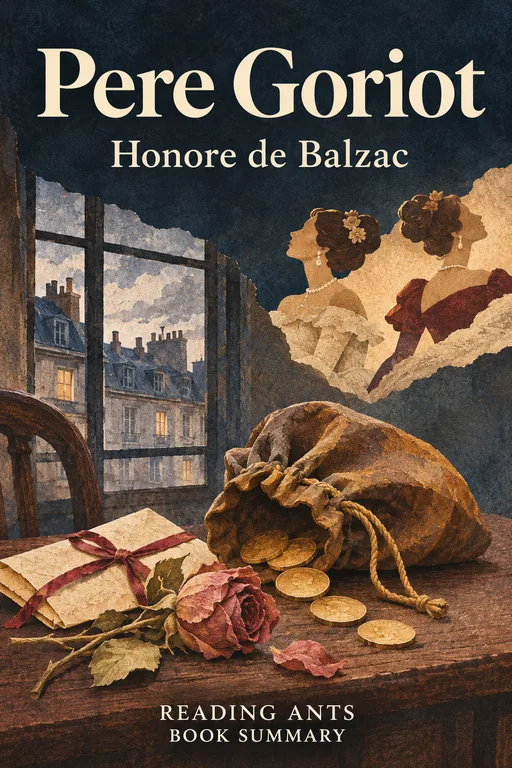
Pere Goriot
Original title: Le Père Goriot
In a shabby Paris boarding house, a poor student learns how ruthless the city is by watching an old man ruin himself for two selfish daughters.
Overview
Pere Goriot (Old Goriot) is a novel by Honore de Balzac, published in 1835. It is set in Paris around 1819, a few years after the fall of Napoleon, in a society where money, birth and connections decide everything. It is one of the best-known parts of Balzac’s huge series of novels called The Human Comedy. The story centers on a poor boarding house, where very different people live under one roof: a young student, a mysterious criminal and an old man who has given his whole fortune to his daughters. The central question is simple and sad: what do children owe their parents, and what is a parent’s love worth?
Main Characters
- Pere Goriot: an old, retired pasta maker who lives only for his two daughters.
- Eugene de Rastignac: a young law student from a poor country family, ambitious but still kind.
- Vautrin: a clever, charming lodger who is secretly a runaway criminal.
- Delphine de Nucingen: Goriot’s younger daughter, married to a wealthy banker.
- Anastasie de Restaud: Goriot’s elder daughter, married to a count.
- Madame Vauquer: the owner of the boarding house, a petty and calculating woman.
- Madame de Beauseant: Rastignac’s well-connected cousin, who teaches him the rules of high society.
- Bianchon: a kind medical student, who lives in the boarding house and befriends Rastignac.
Full Summary
The Maison Vauquer
The story opens in the Maison Vauquer, a dreary boarding house in a poor district of Paris. Madame Vauquer rents rooms to a handful of lodgers. One of them is Goriot, who arrived years earlier as a prosperous man, but who has been slowly moved to cheaper and cheaper rooms. The other lodgers mock him and wonder where his money has gone. Visits from fashionable young women, whom he says are his daughters, are the subject of gossip.
Among the lodgers is Rastignac, a student who has come to Paris to study law and to make his fortune. He sees, on a daily basis, how far the rich and the poor are separated in the city.
Rastignac Learns the Rules
Through his cousin, Madame de Beauseant, Rastignac gains an entry to high society. She tells him bluntly that the world is cruel, and that those who succeed do so by using other people. He becomes interested in Delphine, one of Goriot’s daughters, and he learns that Goriot has given away nearly everything he owned for the sake of his daughters’ marriages and their lives of luxury.
Rastignac wants money badly, and he is tempted. He grows closer to Delphine, who is unhappy in her marriage, and he becomes a regular visitor at her house.
Vautrin’s Offer
Vautrin sees how much Rastignac wants to rise, and he makes him an offer. A young woman in the boarding house, Victorine, is the daughter of a rich man who has refused to recognize her. If her brother were out of the way, she would inherit a fortune, and Rastignac could marry her. Vautrin offers to arrange a duel in which the brother will be killed, in exchange for a share of the money.
Rastignac is horrified, and he refuses, although the temptation stays in his mind. The duel takes place anyway, and Victorine’s brother is killed.
Vautrin Is Caught
Before long, the police learn that Vautrin is a long-wanted criminal, who has been hiding in the boarding house under a false name. One of the other lodgers, who had suspected him, helps to trap him, and he is arrested. The boarders are shocked, and the house begins to empty.
For Rastignac, this is a lesson. The man who showed him the crude, open face of ambition has been taken away, and the polished, hidden ambition of high society remains.
Goriot’s Last Days
Meanwhile, Goriot’s daughters continue to demand money from him. He sells what remains of his silver and his income, to pay for their debts and their needs. Both of them are in trouble with their husbands, and each asks him for more. He gives everything, until he is left with nothing.
He falls gravely ill. Bianchon and Rastignac care for him, and they send word to the daughters. Neither comes when he most needs them: Delphine never visits him, and Anastasie arrives only at the very end, after he has lost consciousness. In his final hours, Goriot weeps, curses and forgives them in turn, and he dies with the young men beside him.
The Burial
The funeral is poor, and it is the young men, not the daughters, who see to it. The daughters do not attend, though their empty carriages are sent as a gesture. Only Rastignac and the servant Christophe, with a couple of paid mourners, follow the coffin to the cemetery.
When the burial is over, Rastignac stands on a hill overlooking Paris. He has lost his illusions, but he has not given up his ambition. He turns toward the city as if issuing a challenge to it, and then goes off to dine with Delphine, which shows that he means to take his place in the very society that has just failed Goriot.
Why It Matters
Pere Goriot is one of the great novels of the nineteenth century, and it is the work in which Balzac first used a technique that later became famous: the same characters appear again and again in different novels, so that the reader sees a whole society. Rastignac, in particular, returns in many later books. The novel is also often compared with King Lear, because both stories are about a father who gives everything to ungrateful daughters. Its portrait of Paris, with its snobbery, greed and loneliness, shaped later realist writers such as Zola, and it is still read today as a study of ambition and family.
Key Takeaways
- Money rules the city. In Balzac’s Paris, status and relationships depend on wealth.
- Ambition has a price. Rastignac must decide what he is willing to give up.
- Love can be one-sided. Goriot loves too much, and his daughters take advantage.
- Excess love can harm. By giving everything, he teaches his daughters to expect everything.
- Innocence is lost. Rastignac begins as a hopeful boy and ends as a more hardened man.
What We Can Learn
The book asks us to look at how we treat the people who love us. Goriot’s daughters are not monsters, but they are careless and selfish. It is easy to take for granted a parent, a teacher or a friend who has always been there, and the story reminds us to say thanks while we can.
It also warns about the way that wealth and status can make people lose sight of what is important. Rastignac shows that each person must decide where to draw a line, and what they will refuse to do, even when it would help them rise. Finally, the book suggests that giving without any boundaries does not always help the person we love, and that care sometimes means saying no.
Criticism and Counterpoints
Some readers find the long opening description of the boarding house slow, and the novel’s many coincidences can feel stagey. Goriot is sometimes seen as so saintly that he is hard to believe, and the daughters as too one-sided. Others point out that Balzac moralizes a lot, and that the melodramatic criminal plot with Vautrin sits uneasily next to the realistic scenes. Still, many consider these flaws small next to the book’s power.
Who Should Read It
This book is for readers of classic novels who enjoy rich descriptions of city life and strong characters. It is a good first book by Balzac, and it is shorter than many other classics. Those who like fast plots may find the early pages slow, but the story gains strength and becomes moving by the end.
Want the whole book?
A summary is a taste, not the meal. Here is where to find the full book.
You reached the end 🎉
Nicely done. Mark this one as read, and we will suggest what to read next.
Read this next

The Red and the Black
Stendhal
A clever carpenter's son in France tries to rise through love, religion and ambition, and in the end his pride and passion destroy him.
🌍 World Literature
Great Expectations
Charles Dickens
A poor orphan boy suddenly receives a fortune from a secret benefactor and becomes a gentleman in London, but he learns that wealth and status mean nothing without loyalty, kindness and gratitude.
📜 Classics
Madame Bovary
Gustave Flaubert
A romantic young woman, bored by her provincial marriage to a kind but dull doctor, seeks excitement in love affairs and luxury, and is crushed by debt and disillusion.
🌍 World Literature
Les Miserables
Victor Hugo
A former convict, transformed by a single act of mercy, spends his life doing good while being hunted by a relentless police inspector, in a sweeping story of love, injustice and redemption in nineteenth-century France.
🌍 World Literature
Oliver Twist
Charles Dickens
An orphan boy born in a workhouse escapes to London, where he falls into a gang of child thieves, and despite cruelty and crime around him, his goodness survives until he finds a loving home and learns the secret of his birth.
📜 Classics
The Little Prince
Antoine de Saint-Exupery
A pilot stranded in the desert meets a small boy from a tiny planet, who teaches him that the most important things in life, like love and friendship, can only be seen with the heart.
🌍 World LiteratureWant something different?
Pick another topic and we will show you three books to start with.