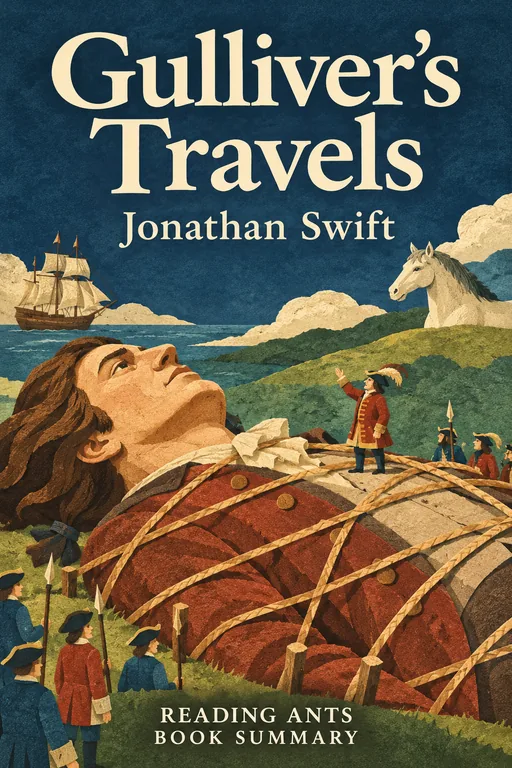
Gulliver's Travels
A ship's surgeon named Lemuel Gulliver visits four strange lands, from a country of tiny people to one ruled by rational horses, and Swift uses these voyages to mock human pride, politics and folly.
Overview
Gulliver’s Travels, published in 1726, was written by Jonathan Swift, an Anglo-Irish satirist and clergyman. It presents itself as the true record of a sea voyager, Lemuel Gulliver, who travels to four imaginary places. Each voyage changes the way Gulliver, and the reader, sees humanity. On the surface, it is an adventure story, and it has often been adapted for children, but it is a sharp satire of politics, science, religion and human nature. Swift wrote the book as a way of attacking the follies of his age, and the harshness of its last part has shocked readers for centuries.
Main Characters
- Lemuel Gulliver: the narrator, an Englishman and ship’s surgeon, who is practical and curious.
- The Lilliputians: tiny people, six inches tall, who are petty and proud.
- The Brobdingnagians: giants who are kind but sometimes crude, and their king, who is wise.
- Glumdalclitch: a farmer’s daughter who takes care of Gulliver in Brobdingnag.
- The Houyhnhnms: rational horses who rule their land, whom Gulliver admires, though they treat the Yahoos and Gulliver harshly.
- The Yahoos: filthy, brutal humanlike creatures who are kept as beasts.
Full Summary
A Voyage to Lilliput
After a shipwreck, Gulliver wakes on a beach, tied down by thousands of tiny ropes. He is in Lilliput, a land where the people are six inches tall. They take him to their capital and give him food and lodging. The emperor and his court are full of vanity and intrigue: politicians are chosen by how well they dance on a rope, and the country is split between the High-Heels and Low-Heels, who quarrel over fashion, and between Big-Endians and Little-Endians, who fight a war over which end of an egg to break. Gulliver helps by capturing the enemy fleet of Blefuscu, but refuses to destroy the enemy nation. When he puts out a fire in the palace by urinating on it, he is accused of treason and has to flee.
A Voyage to Brobdingnag
On a later trip, Gulliver is left behind in a land of giants, Brobdingnag. A farmer finds him and exhibits him as a curiosity, until the queen buys him. He becomes a pet, and is cared for by the farmer’s daughter, Glumdalclitch. In this land, everything is huge, and the tiny Gulliver faces dangers from rats, wasps and a monkey. The king, a wise and kind man, asks about England, and when Gulliver describes its government and wars, he is horrified. He concludes that most humans are a petty and harmful kind of creature. Gulliver is finally carried away by an eagle and dropped into the sea, where a ship rescues him.
A Voyage to Laputa and Other Lands
In the third voyage, Gulliver visits a flying island, Laputa, whose people are so absorbed in mathematics and music that they need servants, called flappers, who tap their mouths and ears with an inflated bladder to remind them to speak and to listen. Below it, on the land of Balnibarbi, he visits an Academy of Projectors where scientists work on absurd schemes, such as extracting sunbeams from cucumbers. He also visits an island where sorcerers raise the dead, and the land of the Struldbrugs, people who live forever but grow old without dying, which shows that immortality is a curse. Swift mocks the pursuit of knowledge without common sense.
A Voyage to the Houyhnhnms
In the final voyage, Gulliver is abandoned by mutineers in a land ruled by Houyhnhnms, rational, honest horses who have no word for lying. They are served by Yahoos, filthy creatures who look like humans but behave like beasts. Gulliver comes to admire the horses, and is disgusted by the Yahoos, whom he sees as similar to himself. He lives happily among the Houyhnhnms, learning their ways, but the assembly decides that, as a Yahoo, he must leave.
Return to England
Gulliver builds a canoe and sails away, and is rescued by a Portuguese captain, who treats him kindly. But Gulliver cannot bear to be with humans, and finds the smell and look of people, even his wife and children, unbearable. He buys two horses and spends hours talking to them in the stable, wishing to live like the Houyhnhnms. The book ends with Gulliver as a bitter misanthrope who has lost faith in humanity.
Why It Matters
Gulliver’s Travels is one of the great works of English satire and a classic of world literature. Its images, such as the tiny Lilliputians tying down a giant, have become part of popular culture, and the words “Lilliputian” and “Yahoo” are used in everyday English. It has been adapted into many films and television series, usually focusing on the first part.
It is also considered an early work of science fiction, and influenced authors such as Voltaire, Orwell and Vonnegut. Its criticism of power and of blind faith in science remains relevant.
Key Takeaways
- Pride and pettiness are universal. The tiny courtiers resemble real politicians.
- Perspective changes judgment. Size and viewpoint alter how things look.
- Knowledge without wisdom is foolish. The Academy of Projectors is absurd.
- Admired ideals can have a cost. Gulliver admires the Houyhnhnms’ reason, but Swift shows that their cold rationality is also harsh.
- Humans are flawed. Swift suggests we should not be too proud.
What We Can Learn
The book teaches us to look at our own society through fresh eyes. By describing familiar behavior from the viewpoint of tiny or giant people, Swift makes us notice how silly our quarrels can look.
It also warns against extremes. Gulliver’s admiration for the Houyhnhnms and hatred of humanity make him unhappy and unfit for life, which suggests that balance matters.
Finally, it reminds us that satire is a way to speak truth to power by using humor, so that people can laugh at their faults and may then be willing to examine them.
Criticism and Counterpoints
Some readers find Swift’s ending too bitter, and think he hates humanity, and critics have long debated whether Gulliver or Swift is the one with the extreme views. Others note that the bodily humor and descriptions of filth, as well as the harsh treatment of women and of the poor, are disturbing. The political satire of Swift’s day, aimed at specific British politicians, may be hard to follow without notes.
Children’s versions usually leave out the satire and the later parts. The third voyage is sometimes considered the weakest. Still, the work is respected for its wit.
Who Should Read It
This book suits readers from about age ten in abridged versions, and teenagers and adults for the full text. It includes crude humor and dark satire. A good edition with notes helps readers to understand the references.
Want the whole book?
A summary is a taste, not the meal. Here is where to find the full book.
You reached the end 🎉
Nicely done. Mark this one as read, and we will suggest what to read next.
Read this next
Robinson Crusoe
Daniel Defoe
After a shipwreck, an English sailor named Robinson Crusoe survives for twenty-eight years on a remote island, building a life with his own skill and faith, and eventually befriending a man he calls Friday.
📜 Classics
Candide
Voltaire
A trusting young man travels through a world of war, disaster, greed and cruelty, slowly learning that cheerful theories matter less than useful work and care for others.
🌍 World Literature
Animal Farm
George Orwell
The animals of an English farm overthrow their cruel human owner to create a fair society, but the clever pigs who lead them slowly become just as tyrannical as the humans they replaced.
📜 Classics
Alice's Adventures in Wonderland
Lewis Carroll
A curious girl follows a white rabbit down a hole into a crazy world where she keeps changing size, meets mad and marvelous creatures, and stands up to a furious Queen.
🧸 Children's Books
Don Quixote
Miguel de Cervantes
An aging Spanish gentleman reads so many tales of knights that he loses his mind, sets out to become a knight himself with a down-to-earth farmer as his squire, and turns every adventure into glorious, comic disaster.
🌍 World Literature
Pride and Prejudice
Jane Austen
Quick-witted Elizabeth Bennet and the proud, wealthy Mr. Darcy badly misjudge each other, and only by facing their own faults do they find their way to love.
📜 ClassicsWant something different?
Pick another topic and we will show you three books to start with.