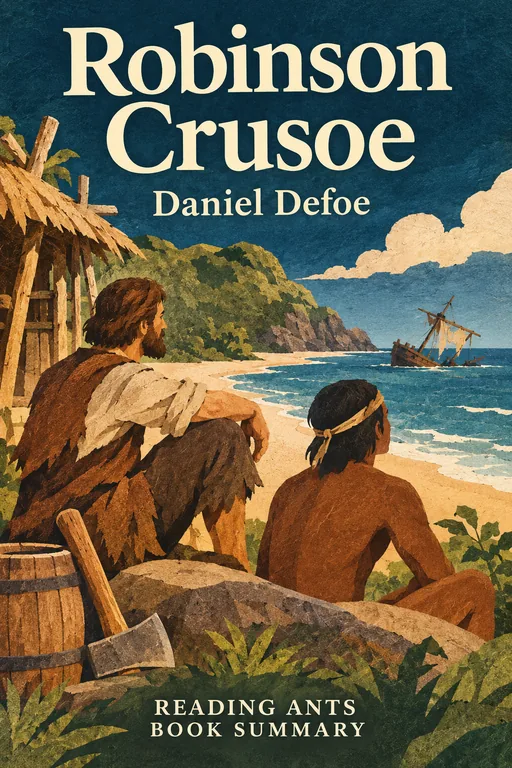
Robinson Crusoe
After a shipwreck, an English sailor named Robinson Crusoe survives for twenty-eight years on a remote island, building a life with his own skill and faith, and eventually befriending a man he calls Friday.
Overview
Robinson Crusoe is a novel by Daniel Defoe, published in 1719, and often called the first English novel. It is presented as the autobiography of Crusoe, a young man from York who defies his father’s advice and goes to sea. The story is inspired by real castaways, especially Alexander Selkirk. Much of it is about how a man alone must use his reason, labor and tools to survive, which made it a model for many later adventure and survival stories. It also reflects the religious and colonial attitudes of Defoe’s time, which modern readers see in different ways.
Main Characters
- Robinson Crusoe: the narrator, an adventurous, practical and religious sailor.
- Friday: a native man whom Crusoe rescues from cannibals and who becomes his servant and companion.
- Crusoe’s father: a prudent merchant who warns him against going to sea.
- The Portuguese captain: a kind man who helps Crusoe in Brazil.
- Xury: a boy who escapes with Crusoe from enslavement.
- The English captain: the leader of a ship whose crew mutinies and who helps Crusoe.
Full Summary
Leaving Home
Crusoe, the youngest son of a merchant family, wants to go to sea, though his father warns him that a quiet middle-class life is best. Ignoring this advice, he boards a ship at Hull, and soon a storm wrecks the vessel near Yarmouth, and he survives. He vows to go home if he survives, but forgets his promise when the weather clears. On a later voyage, his ship is captured by pirates, and he is enslaved in North Africa. He spends two years as a slave to a Moorish captain, performing menial tasks, and watching for a chance to escape. When he is sent out fishing one day, he seizes the boat with the help of Xury, and the two sail south along the African coast, living on what they can find, until a Portuguese captain rescues them and takes them to Brazil. Crusoe sells Xury to the captain, who promises to free him after a number of years.
Planter and Castaway
In Brazil, Crusoe becomes a successful planter, but he is restless, and agrees to join an expedition to bring slaves from Africa. A storm wrecks the ship near an island, and everyone is lost except Crusoe, who is cast ashore alone. He salvages many supplies from the wreck, including tools, food, guns and a dog. He builds a fortified shelter, and marks the days by cutting notches in a post. He also keeps a journal, listing the good and evil of his situation in two columns, and reminds himself that he is alive when others have drowned. As the months pass, he starts to build a better life with the little he has.
Making a Life
On the island, Crusoe works for years to survive. He builds a home, grows barley and rice, tames goats, makes pottery and clothing and invents tools. He keeps a journal and reads the Bible he saved, and becomes more religious as he sees his survival as an act of providence. He is lonely, but also he takes pride in his achievements, and calls himself the “king” of the island. Defoe lists in detail his inventory of items and his daily work.
The Footprint
After many years, he is shocked to see a single human footprint on the beach. His fear of cannibals leads him to build more defenses. He discovers the remains of a cannibal feast, and lives in fear for years. Eventually, he learns that natives from the mainland occasionally visit the island to hold such feasts and take prisoners.
Friday
One day, Crusoe sees a group of natives bringing prisoners, and rescues one who tries to escape. He names the man Friday, after the day of his rescue, and teaches him English and Christianity. Friday becomes a loyal companion and servant, and the two live together happily. Crusoe is pleased to have someone to talk to after so many years, and grows to trust Friday, who shows courage and loyalty. Together they build a boat and plan to leave the island, and Friday tells him about the mainland and the white men who live there. They also rescue Friday’s father and a Spanish prisoner from another group of cannibals. Crusoe’s attitude toward Friday is a mix of affection and the assumption of superiority.
Rescue and Return
Many years later, an English ship arrives, with a crew in mutiny against its captain. Crusoe and Friday help the captain recover his ship. The captain takes Crusoe back to England, where he finds that his family is mostly gone, and that his Brazilian plantation has prospered during his absence, making him wealthy. He eventually marries and has children, but at the end, he sets out again on another voyage, showing that his love of adventure remains.
Why It Matters
Robinson Crusoe was an immediate success, and has been published in countless editions and languages. It created the genre of the “Robinsonade,” survival stories of people stranded alone, which include books like The Swiss Family Robinson and Lord of the Flies, and films like Cast Away. The character of Crusoe has become a symbol of individual self-reliance and of the entrepreneurial spirit. Schools have long used the story to teach about economics, since Crusoe’s island offers a simple example of production, saving and trade.
The book is also studied as a document of colonialism, and has been a source for debates about how Europeans viewed other cultures.
Key Takeaways
- Resourcefulness helps survival. Crusoe uses what he has and learns new skills.
- Hard work gives meaning. His daily labor keeps him going.
- Faith can comfort. Religion supports him in loneliness.
- Isolation tests character. Crusoe learns about himself.
- Companionship matters. Friday relieves his loneliness after many years alone.
What We Can Learn
The story encourages us to be practical and patient. Crusoe survives by taking one problem at a time, such as building shelter, finding food and making tools, a good model for facing big tasks.
It also shows how routine and records can help in hard times. Crusoe’s calendar and journal give him a sense of order and purpose.
Finally, the book prompts us to look critically at how Crusoe treats others. His relationship with Friday, and his earlier involvement in the slave trade, invite us to think about fairness and the assumptions of one’s own culture, a reminder that old books can be both enjoyed and questioned. Crusoe’s story can also remind us that being alone is not only a hardship, but a way to find out what we truly value.
Criticism and Counterpoints
Many modern readers criticize the novel for its colonial attitudes. Crusoe assumes that his culture and religion are superior, treats Friday as a servant, and participates in the slave trade without moral concern. The writer J. M. Coetzee’s novel Foe and other works have responded to this.
Others find the book slow, with long lists and repeated reflections, and say that Crusoe is less a hero than a self-satisfied businessman. Some note that the details of his survival are not always realistic. Still, it is a milestone of the novel.
Who Should Read It
This book suits readers from about age ten, though the original is difficult for younger readers, and abridged editions are common. It contains violence and attitudes that need discussion. It is a good choice for those interested in survival stories.
Want the whole book?
A summary is a taste, not the meal. Here is where to find the full book.
You reached the end 🎉
Nicely done. Mark this one as read, and we will suggest what to read next.
Read this next
Gulliver's Travels
Jonathan Swift
A ship's surgeon named Lemuel Gulliver visits four strange lands, from a country of tiny people to one ruled by rational horses, and Swift uses these voyages to mock human pride, politics and folly.
📜 Classics
Treasure Island
Robert Louis Stevenson
A boy who finds a pirate's treasure map sails to a distant island, only to discover that the ship's charming one-legged cook is the leader of a band of pirates who want the gold for themselves.
🧸 Children's Books
Lord of the Flies
William Golding
A group of British schoolboys stranded on a deserted island try to govern themselves, but fear and the desire for power slowly turn them into savages, revealing the darkness inside human nature.
📜 Classics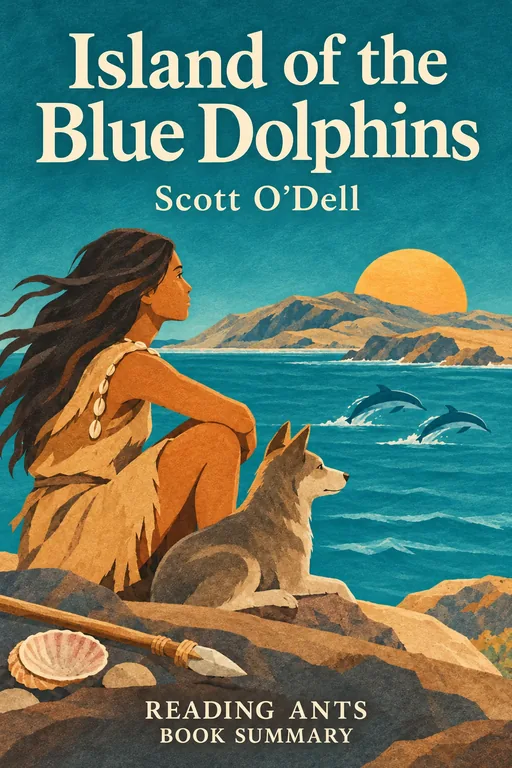
Island of the Blue Dolphins
Scott O'Dell
After her people leave their island and she is left behind, a Native American girl named Karana survives alone for years, learning to hunt, build and make friends with animals.
🧸 Children's Books
Pride and Prejudice
Jane Austen
Quick-witted Elizabeth Bennet and the proud, wealthy Mr. Darcy badly misjudge each other, and only by facing their own faults do they find their way to love.
📜 Classics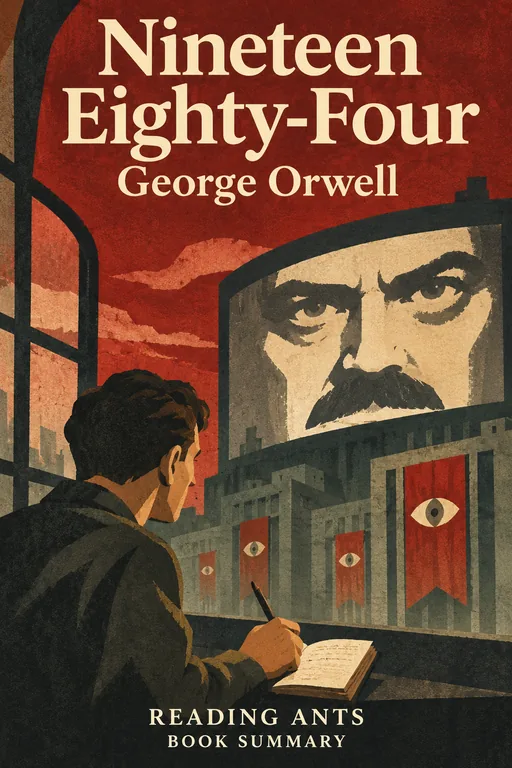
Nineteen Eighty-Four
George Orwell
In a future Britain ruled by an all-seeing Party, one man secretly rebels by keeping a diary and falling in love, and discovers just how completely a totalitarian state can crush the human mind.
📜 ClassicsWant something different?
Pick another topic and we will show you three books to start with.