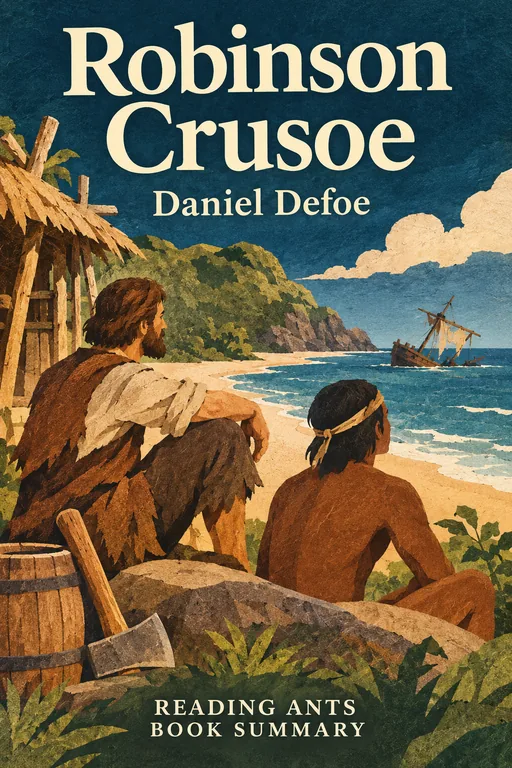
Robinson Crusoe: the longer summary
In One Sentence
After a shipwreck, an English sailor named Robinson Crusoe survives for twenty-eight years on a remote island, building a life with his own skill and faith, and eventually befriending a man he calls Friday.
Before You Start (No Spoilers)
Robinson Crusoe is a novel by Daniel Defoe, published in 1719, narrated as the life story of a traveler who repeatedly leaves safety behind. It is presented as the autobiography of Crusoe, a young man from York who defies his father’s advice and goes to sea. The local edition follows his early voyages, captivity, plantation life and long isolation before his return to England. Much of it is about how a man alone must use his reason, labor and tools to survive, giving ordinary tasks such as making a pot or saving seed an unusual amount of narrative space. It also reflects the religious and colonial attitudes of Defoe’s time, which modern readers see in different ways.
Who’s Who
- Robinson Crusoe: the narrator, an adventurous, practical and religious sailor.
- Friday: a native man whom Crusoe rescues from cannibals and who becomes his servant and companion.
- Crusoe’s father: a prudent merchant who warns him against going to sea.
- The Portuguese captain: a kind man who helps Crusoe in Brazil.
- Xury: a boy who escapes with Crusoe from enslavement.
- The English captain: the leader of a ship whose crew mutinies and who helps Crusoe.
Full Summary
Leaving Home
Crusoe, the youngest son of a merchant family, wants to go to sea, though his father warns him that a quiet middle-class life is best. Ignoring this advice, he boards a ship at Hull, and soon a storm wrecks the vessel near Yarmouth, and he survives. His promises during danger repeatedly weaken afterward, and even the loss of the ship does not send him straight back to his parents. On a later voyage, his ship is captured by pirates, and he is enslaved in North Africa. He spends two years as a slave to a Moorish captain, performing menial tasks, and watching for a chance to escape. When he is sent out fishing one day, he seizes the boat with the help of Xury, and the two sail south along the African coast, living on what they can find, until a Portuguese captain rescues them and takes them to Brazil. Crusoe sells Xury to the captain, who offers to free him after ten years if he becomes Christian, and Xury agrees to go with the captain.
Planter and Castaway
In Brazil, Crusoe becomes a successful planter, but he is restless, and agrees to join an expedition to bring slaves from Africa. A storm wrecks the ship near an island, and everyone is lost except Crusoe, who is cast ashore alone. He salvages many supplies from the wreck, including tools, food and guns. He builds a fortified shelter, and marks the days by cutting notches in a post. He also keeps a journal, listing the good and evil of his situation in two columns, and reminds himself that he is alive when others have drowned. As the months pass, he starts to build a better life with the little he has.
Making a Life
On the island, Crusoe works for years to survive. He builds a home, grows barley and rice, tames goats, makes pottery and clothing and invents tools. He keeps a journal and reads the Bible he saved, and becomes more religious as he sees his survival as an act of providence. He is lonely, but also he takes pride in his achievements, and calls himself the king of the island. Defoe lists in detail his inventory of items and his daily work.
The Footprint
After many years, he is shocked to see a single human footprint on the beach. His fear of cannibals leads him to build more defenses. He discovers the remains of a cannibal feast, and lives in fear for years. Eventually, he learns that natives from the mainland occasionally visit the island to hold such feasts and take prisoners.
Friday
One day, Crusoe sees a group of natives bringing prisoners, and rescues one who tries to escape. He names the man Friday, after the day of his rescue, and teaches him English and Christianity. Friday becomes a loyal companion and servant, and the two live together happily. Crusoe is pleased to have someone to talk to after so many years, and grows to trust Friday, who shows courage and loyalty. Together they build a boat and plan to leave the island, and Friday tells him about the mainland and the white men who live there. They also rescue Friday’s father and a Spanish prisoner from another group of cannibals. Crusoe’s attitude toward Friday is a mix of affection and the assumption of superiority.
Rescue and Return
An English ship eventually arrives, with a crew in mutiny against its captain. Crusoe and Friday help the captain recover his ship. Before leaving, Crusoe gives the men remaining on the island supplies and advice about its crops and animals. He takes possessions that have become important to him and sails with the captain. The downloaded edition closes with his arrival in England after his long absence.
Survival, Belief and the Desire to Rule
Crusoe repeats choices he later condemns
Crusoe tells the story after the events, so his younger self is repeatedly judged by the man he becomes. When he describes ignoring his father, he already knows how much trouble will follow. The narration encourages readers to see a pattern in what once felt like separate decisions: a warning, a danger, a promise to change and a renewed appetite for travel.
That pattern does not make him simply foolish. His curiosity and willingness to act are also the qualities that later keep him alive. The same restlessness that leads him away from security helps him attempt unfamiliar work. Defoe allows useful energy and destructive dissatisfaction to share a source.
His early captivity introduces a troubling contradiction. Crusoe knows what it means to lose freedom and be controlled by another person. Yet after escaping with Xury’s help, he agrees to sell the boy to the Portuguese captain under a promise of eventual release. Later, his own prosperity in Brazil depends on a plantation economy. He recognizes enslavement as terrible when it happens to him without consistently questioning the systems from which he can profit.
The wreck leaves him dependent on other people’s work
Once ashore, Crusoe experiences terror before he begins to organize. He has survived, but survival is not yet a secure condition. Exposure, hunger and possible threats make the island seem hostile. The wrecked ship offers a temporary opportunity to bring useful materials from a lost social world into his new one.
His repeated salvage trips are central to everything that follows. Guns, tools, clothing, food and other supplies are not inventions produced entirely by solitary ingenuity. They represent the labor and knowledge of many people. Crusoe’s later independence rests partly on these inherited resources, even when the narration emphasizes his individual achievement.
The shelter develops through small decisions rather than a complete plan delivered at once. He considers protection, storage and access. He learns the value of moving supplies before weather destroys the chance. This makes the book’s detailed inventories meaningful: each object may become a way to act in a future he cannot yet predict. The contrast with money is especially pointed. Wealth is of little immediate use where there is nobody from whom to buy bread.
Work becomes a way of organizing time
Crusoe records days and tasks because isolation threatens more than his body. Without a calendar or routine, his life could become a sequence of indistinguishable fears. Keeping a journal gives events an order and lets him look back at changes he might otherwise miss.
Growing grain reveals how long useful work can take. A harvest must produce enough seed for another crop before it can supply dependable food. Weather and timing matter. An error may cost months rather than minutes, so patience becomes a practical skill instead of a moral slogan.
Making pottery and bread likewise turns ordinary objects into complicated achievements. Crusoe has used such things throughout his life without needing to perform every stage of their production. On the island, the distance between wanting a bowl and making one becomes visible. The novel slows down to show that distance. Survival is not just courage during a storm; it is repeated labor on problems whose solutions other people normally provide.
Failed plans limit his confidence
Crusoe’s effort to build a large boat is one of the clearest checks on his self-reliance. He can complete difficult work and still discover that he has not considered how to move the result. The failure distinguishes persistence from sound judgment. Working harder cannot correct every mistake in planning.
His movement around the island also changes his understanding of safety. A favorable-looking coast or a promising route may contain currents he cannot control. Knowledge of one part of the island does not make him master of the surrounding sea. He must learn the limits of both equipment and observation.
Such setbacks matter to his religious interpretation of events. He increasingly sees protection and correction where his younger self saw only luck or frustration. Readers do not have to accept every conclusion to understand how the belief functions. It gives him a language for gratitude, guilt and hope, helping him endure a situation that might otherwise feel meaningless.
The footprint changes the island without changing its resources
Before the footprint, Crusoe often suffers from the absence of other people. After seeing it, the possibility of company becomes a source of fear. The same island that supported his routines suddenly seems insecure because somebody else may be using it. He imagines dangers faster than he can collect information about them.
He reinforces defenses and becomes more secretive. The episode exposes how uncertain his supposed kingship has always been. Calling a place his own does not establish that nobody else knows it or has claims there. His authority exists largely within the story he tells himself about possession.
The violence he later witnesses raises further questions. Crusoe condemns the visitors’ practices, but he also debates whether he has the right to punish people whose society he does not understand. His reasoning is uneven and remains shaped by his assumptions. Still, these hesitations complicate the image of a man who instantly treats every unfamiliar person as an enemy to be destroyed.
Friday brings knowledge as well as service
Rescuing Friday changes daily life more deeply than any new tool. Crusoe again has someone to speak with, teach and depend on. Yet he establishes the relationship through naming and command. He chooses Friday’s name and teaches a language in which his own authority is built into the arrangement.
Friday is not merely a passive student. He brings knowledge of the mainland, physical skill, courage and his own attachments. His joy on discovering his father reveals a family life that existed before Crusoe entered it. The island story briefly opens onto another person’s history, rather than treating that person solely as an answer to the castaway’s loneliness.
Their religious conversations also expose limits in Crusoe’s understanding. Explaining a belief to an intelligent listener can reveal questions the teacher has not answered for himself. Friendship and unequal power remain intertwined. Calling their bond affectionate is accurate; calling it equal would hide the structure Crusoe assumes and maintains.
Leaving turns private knowledge into something he can pass on
The arrival of the mutineers gives Crusoe a chance to use knowledge accumulated during isolation. He knows the terrain, has supplies and can help organize a response. The island that once made him helpless now gives him advantages over newly arrived strangers. His rescue depends on cooperation with a captain, not on a solitary crossing of the ocean.
Before departing, Crusoe explains his arrangements to men who will remain on the island. He gives them supplies and instructions about the goats, crops and other resources. Skills that he acquired slowly can now be passed on in conversation. His experience becomes useful knowledge for people who will begin with advantages he did not have on arrival.
This downloaded edition ends with his arrival in England after a long absence. No account of later wealth or travel is included here, because those events lie outside this downloaded text. Within this ending, the main change is from a man fearing that nobody will find him to a man able to leave a functioning settlement behind. He is capable and reflective, but the unequal power he assumes over others remains part of his character. Survival has enlarged his skills without answering every moral question raised by his earlier life.
Why It Still Matters
The detailed work makes dependence visible inside an apparently solitary life. Crusoe has to discover how to turn grain into a dependable food supply, how to make vessels that can hold water and how to protect useful materials. Yet the tools, weapons and supplies salvaged from the wreck are products of other people’s work. His later skill does not mean he began with nothing.
The arrival of Friday gives that tension a human form. Crusoe gains conversation, knowledge and companionship while assuming that he should name and command the person he rescues. His own earlier enslavement has not made him reject ownership of others. Reading those passages together allows admiration for persistence without treating every claim of mastery as justified. The narrative’s retrospective judgments also matter: the older teller condemns his restlessness, but some of that same energy makes survival possible. His explanation of himself remains a subject to examine rather than a final moral verdict.
Key Takeaways
- Resourcefulness helps survival. Crusoe uses what he has and learns new skills.
- Hard work gives meaning. His daily labor keeps him going.
- Faith can comfort. Religion supports him in loneliness.
- Isolation tests character. Crusoe learns about himself.
- Companionship matters. Friday relieves his loneliness after many years alone.
What We Can Learn
The story encourages us to be practical and patient. Crusoe survives by taking one problem at a time, such as building shelter, finding food and making tools, a good model for facing big tasks.
It also shows how routine and records can help in hard times. Crusoe’s calendar and journal give him a sense of order and purpose.
Finally, the book prompts us to look critically at how Crusoe treats others. His relationship with Friday, and his earlier involvement in the slave trade, invite us to think about fairness and the assumptions of one’s own culture, a reminder that old books can be both enjoyed and questioned. Crusoe’s story can also remind us that being alone is not only a hardship, but a way to find out what we truly value.
Criticism and Counterpoints
Crusoe describes his culture and religion as superior and readily places Friday in a subordinate role. He sells Xury under a conditional promise of freedom and joins a voyage intended to obtain enslaved people for the Brazilian plantations. Those acts are part of the narrative, not problems invented by a modern adaptation.
The practical account can also produce an exaggerated image of self-sufficiency if the ship’s supplies and Friday’s contributions are forgotten. His failed large boat shows that strenuous labor can be wasted by poor planning. The book therefore gives evidence against an uncomplicated celebration of solitary competence even while Crusoe takes pride in his achievements. Its detailed routines and repeated religious reflections may slow the adventure, but they reveal how he makes isolation bearable.
Who Should Read It
This book suits readers from about age ten, though the original is difficult for younger readers, and abridged editions are common. It contains violence and attitudes that need discussion. It is a good choice for those interested in survival stories.
What to Notice While Reading
- The older narrator and younger traveler. Notice when Crusoe describes a decision and then judges it. Those judgments guide the book but do not settle every question.
- The ship’s contribution. Track what is salvaged. His achievements depend on tools and supplies made possible by the society from which he is separated.
- Unsuccessful work. The large boat shows why determination needs planning. A detailed record of failure can be as important as a record of success.
- Names and titles. Crusoe names Friday and describes himself as a ruler. Ask how language turns an unequal arrangement into something that feels natural to him.
- Friday’s own life. His knowledge and relationship with his father reveal interests beyond serving Crusoe. Pay attention when the narration lets those interests appear.
Questions to Think About
- Which of Crusoe’s strengths also lead him into danger?
- How independent is a survivor who has tools, weapons and supplies from a ship?
- Why does a sign of human presence frighten a lonely man?
- Where does Friday challenge or exceed Crusoe’s expectations?
- What does Crusoe’s instruction of the remaining islanders reveal about how knowledge is preserved and shared?
Want the whole book?
A summary is a taste, not the meal. Here is where to find the full book.