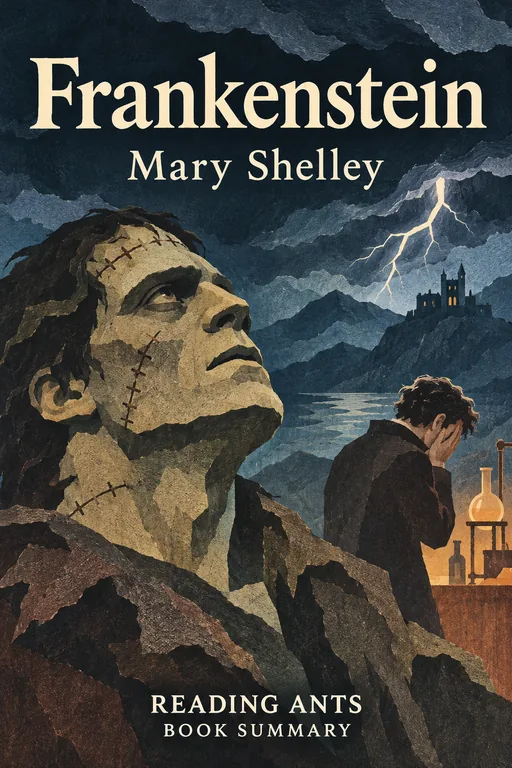
Frankenstein: the longer summary
Before You Start (No Spoilers)
Frankenstein is one of the most famous novels in English, but the book is quite different from the movies. There is no lightning-bolt laboratory with a laughing assistant and no stitched-together monster with bolts in his neck. Mary Shelley began it when she was only eighteen and published it at twenty, and the story is quiet, sad and thoughtful. It asks hard questions: What do you owe the person you create? What happens to someone who is never shown kindness? And who is the real monster?
The book is told as a story inside a story inside a story, which can be confusing at first. A sea captain writes letters to his sister. In those letters he tells the story of a scientist he rescues. And inside the scientist’s story is a long speech by the creature himself. If you keep track of who is speaking, it becomes easy to follow.
It is a darker book than most classics for teenagers. A child is murdered, an innocent young woman is executed, and several people die. The violence is described briefly, not graphically, but the sadness is heavy. The language is formal and sentences are long, so many readers find the first twenty pages slow and then become gripped.
What follows tells the whole plot, including the ending.
The Frame: Walton’s Letters
The book begins with four letters from Robert Walton, a young English explorer, to his sister Margaret, who is married and lives in England. Walton is on his way north from St. Petersburg in Russia, hoping to reach the North Pole and make discoveries that will help all humanity. He is lonely. He longs for a friend who can understand him, and he does not have one among the sailors.
In the later letters his ship is stuck among floating ice. One day the crew sees a strange sight across the ice: a sledge pulled by dogs, driven by a figure of enormous size, moving fast toward the north. The next morning, another sledge appears, with a nearly frozen, half-starved traveler and only one dog left. The man is brought on board. Once he has recovered, he tells Walton that he is hunting for someone, and he decides to tell Walton his story as a warning. His name is Victor Frankenstein. Walton writes it all down for his sister.
Victor’s Story, Part One: Childhood and Ingolstadt
A happy family. Victor is born in Geneva, Switzerland, to a respected family. His father is a public official, and his mother, Caroline, is gentle and kind. His parents adopt a girl, Elizabeth Lavenza, who has been living in poverty with a peasant family in Italy, and Victor grows up with her as his closest companion. He also has two younger brothers, Ernest and William. He also has a good friend, Henry Clerval, who is warm, cheerful and loves poetry and adventure. Victor and Elizabeth are inseparable; Victor says she is more than a sister. Their childhood is gentle and happy.
An early obsession. Victor is fascinated with the old writers on natural magic and alchemy. He reads them eagerly, hoping to find the secret of life and ways to conquer death. His father dismisses them as nonsense, which only makes Victor more determined to study them in secret. When he is fifteen, he sees lightning destroy an oak tree and is struck by the power of electricity. After that, he gives up his old books for modern science, mathematics and chemistry.
His mother’s death. Before he leaves for university, his mother catches scarlet fever from nursing Elizabeth. On her deathbed she tells them that her one wish is for the two of them to marry someday. She dies, and Victor is heartbroken. He leaves soon afterward, and the loss follows him.
University at Ingolstadt. Victor goes to the University of Ingolstadt in Germany. One professor, M. Krempe, is rude and discourages him. Another, M. Waldman, is generous and inspiring. Waldman speaks about the old alchemists with respect, though he says modern science has done more than they ever imagined, and Victor throws himself into his studies. He works so hard that he forgets his family and his health. He wants to find the origin of life. After two years, he believes he has found it.
The creation. Victor gathers materials, spends months working alone at night in a secluded room, and keeps his work secret from everyone. In his mind this is a glorious project: a new kind of being who will owe his life to him. Then, on a dreary night in November, the creature opens his yellow eyes and breathes. Victor’s feelings change instantly. The creature is hideous, and the dream becomes a nightmare. Victor rushes out of the room, unable to bear the sight of what he has made. Later he returns to find that the creature has disappeared.
Illness and a friend. Victor collapses into a long nervous fever. Henry Clerval, who has come to study at the university, finds him and nurses him through many months. When Victor recovers, he receives a letter from Elizabeth and spends time in Clerval’s cheerful company. He does not tell anyone what he has done.
Victor’s Story, Part Two: Death in Geneva
A terrible letter. A letter from his father brings the worst news: William, Victor’s youngest brother, has been found murdered. The family had been walking on the Plainpalais, outside the city, and William went missing in the evening. He was found strangled. A valuable miniature picture of their mother, which the boy had been wearing, was missing.
Justine is accused. Victor hurries home. On the way he sees the creature in the shadows during a lightning storm and understands at once who the murderer is, but he cannot say anything, because who would believe him? Justine Moritz, a loyal young woman who has long been treated as part of the family, is accused, because the miniature is found in her pocket. She is put on trial and, although she says she is innocent, she is persuaded to confess and is executed. Victor is overwhelmed with guilt. He knows the truth and could have spoken, and Elizabeth and his father suffer terribly.
A glacier and a meeting. To clear his mind, Victor walks and climbs in the Alps, up toward Chamonix and Montanvert. On the glacier, the creature appears, moving with astonishing speed. Victor is full of rage and horror and tries to attack him, but the creature calmly asks to be heard and says that he is not what Victor thinks. He is intelligent, he can speak, and he wants Victor to listen to his story. They go into a hut on the mountain.
The Creature’s Story
This is the heart of the book, and it changes how most readers feel about the creature.
Learning to live. He explains that when he first woke he did not know anything. He was cold, hungry and confused, and everyone who saw him ran away or screamed. He wandered into the woods. He learned slowly to find food, to make fire, and to tell light from dark, hearing from touch.
The cottagers. He settled in a hovel next to a small cottage where a poor family lives: an old blind man, his son Felix and his daughter Agatha. By listening through a crack in the wall he learned their language. He was moved by their gentleness and their love for each other. He secretly helped them by gathering firewood in the night. Later, Safie, a young woman from Turkey, arrived, and he learned the family history through her lessons: how the family had been ruined after helping her father, a merchant, and how she fell in love with Felix.
Reading and understanding. He found some books in the woods, among them a novel of lovers’ sorrow, a book of lives of great men from ancient history, and Milton’s Paradise Lost. He also found in a coat pocket the notes Victor made while building him. From these he learned what he was, who made him and how Victor had abandoned him. He identifies with the fallen angel in Milton, abandoned and alone.
Rejection. He hoped the family would accept him. When he finally approached them, he began with the blind old man, who could not see his face and spoke to him kindly. But when the others came back, Felix attacked him and drove him away, and the family fled the cottage. He was devastated and enraged, and he vowed revenge on all humankind, but especially on his creator. When he returned and found the cottage empty, he set it on fire.
Murder. He traveled toward Geneva. On the way he rescued a young girl from a river and was shot by a man who thought he was a threat. By then he was filled with bitterness. In the woods he encountered William, a small boy, and hoped to teach him not to fear him. When William called him a monster and said his father was an important man, the creature killed him. Then he took the miniature and, finding Justine sleeping, hid it in her clothes.
His demand. The creature says he is miserable because he is entirely alone. He asks Victor to make a female creature like himself, so that they can live far away from humans, in a remote place such as South America. If Victor agrees, they will disappear forever. If he refuses, the creature will destroy everything Victor loves. Victor, moved by pity against his better judgment, agrees.
Victor’s Story, Part Three: The Broken Promise
Travel and delay. Victor stalls. He goes home and spends time with Elizabeth and his father, but he is haunted by his promise. He suggests a trip to England with Clerval, which his father welcomes, and he plans to marry Elizabeth when he returns. The two friends travel up the Rhine, to London and then to Scotland. Victor says he will work alone in a remote place, so Clerval goes on separately.
The island. Victor sets up in a rough hut on one of the remotest Orkney islands, a bleak place beaten by the sea. Day by day he works on the female creature. But as he nears completion, he is struck by doubts. What if she is more evil than the male? What if they have children and a race of monsters spreads over the earth? One night he sees the creature at the window, grinning, and in a rush of horror he tears the half-made body to pieces. The creature howls, swears revenge, and warns that he will be present on the night of Victor’s wedding.
Clerval’s death. Victor throws the remains into the sea, and a storm blows him off course. He lands on the coast of Ireland, where he is arrested because a body has washed ashore, and it is the body of Henry Clerval, strangled. Victor is in a state of collapse and is held until a magistrate clears him with evidence that he was on Orkney at the time. His father comes to bring him home.
The wedding. Victor and Elizabeth marry. Victor, thinking that the creature intends to kill him on the wedding night, arms himself and tells Elizabeth to go to bed while he guards the house. While he searches the inn, he hears a scream. The creature has killed Elizabeth. Victor’s father soon dies of grief.
The Chase
With nothing left, Victor vows to hunt the creature until one of them is destroyed. He follows him across Europe and Russia and into the Arctic, where the creature taunts him by leaving messages and food. Through ice and snow, Victor pursues him by sledge until his dogs die and he is almost dead himself. That is when Walton’s ship finds him.
The End
Victor finishes his story and tells Walton to use it as a warning. Walton’s crew, afraid of being frozen in forever, demands that the ship turn south if they are freed from the ice. Victor, weak as he is, urges the men to keep their courage, but they will not be persuaded, and Walton reluctantly agrees to turn back. Victor soon dies, advising Walton to seek happiness in a quiet life and to be wary of ambition, though he also admits that he still wishes the creature dead.
Soon afterward Walton comes into the cabin and finds the creature leaning over Victor’s body. The creature does not threaten him. He speaks sorrowfully, saying that his suffering was greater than Victor’s, that his crimes have tormented him, and that now Victor is dead there is no one left to hate or to understand him. He says he will sail north on the ice raft, build his own funeral fire, and burn himself to ash so that no one will ever be able to create such a being again. Then he leaps from the cabin window and is carried away across the ice.
Who’s Who
- Victor Frankenstein: a brilliant, driven student from Geneva who creates life and then cannot face what he has made. The book’s narrator for most of the story.
- The creature: Victor’s creation, enormous, strong and ugly, but also intelligent, articulate and sensitive. He is never given a name.
- Robert Walton: an English sea captain and explorer, lonely and ambitious, who writes the letters that frame the story and who is a possible mirror of Victor.
- Elizabeth Lavenza: adopted by Victor’s parents, his closest companion and later his wife.
- Henry Clerval: Victor’s cheerful, humane friend, who loves poetry and nurses him through illness.
- Alphonse and Caroline Frankenstein: Victor’s loving father and mother.
- William and Ernest: his younger brothers. William is murdered.
- Justine Moritz: a faithful servant treated almost as a family member, who is wrongly executed.
- M. Waldman and M. Krempe: two professors at Ingolstadt, one encouraging and one scornful.
- The De Lacey family: Felix, Agatha and their blind father, who are the poor cottagers the creature watches and learns from.
- Safie: the young woman who joins them and who is the creature’s second teacher in language.
Key Scenes Explained
The creation. Mary Shelley does not describe the method. She spends only a short passage on the moment of creation, and the weight falls on Victor’s reaction. His horror is immediate and total, and he runs. The book is about what happens after the experiment, not the experiment itself.
Justine’s trial. This is the first moment Victor can prevent a disaster and does not. He is afraid that nobody will believe a story about a living creature, and he lets an innocent person die. It also shows that the family’s grief, which Victor caused, is spreading.
The meeting on the glacier. The creature confronts his maker in a place of cold, empty grandeur. For the first time he is allowed to speak, and the book’s sympathy begins to shift. Victor wants to attack him, but the creature insists on being heard, as anyone should be.
The cottage. The creature watches the De Laceys for months and learns language, kindness and love, then is driven away. This scene is the center of the book. It shows that his violence is the result of rejection, not his nature, and it is the most direct challenge to the idea that he is simply a monster.
The destruction of the female creature. Victor’s decision is partly a moral one, since he fears creating a new race. But it is also an act of control: he is again deciding the fate of a living being without asking what it wants. The creature’s revenge follows from this.
The Arctic chase. The long ending takes the story to the edge of the world. Both Victor and the creature are by then consumed by each other, and neither can live without the other. Their last meeting shows that the creature, too, has been destroyed by what happened.
Why It Still Matters
Frankenstein is often called the first science fiction novel. It raises questions that are still very much alive: What responsibilities do scientists have for what they create? How should we treat people who look or act differently? What happens to people who are never shown love? It also shows how easily one person’s ambition and silence can lead to harm for others. The book has inspired hundreds of films, plays and retellings, though few match its depth, and it is still one of the most discussed novels in schools and universities.
What to Notice While Reading
- The creature is not born evil. Early in his story he is gentle, curious and kind, and what turns him toward murder is repeated cruelty. Shelley wants readers to think about how people are shaped by how they are treated.
- Victor is both the hero and the villain. He suffers greatly, and he is a sympathetic narrator, but almost every disaster comes from his choices: abandoning the creature, staying silent about the murder, and breaking his promise.
- Nature is a character. Storms, glaciers, mountains and polar ice mirror what the characters feel.
- Three narrators, three kinds of truth. Walton, Victor and the creature all tell their story, and each has reasons to make himself look better. Think about which of them you trust and why.
- Family and friendship. Victor’s loss of Clerval, Elizabeth and his family makes clear how much is at stake when he cuts himself off in order to chase his own ambition.
Questions to Think About
- When the creature first opens his eyes, who is responsible for what happens next: Victor, the creature, or society?
- Why doesn’t Victor tell anyone the truth about William’s murder? Would you have kept the secret?
- Was Victor right to destroy the female creature, even though it broke his promise?
- Why do you think Mary Shelley chose to have Walton tell the story?
- Do you think the creature deserves the reader’s sympathy? Does that change after he murders William?
If You Liked Frankenstein
Try Dr Jekyll and Mr Hyde by Robert Louis Stevenson for another story about science, secrets and a divided self, Dracula by Bram Stoker for Gothic horror, The Invisible Man by H. G. Wells for a scientist whose experiment ruins his life, or The Time Machine for early science fiction.
Want the whole book?
A summary is a taste, not the meal. Here is where to find the full book.