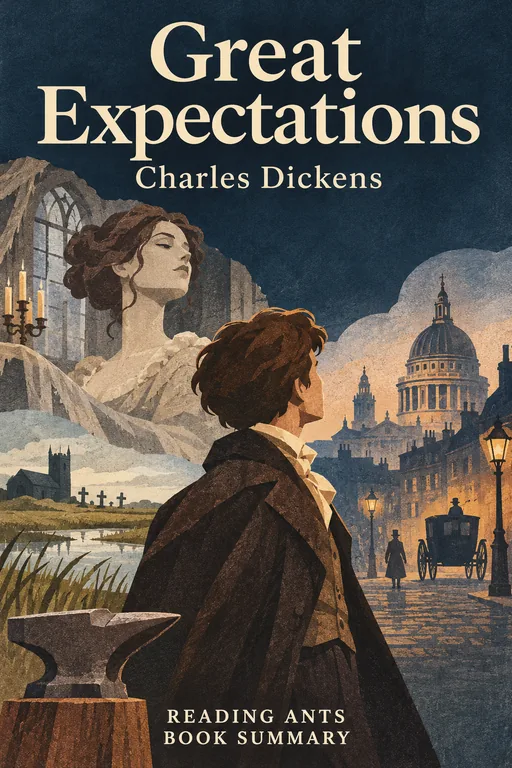
Great Expectations: the longer summary
Before You Start (No Spoilers)
Great Expectations is the story of an orphan boy named Pip who is given the chance to become a gentleman and nearly loses his goodness in the process. It begins in a lonely marsh with a frightening encounter that shapes the rest of his life. Dickens published it in weekly installments in 1860 and 1861, and the plot is full of secrets, coincidences and surprises that were made to keep readers waiting for the next chapter.
It is a novel about class and ambition, but it is also about shame, loyalty and growing up. The book is narrated by Pip as an older man looking back, so we get both the child’s feelings and the adult’s honesty about his mistakes. The humor is strong, especially in the early chapters, and the characters are vivid and strange: a woman who stopped all her clocks, a lawyer who washes his hands of his clients, a clerk who lives in a miniature castle.
The book is long and a little slow in the middle, and Dickens’s sentences are of Victorian length. But it is one of his most readable novels, and it is a good first Dickens for a keen teenage reader.
What follows gives away the whole plot, including the big secret about who paid for Pip’s new life.
Part One: The Marsh and Satis House
The convict. Pip, whose full name is Philip Pirrip, is a young orphan who lives in a village in the marshes of Kent with his sister, Mrs. Joe, who is harsh and often hits him, and her husband Joe Gargery, a blacksmith, who is gentle and good-natured. On Christmas Eve, Pip goes alone to the churchyard to look at the graves of his parents. A terrifying escaped convict leaps out, turns him upside down, and threatens to have him killed unless he brings him food and a file to cut his leg iron. Pip, terrified, steals food from the pantry and a file from Joe’s forge and brings them back. The convict eats like a starving animal, and Pip feels a strange pity for him.
The next day soldiers catch the convict. He is also fighting another escaped prisoner, a man with a scarred face. When the soldiers drag him away, he tells them that he stole the food himself, which protects Pip.
Miss Havisham. Some time later, Pip is sent, through Mr. Pumblechook, the pompous corn merchant who is Joe’s uncle, to a strange house called Satis House, home of a rich old woman named Miss Havisham. She is dressed in a decayed wedding dress, with all the clocks stopped at the moment she was jilted at the altar, and the wedding feast still rotting on the table. With her is a beautiful, proud girl called Estella, who is her adopted daughter. Miss Havisham tells Pip to play, and Estella makes fun of him: his rough hands, his thick boots, the way he calls the face cards by the wrong names. Pip is deeply hurt and for the first time feels ashamed of his home and his family. He begins to visit regularly, and Miss Havisham watches Estella torment him with a strange pleasure.
Shame and secrets. When Pip goes home, he lies to his sister and Joe about what he has seen, because he thinks they would not believe the truth. Later, Joe tells him that lies are bad, but that he should not worry about what other people say. Pip is also increasingly ashamed of Joe. A year or so later, Miss Havisham pays for Pip to be apprenticed to Joe, so that he will become a blacksmith, a plan that Pip now dislikes, because he wants to become a gentleman and be worthy of Estella.
An attack at home. One night, Mrs. Joe is attacked and badly hurt by an unknown person, who strikes her on the head from behind. She survives but cannot speak properly and is changed, mild and slow. Pip suspects Orlick, the surly journeyman who works for Joe. A young woman named Biddy, who is clever, kind and plain-spoken, comes to look after the house and becomes Pip’s friend. Pip tells her he wants to be a gentleman for Estella’s sake. Biddy gently suggests that it might be better to be happy as he is. He ignores her.
Part Two: Pip in London
The news. Pip is nearly eighteen when a London lawyer, Mr. Jaggers, arrives. He announces that a person who wants to remain unknown has decided to leave Pip a large fortune and that Pip is to be educated as a gentleman. He tells Pip that he must not try to find out who his benefactor is. Pip is overjoyed and assumes it is Miss Havisham, who has taken an interest in him. He says a rather cold farewell to Joe and Biddy and leaves for London.
Life as a gentleman. In London, Pip lodges with Herbert Pocket, a cheerful young man who is, by coincidence, the same pale young gentleman he once fought in the garden of Satis House. Herbert becomes his closest friend and teaches him table manners and how to behave in society. Pip is also guided by Mr. Wemmick, Jaggers’s clerk, who is dry and businesslike at the office but warm and playful at home in Walworth, where he lives in a little house with a drawbridge and cannon and cares for his deaf father. Mr. Jaggers himself is a powerful, secretive lawyer who is feared by criminals, and who washes his hands as if to clean away his clients’ crimes.
Pip is a spendthrift and a snob. He gets into debt, falls in with a rich, unpleasant young man named Bentley Drummle, and is embarrassed when Joe comes to visit him in his shabby but clean best clothes. Joe is hurt by Pip’s coldness, and Pip is ashamed of himself afterward.
Estella. Pip continues to visit Estella, who has been educated to be a lady and is more beautiful than ever. She tells him plainly that she has no heart and that she was brought up to break men’s hearts, but he persists in loving her. Miss Havisham, who was herself jilted, has trained her to take revenge on men. Estella tells him she will marry Drummle, whom she despises, and Pip is devastated.
Mrs. Joe’s death. Mrs. Joe dies, and Pip returns for the funeral. He notices that Biddy and Joe are close, and he leaves with a promise to visit more often. He does not keep it.
Part Three: The Truth
The visitor. When Pip is twenty-three, on a stormy night in London, a rough, weather-beaten stranger arrives at his rooms. It is the convict from the marshes. His name is Abel Magwitch, and he has been transported to Australia, where he became rich as a sheep farmer. He tells Pip that he has spent his fortune on him because Pip’s act of kindness changed his life. It is Magwitch, not Miss Havisham, who has been paying for Pip’s education and his expectations. Pip is appalled. He realizes that everything he believed about his rise was wrong, and he is disgusted by the thought of owing it all to a convict. But he is also moved by Magwitch’s loyalty. Because Magwitch has returned illegally from transportation, he will be hanged if he is caught.
More secrets. Pip learns more about Magwitch’s past. He had been a petty criminal, exploited by a fellow criminal named Compeyson, a gentleman swindler. Compeyson turned out to be the man who jilted Miss Havisham. Pip also discovers that Estella is Magwitch’s daughter by a woman named Molly, who is Jaggers’s housekeeper. Jaggers had arranged for Estella to be adopted by Miss Havisham as a baby.
Miss Havisham. Pip visits Miss Havisham and discovers that she has been using him and Estella to take revenge. He begs her to help Herbert, and she gives money to help Herbert’s career. She is full of remorse for what she has done to Estella and to him, and she asks him to forgive her, which he does. As he leaves, he sees her dress catch fire. He rescues her and burns his hands badly, but she later dies of her injuries.
The escape. Pip, with the help of Herbert and Startop, plans to get Magwitch out of England by boat down the Thames. On the day they are to leave, Pip is lured to a lonely sluice-house on the marshes by Orlick, who admits he attacked Mrs. Joe and who intends to kill Pip. Herbert arrives in time to save him. They rescue Magwitch by boat, but a police boat intercepts them, with Compeyson on board. Compeyson and Magwitch fight in the river, and Compeyson drowns. Magwitch is badly injured and caught. He is tried and sentenced to death, but he dies of his injuries before he can be hanged. Pip holds his hand and tells him that his daughter is alive and that he loves her. Because he is a convicted felon, his fortune is forfeited to the crown, and Pip is left without anything.
Part Four: Recovery
Joe. Pip falls seriously ill, is nearly arrested for debt, and is at the end of his strength. Joe arrives from the forge, nurses him patiently, and pays his debts. When Pip recovers, Joe leaves a note and goes home. Pip, humbled, decides to go to Joe and Biddy and ask forgiveness. He finds that Joe and Biddy have married, and that he has come on their wedding day. He asks for their forgiveness and receives it.
A new life. Pip goes abroad to work with Herbert in Cairo, in Egypt, at an import firm, and over the years, he works his way up and pays his debts. When he is back in England after eleven years, he visits Joe and Biddy and meets their small son, named Pip.
The ending. He goes to see the ruins of Satis House, where he meets Estella. She has been through a terrible marriage with Drummle, who treated her cruelly and died, and she says that suffering has taught her what Pip felt. In the revised ending that Dickens chose for publication, Pip takes her hand as they leave the garden, and he sees no sign of another parting. In the first draft, which Dickens wrote before a friend persuaded him to change it, Pip and Estella met by chance on a London street, parted again, and she remarried. Readers still disagree about which ending is better.
Who’s Who
- Pip (Philip Pirrip): the narrator, an orphan with a sensitive conscience, who is easily embarrassed and easily led.
- Joe Gargery: Pip’s brother-in-law and a blacksmith, uneducated but kind and morally strong.
- Mrs. Joe: Pip’s older sister, harsh and temperamental, later injured.
- Abel Magwitch: the convict from the marshes and Pip’s secret benefactor.
- Miss Havisham: a rich woman who was jilted and has built her life around her grief.
- Estella: Miss Havisham’s adopted daughter, beautiful, cold and unhappy.
- Mr. Jaggers: the lawyer, tough and secretive.
- Mr. Wemmick: Jaggers’s clerk with a double life.
- Herbert Pocket: Pip’s cheerful friend.
- Biddy: a clever, kind young woman from Pip’s village.
- Orlick: the sullen journeyman with a grudge.
- Compeyson: the criminal who ruined both Magwitch and Miss Havisham.
- Bentley Drummle: a rich, arrogant young man who marries Estella.
- Mr. Pumblechook: a pompous merchant who takes credit for Pip’s luck.
Key Scenes Explained
The churchyard. The meeting with Magwitch is the book’s starting point. Pip’s small act of kindness, giving food to a man in need, comes back at the end of the story in ways he could not expect.
Satis House. The stopped clocks and decayed wedding feast show a person who is trapped by her past. It is also where Pip learns to feel ashamed of who he is.
The announcement. The news that Pip will inherit money changes the story. Pip assumes his luck comes from the person he admires, and the false assumption feeds his pride.
Joe’s visit to London. The scene is uncomfortable because Joe behaves with such dignity while Pip behaves with such snobbery. It is the moment the reader first dislikes Pip.
Magwitch’s return. The scene reverses everything: the benefactor turns out to be the convict, and Pip’s rise is built on a debt he never intended to owe. The shock forces Pip to rethink what it means to be a gentleman.
The fire. Miss Havisham’s burning is both literal and symbolic. Her attempt to freeze time ends, and Pip, though he suffers for it, is the one who tries to save her.
How the Book Was Written
Dickens published Great Expectations in weekly installments in a magazine he edited, with each part ending on a small hook to make readers want the next. That is why the story is full of cliffhangers, sudden reveals and coincidences. It also explains why the plot moves in three clear stages: Pip’s childhood, his life as a young gentleman, and the collapse and recovery that follow the discovery of the secret. Dickens is said to have planned the whole story around the single reversal that the benefactor is Magwitch, and the earlier chapters are carefully built to hide that truth.
Why It Still Matters
Great Expectations is one of the great novels about ambition and its costs. Dickens asks what makes a person truly good: money, education and polish, or loyalty and kindness. The book’s answer, through Joe, is clear, but it does not let Pip off the hook for getting it wrong. It is also an early example of a story told by a flawed narrator who confesses his failings. It has been adapted for film and television many times, and its images, the marsh, the decaying house, the cake covered with cobwebs, are part of popular culture.
What to Notice While Reading
- What counts as being a gentleman. Dickens offers several answers: money, manners, education, and character. Look at who actually behaves like one.
- Hands and washing. Pip’s rough hands, Jaggers’s constant hand-washing, and Pip’s burned hands are all signs of class and guilt.
- Parents and children. Many characters are not raised by their real parents: Pip, Estella, Magwitch’s daughter, Herbert’s friend. Notice the different ways adults shape children.
- Prisons and chains. The book is full of literal and metaphorical imprisonment, including by money, pride and past wrongs.
- Unreliable luck. Nearly every character is affected by a decision they did not make. Notice how often it is a secret.
Questions to Think About
- Why is Pip ashamed of Joe, and is he right to be ashamed of himself?
- Is Magwitch a villain, a victim, or both?
- Why does Miss Havisham ask for Pip’s forgiveness at the end, and does she deserve it?
- Which ending do you prefer, the original or the revised one? What does each suggest about Pip?
- What do you think Dickens means by the title?
If You Liked Great Expectations
Try David Copperfield or Oliver Twist by Dickens for more of his growing-up stories, A Tale of Two Cities for his historical drama, Jane Eyre for another story about an orphan who rises, or Tom Sawyer for a more comic story of boyhood.
Want the whole book?
A summary is a taste, not the meal. Here is where to find the full book.