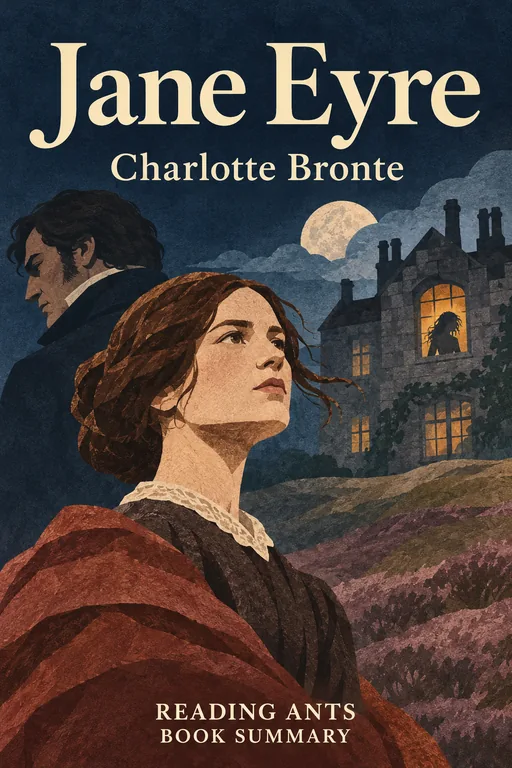
Jane Eyre: the longer summary
Before You Start (No Spoilers)
Jane Eyre is a first-person novel, narrated by Jane herself, an orphan who grows up unloved, becomes a teacher and then a governess, and falls in love with her employer. It was published in 1847 under the name Currer Bell, and it shocked and thrilled readers because it took a plain, poor, plain-spoken young woman seriously and let her speak for herself about injustice, religion and love.
Part of the book is a story of growing up, part is a romance, part is a Gothic mystery with a locked room, strange laughter in the night and a fire. It is also very much about what a person needs to be happy: love, but also freedom, self-respect and a sense of purpose. Jane never accepts being treated as less than she is, and that is why the book still feels modern.
It is long, and the first part is hard going because Jane is treated cruelly as a child. Some of the language is old-fashioned, and one of the characters is treated in a way that most modern readers find unfair and outdated. A teenager who likes long books and strong narrators will be happy with it from about thirteen.
What follows gives away the entire plot, including the secret at the heart of the book.
Part One: Gateshead and Lowood
An unwanted child. Jane Eyre is a small orphan living at Gateshead Hall with her aunt, Mrs. Reed, and her three cousins, John, Eliza and Georgiana. Her uncle, Mrs. Reed’s husband, was kind to her and took her in, but he died, and since then her aunt has resented her. The cousins are spoiled, and John, the eldest, bullies her. The household servants, apart from the nurse Bessie, are no kinder.
One day Jane fights back against John and is punished by being locked in the red-room, the room where her uncle died. She is terrified, believes she sees a ghost, and faints. A kindly apothecary, Mr. Lloyd, hears about it and suggests to Mrs. Reed that Jane should go to school. Mrs. Reed is glad to get rid of her.
Brocklehurst. The head of the charity school, Lowood, is Mr. Brocklehurst, a hard, hypocritical clergyman who visits Gateshead. Mrs. Reed warns him that Jane is a liar. Before Jane leaves, she finally speaks her mind and tells Mrs. Reed that she has been unjust and cruel. It is a turning point, and she feels she has found her own strength.
Lowood. The school is cold, badly fed and strict, and Mr. Brocklehurst preaches that suffering is good for the girls’ souls while his own family dresses in fine clothes. Jane is humiliated in front of the whole school as a liar. But she meets two people who change her life. Helen Burns, an older girl, is patient and forgiving, and she teaches Jane to be calm in the face of injustice and to trust in God. Miss Temple, the kind superintendent, believes in Jane and clears her name.
Then a typhus epidemic strikes. Many of the girls become ill, and Helen, who has consumption, dies in Jane’s arms. The scandal of the outbreak leads to an investigation, and the school is improved with help from generous donors. Jane stays for eight years, six as a student and two as a teacher.
Part Two: Thornfield Hall
A new position. When Miss Temple marries and leaves, Jane feels restless. She advertises for a post as governess and receives a reply from a Mrs. Fairfax of Thornfield Hall, near Millcote. She travels there and finds that Mrs. Fairfax is a kind older housekeeper. Her pupil is a young French girl named Adèle, who is the ward of the master of the house, Mr. Rochester. He is away.
Meeting the master. On a winter evening, Jane goes out to post a letter and sees a horse slip on the ice and throw its rider. She helps him, and he is brusque and teasing. Later she discovers he is Mr. Rochester himself. He is moody, abrupt, often sarcastic, and unlike any employer she has met. But he is also interested in her opinions, and he talks to her as an equal. Jane is neither afraid of him nor flattered by him, and he likes that. They begin to spend evenings together, with Adèle playing nearby.
Strange events. From the beginning, Jane is aware of odd things at Thornfield. She hears a mad, low laugh from the attic floor and is told it is a servant named Grace Poole. One night, she wakes to find smoke and fire in Rochester’s room, and she puts out the flames and saves his life. Rochester thanks her warmly, says he will not forget it, and tells her it was Grace Poole’s doing, though Jane finds it hard to believe a servant is allowed to remain after an attempt like that.
A house party. Rochester entertains many guests, among them the beautiful and haughty Blanche Ingram, whom everyone expects him to marry. Jane watches them from the background and tells herself she must not hope. One night, a man named Mr. Mason arrives from the West Indies, and Rochester is visibly shaken. That night Mason is attacked and wounded in the upper floor of the house. Rochester quietly has a surgeon sent for and gets Mason away before dawn. Jane helps and keeps the secret, though she does not understand it.
Gateshead again. Jane is called back to Gateshead, where her cousin John has died and her aunt, Mrs. Reed, is dying. Mrs. Reed confesses that she had received a letter years before from Jane’s uncle, John Eyre, in Madeira, offering to adopt Jane, and that she had told him Jane was dead. She dies unrepentant.
The proposal. Back at Thornfield, Jane and Rochester meet in the garden one summer evening. He tells her he is going to marry Blanche Ingram and that she, Jane, will have to find a new post. Jane, in tears, speaks out passionately for her equality, saying that she has a soul as full as his. Rochester then asks her to marry him, and she cannot believe it until he convinces her that he means it. She accepts.
The wedding that does not happen. Jane is happy but uneasy. A few nights before the wedding, she wakes to find a strange, frightening woman in her room who tears her wedding veil in two. Rochester says it must have been a dream or Grace Poole. On the wedding day, as the ceremony begins in the church, a man speaks up and declares that there is a legal impediment: Rochester is already married. The man is Mr. Briggs, a lawyer, and with him is Mr. Mason, who says that Rochester’s wife is alive and is his own sister, Bertha Mason.
Rochester admits it. He takes everyone back to Thornfield and shows them the truth: in a hidden room on the third floor lives Bertha, a violent woman who is mentally ill and who is looked after by Grace Poole. Rochester explains that his father arranged the marriage for money when he was young, in Jamaica, and that Bertha became mad and he brought her to England and locked her away. Jane is heartbroken and cannot stay.
Part Three: Flight, Moor House and a Voice
Leaving. Rochester begs Jane to stay with him as his partner, though they cannot marry. She refuses, because she respects herself and cannot live as his mistress. Before dawn, she slips out of the house with almost nothing.
Alone. She takes a coach as far as her small amount of money will go, which is very little, and finds herself at a crossroads with no money and nowhere to go. She wanders over the moors and sleeps outdoors, trying to beg and nearly starving. She finally arrives at a house and is turned away by a servant, but the voice of the master, St. John Rivers, finds her on the doorstep and brings her inside.
Marsh End. The house is Marsh End, the home of St. John Rivers and his sisters, Diana and Mary. They nurse her and shelter her, and she is given the name Jane Elliott to hide her identity. St. John is a clergyman, a serious, handsome, disciplined man with a cold manner. His sisters are warm. With his help, Jane takes a position as the teacher of a village girls’ school in Morton, and she begins a quiet new life.
An inheritance. St. John eventually learns Jane’s real name, because it is the same as the name in a letter from a lawyer, and he explains that her uncle John Eyre in Madeira has died and left her twenty thousand pounds. It turns out that St. John, Diana and Mary are her cousins, and that they are the only other relatives. Jane divides the fortune equally among the four of them, so that each has a share, and she is delighted to have a family.
St. John’s offer. St. John, who is preparing to go to India as a missionary, decides that Jane should come with him as his wife. He does not love her; he sees her as useful and well suited to the work. He presses her to say yes, and she is nearly persuaded. She is willing to go as his fellow worker but not as his wife, since she does not love him and would be giving up her own heart. As she hesitates, one night, she hears a voice that she recognizes. It is Rochester’s, calling her name from far away.
Part Four: Return
Thornfield in ruins. Jane leaves at once and travels back to Thornfield. She finds only a blackened ruin. At a nearby inn she learns what happened: Bertha had set fire to the house, and Rochester had tried to save her and the servants. Bertha died by leaping from the roof. Rochester was badly injured: he lost a hand and his eyesight, and he is living in seclusion at his old manor house, Ferndean.
Reunion. Jane goes to Ferndean and finds Rochester, blind, bitter and lonely. He thinks at first that it is a dream. She tells him she is free, that she has a fortune of her own, and that she is as independent as he is. He says that he has learned humility and has turned to God. Jane stays with him, and they marry.
The narrator tells us they have lived happily for ten years. Rochester regains partial sight in one eye and is able to see his first child when it is born. The book ends with St. John Rivers, who goes to India and who, in a final passage, is said to be near death in the service of his mission.
Who’s Who
- Jane Eyre: the narrator, small, plain, and fiercely honest, who insists on being treated as an equal.
- Edward Rochester: the master of Thornfield, about twenty years older than Jane, passionate, restless and haunted by his past.
- Mrs. Reed: Jane’s aunt, who is unjust and cruel to her.
- John, Eliza and Georgiana Reed: Jane’s cousins, spoiled and unkind.
- Bessie: the Gateshead nurse who is sometimes kind to Jane.
- Mr. Brocklehurst: the harsh head of Lowood and an example of religious hypocrisy.
- Helen Burns: Jane’s friend at Lowood, patient and devout, who dies of consumption.
- Miss Temple: Lowood’s compassionate head teacher.
- Mrs. Fairfax: the kindly housekeeper of Thornfield.
- Adèle Varens: Rochester’s young French ward.
- Grace Poole: the servant who looks after Bertha.
- Bertha Mason: Rochester’s first wife, locked in the attic.
- Blanche Ingram: a beautiful, snobbish guest.
- Richard Mason: Bertha’s brother, who reveals the secret.
- St. John, Diana and Mary Rivers: Jane’s cousins, who shelter her and who share her inheritance.
Key Scenes Explained
The red-room. The scene where Jane is locked in the room where her uncle died sets up the book’s main concern: what happens to someone who is shut in and shut out. Jane’s terror there echoes later, when she learns about Bertha.
Jane’s speech to Mrs. Reed. It is the first time Jane stands up for herself. The sense of strength she feels afterward is the beginning of her independence.
Helen Burns’s death. Helen’s calm faith makes a deep impression on Jane, though Jane does not agree with all of it. She learns from Helen to forgive and to endure, but she also holds on to her belief that unfair treatment should be called what it is.
The garden proposal. Jane’s declaration that she is Rochester’s equal in soul is the emotional center of the book, and it is the moment when her sense of self-respect becomes explicit.
The interrupted wedding. The discovery of Bertha turns the book from a romance to a moral test. Rochester offers Jane a version of love that requires her to give up her principles. Her refusal, at the cost of her own happiness, shows that she values her integrity more than anything.
The voice across the miles. The call from Rochester is a deliberate mystery. Whether you believe in it or not, it tells us that Jane’s love is stronger than the logic she has been following, and that she must act on it.
Why It Still Matters
Jane Eyre is a landmark because it gives a poor, plain, young woman a powerful voice and treats her inner life as important. Many later novels follow its example. The book is also the source of much discussion: about Bertha, who is described in dated and unfair ways and who has been given a voice in later works such as Jean Rhys’s Wide Sargasso Sea, and about how Jane’s happy ending depends on an inheritance and on Rochester’s misfortunes. Even so, the book remains admired for the force of its narrator and for its refusal to accept a smaller life.
What to Notice While Reading
- Jane’s independence. She makes her own choices at almost every turning point. Notice what she gives up in order to keep them.
- Fire and ice. The book uses weather and temperature constantly: cold at Gateshead and Lowood, fire at Thornfield. They mirror Jane’s feelings.
- Different kinds of religion. Brocklehurst preaches harshness, Helen preaches patience, St. John preaches duty. Jane takes something from each but chooses her own path.
- The hidden house. Thornfield has a literal secret. Look for how Charlotte Brontë builds suspense with small clues: the laugh, the fire, the veil.
- Equality. Jane wants to be loved as an equal. Pay attention to the power each character has over her, and how it changes by the end.
Questions to Think About
- Why does Jane refuse to stay with Rochester after the wedding is stopped, even though she loves him?
- Is Rochester a good man? What does he do right, and what does he do wrong?
- How does Jane’s childhood shape the choices she makes as an adult?
- Why do you think Brontë gave Jane an inheritance and a family before she reunites with Rochester?
- How would you feel about the story if Bertha could speak for herself? What does the book keep us from knowing?
If You Liked Jane Eyre
Try Pride and Prejudice for a sharper, funnier love story, Wuthering Heights by Emily Brontë for a darker, wilder one, Rebecca by Daphne du Maurier for a modern Gothic that echoes Thornfield, or Wide Sargasso Sea by Jean Rhys, a later novel written from Bertha’s point of view.
Want the whole book?
A summary is a taste, not the meal. Here is where to find the full book.