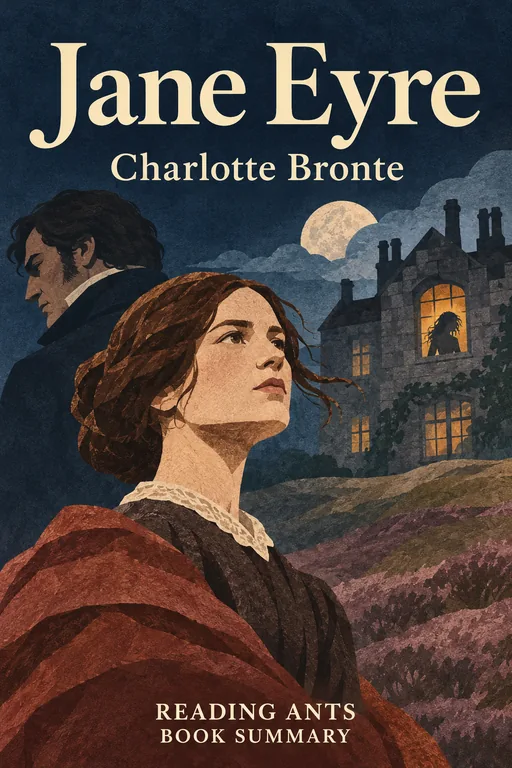
Jane Eyre
A poor, plain but fiercely independent orphan becomes a governess, falls in love with her brooding employer, discovers his terrible secret, and refuses to give up her self-respect even for love.
Overview
Jane Eyre follows its heroine from a cruel childhood to adulthood in early nineteenth-century England. Jane is an orphan raised by an aunt who despises her, then sent to a harsh charity school. Grown up, she becomes a governess at Thornfield Hall, a mysterious house owned by the moody, sarcastic Mr. Rochester. Strange laughter echoes through the halls, and a fire breaks out in the night. Jane and Rochester fall in love, but a dark secret threatens their happiness. Published in 1847 under the male pen name “Currer Bell,” Charlotte Brontë’s novel caused a sensation with its passionate, outspoken heroine, who insists that she is the equal of any man.
Main Characters
- Jane Eyre: an intelligent, honest and independent young woman.
- Edward Rochester: the proud, passionate owner of Thornfield Hall.
- Mrs. Reed: Jane’s cold and cruel aunt.
- Helen Burns: Jane’s gentle, patient friend at school.
- Mr. Brocklehurst: the hypocritical head of Lowood School.
- Adèle Varens: the little French girl Jane teaches.
- Mrs. Fairfax: the kind housekeeper at Thornfield.
- Bertha Mason: a mysterious woman hidden in Thornfield’s attic.
- St. John Rivers: a stern, devoted clergyman.
Full Summary
Gateshead
Ten-year-old Jane lives at Gateshead Hall with her aunt, Mrs. Reed, and her spoiled cousins, who treat her as an unwanted burden. When her cousin John attacks her and she fights back, she is locked in the “red room,” where her uncle died. Terrified that she sees his ghost, she faints. Soon after, Mrs. Reed sends her to Lowood, a charity school. Before leaving, Jane bravely tells her aunt exactly how cruel she has been.
Lowood
Lowood is run by Mr. Brocklehurst, a hypocritical clergyman who preaches humility to the starving, freezing girls while his own family lives in luxury. He publicly shames Jane as a liar. Jane makes a dear friend, Helen Burns, a gentle girl who teaches her about patience and forgiveness. A typhus epidemic sweeps the school, and Helen dies of consumption in Jane’s arms. After the scandal of the epidemic, conditions improve. Jane stays at Lowood for eight years, six as a student and two as a teacher.
Thornfield Hall
Longing for a wider life, Jane advertises for a job as a governess and is hired at Thornfield Hall to teach Adèle, a lively French girl who is the ward of the house’s owner, Mr. Rochester. One evening, on a lonely road, a rider’s horse slips on the ice and Jane helps the injured man. He turns out to be Rochester himself: gruff, moody and fascinating. Jane and Rochester begin to have long, spirited conversations, and she realizes that he respects her mind.
Strange things happen at Thornfield. Jane hears eerie laughter, which Mrs. Fairfax blames on a servant, Grace Poole. One night, Jane wakes to find Rochester’s bed on fire and saves his life. Later, a visitor, Mr. Mason, is mysteriously attacked and wounded in the night.
Love and a Rival
Rochester invites guests, including the beautiful, haughty Blanche Ingram, whom everyone expects him to marry. Jane, plain and poor, believes she has no chance, though she has fallen deeply in love with him. Rochester even disguises himself as a fortune-teller to learn her feelings.
Jane is called back to Gateshead, where Mrs. Reed is dying. Mrs. Reed confesses that Jane’s uncle, John Eyre, had written years ago wanting to adopt her and leave her his fortune, but out of spite she told him Jane had died.
When Jane returns to Thornfield, Rochester tells her he is to marry Blanche, then asks if she would stay. Jane cries out that she is not a machine without feelings, and that her soul is equal to his. Rochester confesses that he loves her, not Blanche, and asks her to marry him. She joyfully accepts.
The Secret in the Attic
On the morning of the wedding, as the vows are being spoken, a lawyer interrupts: Rochester is already married. His wife, Bertha Mason, whom he married in Jamaica years ago, has become violently mentally ill. He has kept her locked in the attic at Thornfield, cared for by Grace Poole. It was Bertha who laughed in the night, set fire to his bed and attacked her brother, Mr. Mason.
Rochester begs Jane to go away with him and live as his wife, even though they cannot legally marry. Jane loves him, but she refuses to give up her principles. Heartbroken, she leaves Thornfield secretly before dawn with almost nothing.
Moor House
Penniless and starving, Jane wanders the moors until she collapses at the door of a house owned by St. John Rivers, a clergyman, and his sisters, Diana and Mary, who nurse her back to health. St. John finds her a job teaching at a village school. Then Jane learns that her uncle John Eyre has died and left her a fortune of twenty thousand pounds, and that the Rivers are her cousins. Overjoyed to have a family, she shares her inheritance equally with them.
St. John, preparing to become a missionary in India, asks Jane to marry him and come with him. He doesn’t love her; he wants a hardworking helper. Jane is tempted to give her life to duty, but she knows she would be crushed without love. As she hesitates, she seems to hear Rochester’s voice calling her name across the miles.
Reader, I Married Him
Jane returns to Thornfield and finds it a blackened ruin. Bertha set fire to the house, and when Rochester tried to save her, she leaped from the roof to her death. Rochester was blinded and lost a hand in the fire. Jane finds him living alone at a remote house called Ferndean. She tells him she will never leave him, and they marry. Two years later, Rochester regains partial sight in one eye, just in time to see their newborn son.
Why It Matters
Jane Eyre is one of the most famous novels in English and a milestone in literature about women. When it was published in 1847, readers were thrilled and sometimes shocked by its heroine, who speaks her mind, demands respect and refuses to be anyone’s possession. It was among the first novels to tell a woman’s inner life so intensely in the first person.
The novel has been adapted many times for film, television and stage, and it inspired later works such as Daphne du Maurier’s Rebecca and Jean Rhys’s Wide Sargasso Sea, which tells Bertha’s story from her side. Jane’s direct announcement to the reader that she married Rochester, which opens the final chapter, is one of the most famous lines in literature.
Key Takeaways
- Self-respect matters more than love alone. Jane leaves Rochester rather than compromise her principles.
- Everyone deserves equality. Jane insists that her soul is equal to anyone’s.
- Cruelty in childhood leaves scars. Jane’s early suffering shapes her strength.
- Love requires honesty. Rochester’s secret nearly destroys their happiness.
- Independence is precious. Jane returns to Rochester only when she is free and his equal.
What We Can Learn
Jane’s story teaches us to stand by our values, even when it is painful. Saying no to something we want, because it would mean betraying ourselves, takes great courage.
It also encourages us to speak up for ourselves. Jane, though poor and plain in others’ eyes, insists on being treated with dignity. Everyone deserves respect, whatever their background or appearance.
Finally, the book shows that true love is built on honesty and equality. Relationships work best when both people respect each other, tell the truth and choose freely to be together.
Criticism and Counterpoints
Modern critics have raised serious concerns about the novel’s portrayal of Bertha Mason, a Creole woman from the Caribbean who is presented as violent and almost animal-like. Many see this as reflecting racist and colonial attitudes of the time, as well as harmful views of mental illness. Jean Rhys’s Wide Sargasso Sea was written partly to give Bertha a voice.
Some readers also find Rochester troubling: he lies to Jane, attempts a bigamous marriage and manipulates her feelings. Others note the novel’s many coincidences, such as Jane collapsing at the door of her own unknown cousins. Still, most readers find Jane’s voice unforgettable.
Who Should Read It
This novel suits teenagers and adults who enjoy romance, mystery and strong heroines. Its language is old-fashioned, but the story is gripping. Readers who love gothic atmosphere, with secrets, fires and mysterious houses, will especially enjoy it.
Want the whole book?
A summary is a taste, not the meal. Here is where to find the full book.
You reached the end 🎉
Nicely done. Mark this one as read, and we will suggest what to read next.
Read this next
Wuthering Heights
Emily Bronte
On the wild Yorkshire moors, an orphan named Heathcliff falls into a fierce, all-consuming love with Catherine Earnshaw, and when she marries another man, his bitterness drives a revenge that poisons two families for a generation.
📜 Classics
Pride and Prejudice
Jane Austen
Quick-witted Elizabeth Bennet and the proud, wealthy Mr. Darcy badly misjudge each other, and only by facing their own faults do they find their way to love.
📜 Classics
Rebecca
Daphne du Maurier
A shy young woman marries a wealthy widower and moves to his great estate, Manderley, where she is haunted by the memory of his first wife, Rebecca, and slowly learns the truth about her death.
📜 Classics
Nineteen Eighty-Four
George Orwell
In a future Britain ruled by an all-seeing Party, one man secretly rebels by keeping a diary and falling in love, and discovers just how completely a totalitarian state can crush the human mind.
📜 Classics
To Kill a Mockingbird
Harper Lee
In a small Alabama town in the 1930s, young Scout Finch watches her father, a lawyer, defend a Black man falsely accused of a crime, and learns hard lessons about prejudice, courage and seeing the world through other people's eyes.
📜 Classics
The Great Gatsby
F. Scott Fitzgerald
A mysterious millionaire throws lavish parties on Long Island in the hope of winning back the woman he loved years ago, but his dream collides with the careless cruelty of the rich.
📜 ClassicsWant something different?
Pick another topic and we will show you three books to start with.