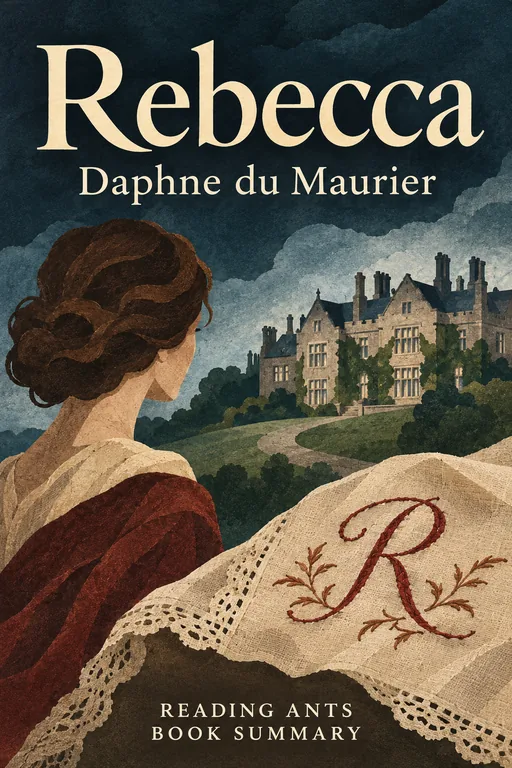
Rebecca
A shy young woman marries a wealthy widower and moves to his great estate, Manderley, where she is haunted by the memory of his first wife, Rebecca, and slowly learns the truth about her death.
Overview
Rebecca is a gothic suspense novel by Daphne du Maurier, published in 1938, and was a huge success. The story is told by a narrator whose first name is never given, and who is known only as the second Mrs. de Winter. She is a young, insecure companion to a rich woman, who meets and marries Maxim de Winter, a wealthy man whose first wife, Rebecca, died the year before. At Manderley, a grand house in Cornwall, the new bride finds that Rebecca’s presence is everywhere, and that the housekeeper, Mrs. Danvers, is devoted to the dead woman. The book opens with one of the most famous first lines in English fiction, in which the narrator says she dreamed of returning to Manderley.
Main Characters
- The narrator (the second Mrs. de Winter): a young, shy, observant woman who is eager to please.
- Maxim de Winter: her wealthy, brooding husband, the master of Manderley.
- Rebecca: Maxim’s dead first wife, who is beautiful, charming and, as it turns out, cruel.
- Mrs. Danvers: Manderley’s housekeeper, cold and fiercely loyal to Rebecca.
- Mrs. Van Hopper: the vain, snobbish woman whom the narrator works for.
- Frank Crawley: Maxim’s loyal land agent and friend.
- Jack Favell: Rebecca’s charming, sly cousin.
- Beatrice and Giles: Maxim’s sister and brother-in-law.
Full Summary
A Marriage
The narrator, a young paid companion, is staying in Monte Carlo with Mrs. Van Hopper when she meets Maxim de Winter, a handsome man in his forties. He takes her on drives, and after a short time, he proposes. She is overwhelmed, and accepts, though she knows little about him. After their honeymoon, they go to his famous estate, Manderley, where the staff, led by Mrs. Danvers, watch the new bride with cold disapproval.
Rebecca’s Shadow
At Manderley, the narrator feels out of her depth. Everywhere she sees signs of Rebecca: her handwriting on notepaper, her room preserved as if she might return, and the way she ran the household. Mrs. Danvers makes things worse, showing the narrator Rebecca’s rooms and speaking of her beauty and her taste, hinting that the narrator will never match her. The neighbors and Maxim’s family also compare her, politely, to the first wife.
The Costume Ball
Maxim’s neighbors expect a grand costume ball, as was the custom under Rebecca. Mrs. Danvers urges the narrator to dress as an ancestor from a portrait in the gallery. She does, but the dress is the same one that Rebecca wore at the last ball, and when she descends, Maxim is furious and shocked. She realizes that Mrs. Danvers has tricked her. Humiliated, the narrator is despondent, and Mrs. Danvers urges her to jump from the window of Rebecca’s room.
The Truth
That night, a ship runs aground in the bay, and divers who investigate the wreck discover Rebecca’s sunken boat, with a body inside. Maxim then tells his wife the truth: he never loved Rebecca. She was cruel, unfaithful and mocking, and in a fit of rage, after she told him she was pregnant with another man’s child and would pass it off as his heir, he shot her, and sank the boat. The body that had been buried in the family vault was someone else’s. The narrator is shocked but relieved to learn that he never loved her, and that he loves her.
The Inquest
At the inquest, the verdict first suggests that Rebecca’s death was suicide, which helps Maxim, but Rebecca’s cousin Favell tries to blackmail him, claiming that Rebecca could not have killed herself. Then a doctor’s record is found showing that Rebecca had a terminal illness, which gives a possible reason for her to have wanted to die. Maxim is cleared of suspicion, and Favell is sent away. The couple feel they are finally free.
The Fire
On their way back to Manderley, Maxim and the narrator see an orange glow in the sky. When they arrive, the house is in flames. Mrs. Danvers has vanished, and the book strongly implies that she set it alight. Manderley is destroyed. The novel’s opening chapter has already shown the narrator and Maxim living abroad in a quiet exile, haunted by their past but at peace with one another, and dreaming of the lost home; the closing pages explain how they came to that exile.
Why It Matters
Rebecca has never been out of print, and is considered a classic of twentieth-century suspense. It was adapted into Alfred Hitchcock’s 1940 film, which won the Academy Award for Best Picture, and has been remade several times, including a 2020 Netflix version. The novel’s mix of romance, mystery and psychological tension shaped the genre now sometimes called “domestic noir.”
Its first line, and its portrait of the unseen Rebecca, who dominates the story though she never appears, are among the most famous in popular fiction.
Many later novels and films about wives haunted by a predecessor, and about grand houses with secrets, owe a debt to it, and du Maurier’s other works, including the novel Jamaica Inn and the short story behind The Birds, were also filmed by Hitchcock.
Key Takeaways
- The past can haunt the present. Rebecca’s memory controls Manderley.
- Insecurity can be exploited. Mrs. Danvers uses the narrator’s fears.
- Appearances deceive. Rebecca was admired, but she was cruel.
- Love and guilt can be tangled. Maxim’s secret shapes the marriage.
- Moral lines can blur. Readers may sympathize with Maxim despite his crime.
What We Can Learn
The novel shows how comparing ourselves to others can damage our sense of worth. The narrator spends much of the story measuring herself against an idealized rival, and her story warns us not to let others’ reputations overshadow our own.
It also shows that secrets can be a burden, even to the person who keeps them. Maxim’s lie casts a shadow over his marriage, and his wife finds more confidence once the truth is out, which suggests that honesty can free relationships.
Finally, it invites us to look critically at what we are told about people. Rebecca is described as perfect by those who loved her, and the truth is different.
Criticism and Counterpoints
Some readers object that Maxim’s murder of his wife is treated sympathetically, since the novel encourages the reader to side with him, and that this raises moral questions about excusing violence against a woman who was cruel. Others find the narrator passive and naive, and her fear of Mrs. Danvers excessive.
Feminist critics have debated the book’s portrayal of Rebecca, who is both a victim of male judgment and a villain, as well as the way that women are set against each other. The ending’s easy justice for Maxim troubles some. Still, many admire its atmosphere.
Who Should Read It
This book suits teenagers and adults who enjoy gothic suspense. It is compelling and easy to read, with a slow-burning plot. It includes a murder and psychological cruelty, but little graphic violence.
Want the whole book?
A summary is a taste, not the meal. Here is where to find the full book.
You reached the end 🎉
Nicely done. Mark this one as read, and we will suggest what to read next.
Read this next
Jane Eyre
Charlotte Bronte
A poor, plain but fiercely independent orphan becomes a governess, falls in love with her brooding employer, discovers his terrible secret, and refuses to give up her self-respect even for love.
📜 Classics
Wuthering Heights
Emily Bronte
On the wild Yorkshire moors, an orphan named Heathcliff falls into a fierce, all-consuming love with Catherine Earnshaw, and when she marries another man, his bitterness drives a revenge that poisons two families for a generation.
📜 Classics
Gone Girl
Gillian Flynn
On the morning of their fifth wedding anniversary, a woman vanishes and her husband becomes the prime suspect, but the truth about their marriage is far stranger and more twisted than anyone suspects.
🔍 Mystery & ThrillerNorthanger Abbey
Jane Austen
A young woman who loves Gothic horror novels goes to Bath and then to a mysterious old abbey, where her overactive imagination leads her into embarrassing mistakes, and she learns to tell fiction from real life.
📜 Classics
Pride and Prejudice
Jane Austen
Quick-witted Elizabeth Bennet and the proud, wealthy Mr. Darcy badly misjudge each other, and only by facing their own faults do they find their way to love.
📜 Classics
Nineteen Eighty-Four
George Orwell
In a future Britain ruled by an all-seeing Party, one man secretly rebels by keeping a diary and falling in love, and discovers just how completely a totalitarian state can crush the human mind.
📜 ClassicsWant something different?
Pick another topic and we will show you three books to start with.