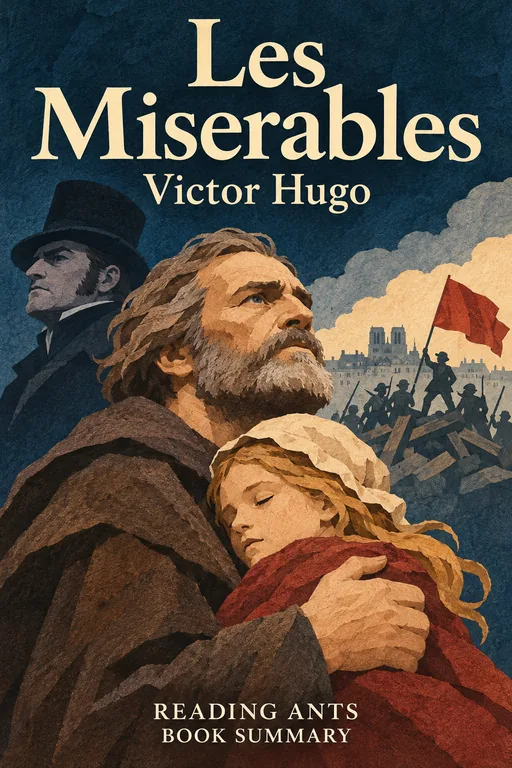
Les Miserables: the longer summary
Before You Start (No Spoilers)
Les Misérables is one of the great stories of a person who tries to change. Its hero, Jean Valjean, is a man who has spent nineteen years in prison for stealing bread and is released with a yellow passport that marks him as a danger. Everyone turns him away, until a kind old bishop gives him a chance. The rest of the book follows his attempt to live honestly, while an obsessive police inspector, Javert, who treats legal condemnation as a final measure of a person, hunts him across France.
The novel is also a portrait of France in the early nineteenth century, from the aftermath of Napoleon to the uprising of 1832. Hugo places the poor, the outcast and people marked by punishment at the center of the narrative, while the preface explicitly challenges social misery. The book is full of long digressions on the Battle of Waterloo, the Paris sewers, convents and slang, which many readers skip. The story itself is tightly plotted and full of drama, love, injustice and sacrifice.
The local English text includes all five volumes and the long digressions as well as the principal story. It is a book for a determined reader of thirteen or older. Some parts deal with serious themes, including the exploitation of a woman and the violence of a rebellion, and the novel itself sometimes describes suffering and violence in considerable detail; this summary keeps them brief. What follows gives away the entire plot, including the ending.
Who’s Who
- Jean Valjean: a former convict who tries to become a good man. He is enormously strong and gentle, and the book’s moral center.
- Javert: a police inspector who believes in law without mercy.
- Bishop Myriel (Monseigneur Bienvenu): the kindly bishop whose act of grace changes Valjean’s life.
- Fantine: a poor young woman who is abandoned and forced into hardship to support her daughter.
- Cosette: Fantine’s daughter, who grows from a mistreated servant child to Valjean’s beloved adopted daughter.
- The Thénardiers: a greedy innkeeper couple who mistreat Cosette. Their children include Éponine, Azelma and Gavroche.
- Marius Pontmercy: a young man trained in law who falls in love with Cosette.
- M. Gillenormand: Marius’s old, royalist grandfather.
- Enjolras: the leader of a group of student revolutionaries, the Friends of the ABC, which includes Combeferre, Courfeyrac and the cynical Grantaire.
- Fauchelevent: a man whom Valjean once saved from under a cart.
Volume One: Fantine
The bishop. In 1815, a man arrives in the town of Digne. He is Jean Valjean, just released after nineteen years in the galleys. He was sentenced to five years for stealing a loaf of bread to feed his sister’s starving children, and the sentence grew longer with each attempt to escape. Because of his yellow passport, no inn will take him in, and the people he asks for food turn him away. At last he knocks on the door of the bishop, Monseigneur Myriel, who welcomes him and gives him dinner and a bed.
In the night, Valjean steals the bishop’s silver and runs away. He is caught by the police and brought back. To his astonishment, the bishop says that he gave the silver to Valjean as a gift, and that Valjean forgot to take the two silver candlesticks too. He gives him the candlesticks, and urges him to let this mercy become the beginning of an honest life. Shaken, Valjean leaves. Later, he keeps a coin belonging to a small boy and then becomes horrified by what he has done. He decides to become a different man.
Monsieur Madeleine. Years later, in the town of Montreuil-sur-Mer, a stranger named Monsieur Madeleine has made a fortune with a new manufacturing process, and has used the money to build a hospital and help the poor. He is so respected that he is made mayor. He is Jean Valjean, living under a false name.
Fantine. One of the workers in his factory is Fantine, a young woman who has a secret child, Cosette, whom she has left in the care of an innkeeper family, the Thénardiers, who demand ever more money for her. When the other women find out, she is dismissed. Desperate, she sells her hair and her teeth and eventually is forced onto the street. Javert, who has recently been posted to the town, arrests her after an incident with a man who insulted her. Madeleine intervenes, and takes her to a hospital, promising to find her daughter.
Javert’s suspicion and the wrong man. Javert has long suspected that Madeleine is the convict Valjean, but then he hears that a man called Champmathieu has been arrested and is thought to be Valjean. Madeleine is in agony: if he lets the innocent man be condemned, he saves himself; if he speaks, he loses everything. After a night of struggle, he goes to the court and declares that he is Jean Valjean. He then returns to the dying Fantine, who dies without ever seeing her child, and is arrested by Javert.
Volume Two: Cosette
Escape. Valjean escapes from prison, and goes to Montfermeil, where he finds Cosette. She is a little girl, ragged and exhausted, who works as a servant for the Thénardiers, hauling water from a dark spring in the woods at night. Valjean buys her freedom for a sum of money, and takes her away. For the first time in her life, she has a doll and a father.
Petit-Picpus. They go to Paris and live in a poor house, the Gorbeau hovel, until Javert traces them. Valjean and Cosette escape through the streets, over a wall and into a convent garden, the Petit-Picpus. By a stroke of luck, the gardener of the convent is old Fauchelevent, the man whose life Valjean once saved. Valjean is hired as his assistant, and Cosette is sent to the convent school. They live there for several years, safe and hidden.
Volume Three: Marius
A student. In Paris, Marius Pontmercy is a young law student who has been raised by his royalist grandfather, M. Gillenormand, but has quarreled with him and lives in poverty. He has learned that his father, a colonel who fought for Napoleon at Waterloo, was a hero. Marius is passionate and idealistic, and becomes close to members of a circle of student friends, the Friends of the ABC, led by the fiery Enjolras, who talk of revolution and a better world.
The Thénardiers again. Marius lives in the Gorbeau hovel, next door to a family of beggars who are the Thénardiers living under another name. Their daughter, Éponine, falls in love with him, though he does not notice. Their younger son Gavroche is a street child, cheerful and brave, who looks after other children even though he is neglected by his parents.
A girl in the garden. Marius notices a girl and her father walking in the Luxembourg Gardens. He is soon in love. The girl is Cosette, grown up, and the older man is Valjean. His first efforts to follow them fail. Later, Éponine finds their garden house on the Rue Plumet and leads him there.
Volume Four: The Rue Plumet and the Rue Saint-Denis
The garden and an unwelcome future. After Éponine shows him the address, Marius meets Cosette in the garden at night. Valjean does not initially know about their attachment. Éponine, although she loves Marius herself, prevents her father’s gang from robbing the house. Her help coexists with jealousy and the wish not to lose him.
Valjean prepares to leave for England as fear of exposure and warning signs disturb him. He discovers evidence of Cosette’s attachment while this plan is developing, rather than first learning of it and then simply choosing flight for that reason. Cosette is distressed by the move. Her letter for Marius passes into Éponine’s hands and is withheld from him for a time, deepening his belief that he has lost her.
The barricade. During the June1832 uprising after General Lamarque’s death, Enjolras and his friends establish a barricade near the Rue de la Chanvrerie. Javert enters as a spy, but Gavroche recognizes him and the rebels bind him. Marius comes in despair and fights with the insurgents. Éponine, dressed as a boy, prevents a shot from striking him and is mortally wounded herself. Before dying, she gives him Cosette’s letter and admits that she kept it back.
Marius writes to Cosette and entrusts his reply to Gavroche. The boy carries it to the new address, where Valjean receives it. The letter makes Marius’s danger immediate to him. He goes to the barricade, bringing his conflict over losing Cosette into a place where another young person’s life may end.
Volume Five: Jean Valjean
Mercy at the barricade. Valjean helps the insurgents while avoiding deliberate killing. When he asks to take responsibility for executing the captive Javert, the others think he will carry out the sentence. Instead, he cuts the inspector’s bonds, sends him away and fires into the air to conceal the release. The man Javert has pursued has chosen to spare him.
The last defense. The barricade receives no rescue from the wider city. Gavroche goes outside to collect cartridges from fallen soldiers and is killed in the gunfire. During the final assault, the remaining defenders are overwhelmed. Grantaire wakes from drunken sleep and chooses to die beside Enjolras. Valjean finds Marius badly wounded and carries him down into the sewers before the position is completely lost.
Below the city. Carrying Marius through the sewers exhausts Valjean. He struggles through deep, dangerous mud and eventually reaches a locked exit. Thénardier, hiding there, assumes that the burden is a corpse carried by a murderer. He opens the grating for money and secretly tears a piece from Marius’s coat as possible evidence. Valjean escapes with the living man, not with the motive Thénardier imagines.
Javert’s last choice. Javert is outside. He permits Valjean to take Marius to his grandfather, then allows him to go briefly to his own home. When Valjean comes back downstairs, the inspector has gone. Javert cannot fit the mercy he has received into the obligations by which he has lived. After writing a report about police practices, he goes to the Seine and kills himself. His disappearance frees Valjean, but it is also the end of a life that has lost its governing certainty.
Marriage and separation. Marius recovers in his grandfather’s house, and Gillenormand welcomes the marriage to Cosette. Valjean supplies a large dowry. On the day after the wedding, he tells Marius that he is a former convict and not Cosette’s biological father. He does not explain that he saved Marius. Marius begins withdrawing trust, while Valjean’s own sense of unworthiness helps drive him away from the couple. The visits diminish, and Valjean becomes ill in isolation.
The truth arrives late. Thénardier approaches Marius hoping to sell damaging information. He inadvertently clears Valjean of some suspicions and produces the torn piece of coat as supposed proof of murder. Marius recognizes it and understands that he was the man carried through the sewers. He and Cosette hurry to Valjean. Their affection reaches him before he dies. The bishop’s candlesticks burn nearby, and he tells Cosette about Fantine. The final grave is modest, with the written trace of his memory left vulnerable to time.
More Moments Worth Knowing
The cart. In Montreuil-sur-Mer, an old man named Fauchelevent is trapped under his overturned cart, and no one can lift it in time. Madeleine, the mayor, kneels in the mud and lifts it on his back, saving the man’s life. Javert, who is watching, remarks that only one man he has known could do such a thing: the convict Jean Valjean. It strengthens Javert’s suspicion, and it also explains why Fauchelevent later feels indebted to him.
The plaster elephant. Gavroche, the boy of the streets, lives in a huge, decaying plaster elephant that stands in a square near the Bastille. When he finds two small, hungry boys wandering in the cold, he shares his shelter with them without realizing that they are his own brothers, whom the Thénardiers have abandoned. It is one of the book’s most memorable and touching scenes, and an example of how Hugo mixes comedy, poverty and love.
The trap at the Gorbeau house. The Thénardiers, living as the Jondrettes beside Marius, lure Valjean back after he visits them with charitable help. Marius first alerts Javert, then recognizes Thénardier as the man his father believed had saved him at Waterloo. He is torn between protecting that supposed benefactor and saving the prisoner. Javert arrests the gang, while Valjean escapes before the inspector can identify him. It shows how coincidence runs through the book: the characters keep running into each other across Paris.
The Friends of the ABC. The student group’s name is a pun in French, and its members range from the dedicated Enjolras to the cynical Grantaire, who does not believe in anything except his friend Enjolras. At the barricade, Grantaire, who has been drunk, wakes up and asks to die with Enjolras. It is a brief scene of grace in a story of failure.
Valjean’s last hours. In his small room, Valjean unpacks the clothes of Cosette’s childhood, which he has kept. He lights the bishop’s candlesticks. The story that began with a gift of silver ends with the same silver, burning in the room of a dying man. It is a quiet and perfect piece of symmetry.
Key Scenes Explained
The bishop’s gift. The scene of the candlesticks is the book’s heart: mercy, not punishment, changes a person. It sets up the question the whole novel explores, whether society should punish or redeem.
Champmathieu. Valjean’s decision to confess is the book’s greatest moral struggle. It is not a matter of action but of conscience, and Hugo spends a long, gripping chapter on the debate in Valjean’s mind.
Cosette at the spring. The image of the tiny girl hauling a heavy bucket of water through a dark wood is one of the book’s most famous. It shows the cruelty of the Thénardiers and the child’s courage.
The barricade. Hugo describes the uprising with both sympathy and sadness. The students are brave and noble, but the revolt fails, and many young people die for it. Gavroche’s death is one of the book’s most affecting moments.
The sewers. Valjean’s journey through the sewers is a descent into hell and a return to life, and it shows the physical strength and moral endurance of a man who carries another’s life on his back.
Javert’s end. The inspector’s suicide is the collapse of a worldview. He has believed that the law is everything and that mercy is weakness. Valjean’s mercy proves him wrong, and he cannot live with that.
Why It Still Matters
The same legal mark follows Valjean after he has paid for the original theft. His yellow passport makes other people refuse him before hearing his story. The bishop’s welcome interrupts that pattern, while the Champmathieu case later asks whether Valjean will protect his new life by allowing the mark to fall on an innocent man.
The book returns to that conflict through other lives. Fantine is punished for circumstances her employer does not understand; Cosette is made useful by people who profit from her mother’s concern; Marius nearly loses his rescuer because he mistakes a partial account for the whole truth. Javert’s ending gives the struggle its starkest form: he cannot make mercy and duty coexist within his system. These connections support a reading about justice that requires attention to people as well as rules. The final reunion offers forgiveness without making the earlier losses recoverable.
What to Notice While Reading
- Two kinds of justice. Javert represents the law; the bishop represents mercy. Notice how the book weighs them.
- Doubles. Valjean and Javert are mirrors, since both are strong, disciplined men from poor backgrounds, who have chosen opposite paths.
- Children. Cosette, Gavroche and Éponine are all children who are neglected or abused. Notice how Hugo uses them to criticize society.
- The digressions. Hugo writes long essays on history, architecture and slang. They are not the story, but they give the world around it.
- Sacrifice. Valjean, Éponine, Fantine and Gavroche all give up something for others. Notice what each gives and what it costs.
Questions to Think About
- Why does the bishop give Valjean the candlesticks?
- Was Valjean right to confess in the Champmathieu case, even though it cost him everything?
- Why does Javert end his life after Valjean spares him?
- What do the students of the barricade want, and why do they fail?
- Does Valjean’s long life of sacrifice earn him his peaceful death?
How to Read It
Many readers choose an abridged edition, or read the story chapters and skip Hugo’s essays, such as the long account of Waterloo and the sewers. The five volumes each have their own tone: Fantine is a tragedy, Cosette is an adventure, Marius a love story, and the last two a drama of rebellion and redemption. An audiobook can help with the length.
If You Liked Les Misérables
Try The Count of Monte Cristo for another story of a wrongly imprisoned man, A Tale of Two Cities for sacrifice in revolutionary France, Great Expectations for another story of a convict and a boy, or Crime and Punishment for a story of conscience and redemption.
Want the whole book?
A summary is a taste, not the meal. Here is where to find the full book.