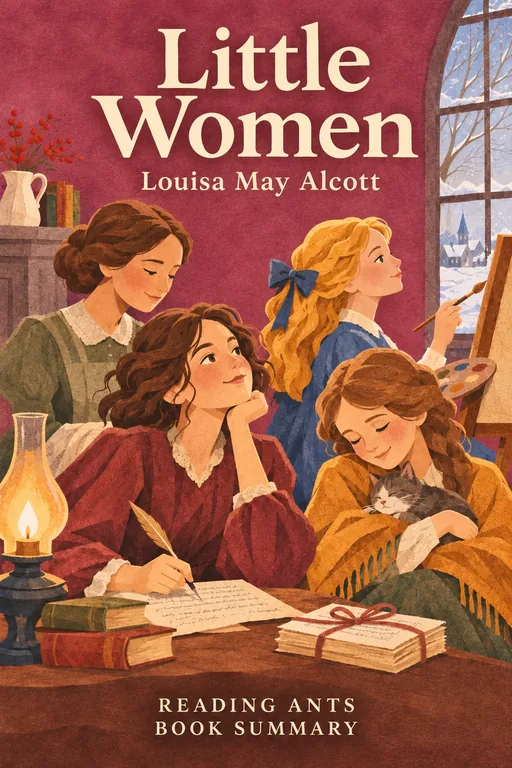
Little Women: the longer summary
Before You Start (No Spoilers)
Little Women follows four sisters growing up in a loving but not rich family in New England during the American Civil War. It was published in two parts, in 1868 and 1869, and was based loosely on the author’s own childhood. The sisters are very different from one another, and each has a goal and a flaw. Readers often see themselves in one, and many fiercely love or fiercely argue about their favorite.
The book is warm, funny and sad in turn. It tells a story of ordinary life, with plays in the attic, Christmas dinners, quarrels, new friends, illness and the long process of deciding what to do with one’s life. It is also a book about what girls and women were allowed to do at that time, and what they wanted to do anyway.
It has some old-fashioned preaching, especially about being good and patient, and a few scenes of heavy sadness. Most readers find that these are balanced by the humor, the warmth and Jo, a sharp, independent girl who wants to be a writer. It is a good book for a reader of about ten or older.
What follows tells the whole story, including the big deaths and marriages.
The Marches
The March family lives in a modest house in a small New England town. Mr. March, who has lost his money helping a friend, is away serving as a chaplain with the Union army. At home, Mrs. March, whom the girls call Marmee, raises her four daughters with the help of Hannah, the loyal family servant. The girls have to work and make do without luxuries, and they feel sorry for themselves at times.
- Meg, the eldest, is sixteen at the start. She is pretty and responsible but longs for money, fine clothes and a comfortable life.
- Jo, fifteen, is tall, awkward and hot-tempered. She cuts her hair short, writes stories and plays, and hates being told what girls should do.
- Beth, thirteen, is shy and loves music and her family. She is gentle and tries never to cause trouble.
- Amy, twelve, is the youngest, an artist who is vain about her appearance and her manners.
Part One
Playing pilgrims. The story begins on a Christmas Eve when the sisters grumble that Christmas will not be Christmas without presents, because there is little money. Then they decide to spend their small amount on gifts for their mother and, on Christmas morning, they give up their breakfast to a poor, starving family, the Hummels, who live nearby. It is a lesson in generosity that sets the tone of the book. Their mother encourages them to think of their lives as a version of The Pilgrim’s Progress, a story about a journey toward goodness, and the girls play at being pilgrims, each trying to fix a fault.
A new friend. At a dance, Jo meets Laurie, the grandson of Mr. Laurence, the rich old man who lives next door. Laurie is lonely and lively, and he is soon welcomed into the March family’s games and plays. His grandfather, a stern man with a soft heart, becomes fond of the girls, particularly Beth, who is brave enough to play his piano. He gives her the piano as a gift.
Faults and punishments. Each sister struggles with a fault. Meg spends too much time on clothes and is embarrassed at a rich friend’s party, where the girls dress her up. Jo has a quick temper. Amy is jealous and bossy. When Amy is furious at Jo for leaving her out of an outing with Laurie, she burns the manuscript of Jo’s stories, which Jo has worked on for years. Jo is so angry that she refuses to speak to Amy. A few days later, when they go skating, Amy falls through thin ice, and Jo, who had ignored a warning, helps Laurie pull her out. Jo is overwhelmed with guilt and understands that her temper almost cost her a sister. Her mother tells her she has fought the same problem all her life, and Jo’s relationship with Amy improves.
A telegram. Mr. March becomes seriously ill in a Washington hospital, and Mrs. March has to go to nurse him. The family needs the money for the trip, and Jo, in a quick, brave decision, cuts off her hair and sells it for twenty-five dollars. Mrs. March leaves, and the girls are left with Hannah.
Beth falls ill. Beth has been helping the Hummels, and she catches scarlet fever from their baby, who dies. She becomes very ill and nearly dies. Amy is sent to live with Aunt March, a sharp, rich elderly relative. Jo takes care of Beth with great devotion, and the family is brought together. Beth recovers, though her health is never fully restored. Mr. March returns home soon afterward. Part One ends with a happy Christmas, and Meg’s engagement to John Brooke, Laurie’s tutor.
Part Two
Three years later. Meg marries John Brooke and moves into a small house. She learns about managing a household, quarrels with John over money, and gradually learns to value their love over luxuries. Later she has twins, Daisy and Demi. Meanwhile, Jo is working on her writing, selling stories for a small income and spending time with Beth. Amy becomes increasingly refined and works on her art.
Laurie’s proposal. Laurie, who is now at college, falls in love with Jo. He asks her to marry him, and she refuses, kindly but firmly, saying she loves him as a friend and a brother and would be miserable as his wife. He is heartbroken, and Jo, who feels guilty, leaves for New York to work as a governess and to get some distance. Laurie goes to Europe, and he travels for a time.
New York. In New York, Jo lives in a boarding house and meets Professor Bhaer, a poor, middle-aged German philosophy teacher who is kind, intelligent and generous. He tutors the children and teaches Jo German in exchange for help with his mending. He gently criticizes the sensational stories she has been writing for money, and Jo, who respects his opinion, gives them up. She comes to rely on his friendship.
Beth’s death. Jo returns home to be with Beth, whose illness has come back. Beth is calm and does not want anyone to be sad, and she slowly weakens. Jo stays with her through the last months, and they share a strong, quiet bond. Beth dies peacefully, and Jo is shattered, but she begins to write about her family with greater honesty and finds that she is more successful.
Amy and Laurie. In Europe, Amy travels with Aunt March’s relatives and meets Laurie again. He has been drifting, wasting his time and money, and she tells him bluntly to find a purpose. Over time, the two grow close, and they are married abroad before returning home as a couple. At first Jo is shocked, but she is glad to see them happy.
Professor Bhaer returns. Professor Bhaer visits the Marches. He and Jo have a wonderful time, and, one rainy evening, he comes to find her. He is about to go west to help his nephews, who need him, and has come to say goodbye. In the famous scene under an umbrella, he tells her he has nothing to offer but a full heart and empty hands. Jo takes his hands and says that they are not empty now, and they kiss under the umbrella. They agree that they must wait, since he has a duty to the boys and she has hers to her family.
A year later: Plumfield. After a year of waiting, working and writing long letters, Aunt March dies suddenly and leaves her house, Plumfield, to Jo. Laurie assumes she will sell it, but Jo sees it as the perfect place for a school for boys. She and the Professor marry and start the school, a happy mix of boys, teachers and family. The book ends on an autumn day at Plumfield, during an apple harvest on Marmee’s birthday, with everyone together.
More Scenes Worth Knowing
Vanity Fair. In Part One, Meg spends two weeks with her wealthy friend Annie Moffat. At first she is delighted by the dresses and parties, but she is also made to feel poor, and the other girls dress her up in a way that makes her uncomfortable. She overhears gossip about her mother’s plans for her and about Laurie, and she realizes that she has behaved foolishly. She goes home chastened, and her mother tells her she would rather see her a happy wife than a rich one. It is one of the clearest statements of the book’s values.
The theater and the Pickwick Club. The girls run a weekly newspaper and a small society, named after Dickens’s Pickwick Papers, and Laurie joins in. They also put on dramatic plays that Jo writes. These scenes show how the sisters use imagination to make their lives richer. They are also a quiet picture of Jo’s future as a writer.
Amy’s troubles at school. Amy is punished at school for bringing pickled limes, which are against the rules, and is humiliated in front of the class. Her mother lets her stay home, but also makes it clear that she needs to learn to be less proud of what she wants. It shows how the family treats each child’s individual faults.
Beth and the piano. Beth is so shy that she can barely speak to Mr. Laurence, but she goes into his house to play when she knows he is not there. When he notices and sends her the piano, she goes to thank him herself, a brave act for her, and it starts a friendship between her and the old man. Beth’s courage is of a quiet kind.
The Christmas surprise. Soon after Beth begins to recover, Mr. March comes home on Christmas Day, thin and tired from his service. For the March family the reunion is the best present possible. It closes Part One, and it is a chance to see how deeply the family cares for one another.
Meg’s early marriage. In Part Two, Meg’s first year of marriage is not easy. She buys fabric she cannot afford and tries to become the perfect housewife, which leaves her little time for John, who feels neglected. With the help of her mother, she learns to be more careful with money and to include her husband in the home. Alcott treats this as a real challenge, not a failure.
Jo’s writing life. After Professor Bhaer criticizes the sensational stories, Jo reconsiders what she wants her writing to say. She spends time writing a book about her own family and experiences, and it finds readers. The book that Jo writes within the story is, in a sense, the book we are reading.
Aunt March’s legacy. Aunt March, who has always seemed disapproving, turns out to have been fond of Jo. When she dies suddenly, she leaves Jo the house, and the gift gives Jo and the Professor the means to start the school they have been hoping for.
Who’s Who
- Meg (Margaret) March: the eldest, beautiful, sensible, torn between her wish for comfort and her love for John.
- Jo (Josephine) March: the second sister, a writer, passionate and stubborn, the book’s central character.
- Beth (Elizabeth) March: the quiet third sister, who plays piano and cares for others.
- Amy March: the youngest, an artist, proud and ambitious.
- Mrs. March (Marmee): the girls’ wise and affectionate mother.
- Mr. March: their father, a kind, thoughtful man who is away at war.
- Hannah: the family’s loyal servant.
- Laurie (Theodore Laurence): the neighbor and friend who becomes part of the family.
- Mr. Laurence: Laurie’s gruff but kind grandfather.
- John Brooke: Laurie’s tutor and later Meg’s husband.
- Aunt March: a rich, sharp-tongued relative who is nevertheless generous.
- Professor Bhaer: the German teacher Jo meets in New York.
Key Scenes Explained
Giving away the breakfast. The first Christmas shows the family’s values: they give up something they want for those who need it more. It also sets up the Hummels, who return later in the story.
Amy and the manuscript. Amy’s act is cruel, and Jo’s anger is understandable. The scene at the ice, with Amy’s fall, shows how quickly things can become serious, and how forgiveness has to be won.
Jo’s hair. This is a small act of sacrifice, and it also shows Jo’s independence. She uses what she has for her family, and she does not complain.
Beth’s illness. The novel treats Beth’s illness and her death as real events, not as lessons only. The scenes are gentle but sad, and they show how grief can bind a family together.
Laurie’s proposal. Jo’s refusal surprised and annoyed many readers, who wanted her to marry Laurie. Alcott, who did not want to give in to the pressure, saw Jo as someone who wants to be independent and who would have been unhappy in a marriage with a boy she loved as a brother.
The umbrella. The final love scene is understated and quiet, in keeping with a book that has always valued ordinary life over grand gestures.
A Note on the Two Parts
The book was first published as two volumes, and in some countries Part Two is still sold separately under the title Good Wives. The first part ends with Christmas and an engagement, which is a satisfying stopping point, and some readers stop there. Part Two is a little more serious. The sisters are older, the choices are harder and not everyone ends up where they expected. If you only read one, read the first, but you will miss Jo’s hardest decisions and the book’s saddest chapter.
Why It Still Matters
Little Women has stayed in print since 1868 and has inspired many films, plays and adaptations. It is loved partly because it feels true: the sisters fight, make up, get things wrong and keep trying. It was also one of the first American novels to take girls’ ambitions and inner lives seriously. People still debate its choices, especially Jo’s marriage, but that argument is part of why readers return to it.
What to Notice While Reading
- Four different roads. Each sister represents a different answer to the question of what a woman should do with her life: marriage, writing, music and home, or art and society.
- Work and money. The Marches are not poor, but money is always a worry. Notice how each character earns, spends or gives it.
- Teaching through stories. Marmee uses The Pilgrim’s Progress to teach the girls. Look for how stories and games shape the family’s moral lessons.
- The war in the background. The Civil War takes Mr. March away and shapes the story, even though we rarely see fighting.
- Anger and forgiveness. Both Jo and Amy have tempers, and the book shows how they learn to manage them.
Questions to Think About
- Why does Jo refuse Laurie? Do you agree with her?
- Which sister do you relate to most, and why?
- How does Marmee guide her daughters, and is she always right?
- Why do you think Alcott allows Beth to die?
- Is Jo’s ending, a school and a husband, a victory or a compromise?
If You Liked Little Women
Try Anne of Green Gables for another strong-willed girl, Pride and Prejudice for sisters and marriage, The Secret Garden for a story of healing and growing up, or Eight Cousins and Jo’s Boys, Alcott’s other books about the March family and its world.
Want the whole book?
A summary is a taste, not the meal. Here is where to find the full book.