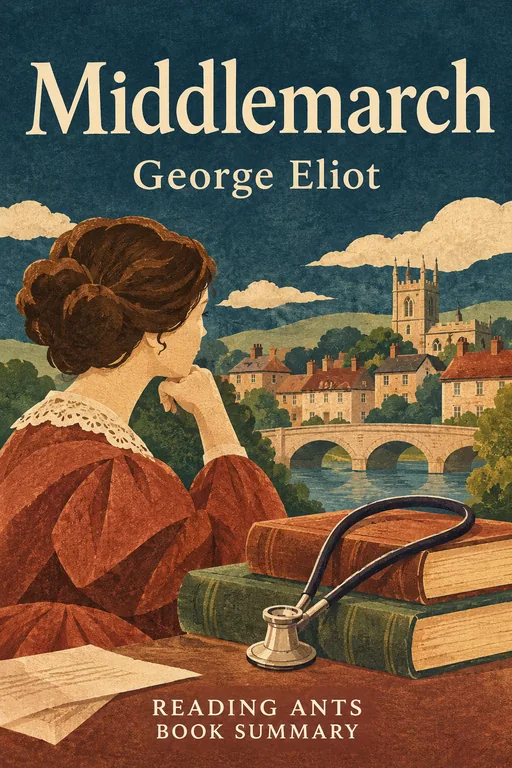
Middlemarch: the longer summary
In One Sentence
In a provincial English town around 1830, several ambitious people, above all the idealistic Dorothea Brooke and the gifted doctor Tertius Lydgate, make marriages and choices that fall short of their dreams.
Before You Start (No Spoilers)
Middlemarch: A Study of Provincial Life was written by Mary Ann Evans, who published under the name George Eliot, and appeared in eight parts in 1871 and 1872. It is set in a fictional Midlands town in the years just before the Reform Bill of 1832. Instead of following one hero, Eliot weaves together several stories: a young woman who wants a life of purpose, a doctor who wants to reform medicine, a banker with a hidden past, and a young man who must find work. The novel looks closely at marriage, money, reputation and the gap between large hopes and ordinary life. Its separate plots repeatedly meet through family connections, property, medicine and local politics.
Who’s Who
- Dorothea Brooke: a serious, generous young woman who longs to do good in the world.
- Edward Casaubon: an older clergyman and scholar who is working on a huge, unfinished study.
- Will Ladislaw: Casaubon’s young cousin, an artistic, restless man who comes to love Dorothea.
- Tertius Lydgate: an ambitious young doctor with ideas about medical reform.
- Rosamond Vincy: the town’s prettiest girl, charming but selfish.
- Fred Vincy and Mary Garth: Rosamond’s brother, who drifts, and the sensible woman he loves.
- Nicholas Bulstrode: a rich banker with strict religious views and a secret in his past.
- Mr. Brooke: Dorothea’s well-meaning, muddled uncle.
Full Summary
Dorothea’s Choice
Dorothea Brooke is young, rich enough to be independent and eager to be useful. She has plans to build better cottages for the poor, and she looks for a husband she can learn from. She rejects the kind, conventional Sir James Chettam and accepts the offer of Mr. Casaubon, a dry, much older scholar, whom she imagines to be a great mind. On their honeymoon in Rome she begins to see that he is anxious, jealous of criticism and unable to share his work. The great book he has been writing for years, the ‘Key to All Mythologies,’ is outdated before it is finished, and Dorothea slowly finds that she has chosen loneliness.
Lydgate and Rosamond
Meanwhile, Tertius Lydgate arrives in Middlemarch, full of ideas about scientific medicine and hopes of directing a new hospital toward the treatment of fevers. The hospital is already being developed under Bulstrode’s influence; Lydgate is not its independent founder. He is proud, and believes that he will not be caught in a foolish marriage. Yet he is charmed by Rosamond Vincy, who is graceful, musical and skilled at getting her own way. They marry before he is ready, and Rosamond expects a comfortable social life. Lydgate soon falls into debt, partly because of her spending, and the gap between his ideals and her tastes widens into misery. When he asks her to economize, she goes behind his back to avoid it.
Fred, Mary and the Garths
Rosamond’s brother Fred is expected to become a clergyman, which he does not want, and he is hoping to inherit money from his rich uncle, Mr. Featherstone. He loves Mary Garth, a plain, honest young woman who works as a companion, and she will not marry him unless he finds a worthwhile occupation. When Fred borrows money and cannot repay it, Caleb Garth, who has guaranteed the debt, and his family suffer for it. Fred is ashamed, and slowly, with Mary’s firm encouragement, he changes, learning estate management from her father. Their story is a quiet counterpart to the more troubled marriages.
Casaubon’s Shadow
Casaubon grows ill and suspicious. He resents Will Ladislaw, his cousin, whom he has supported, and he fears that Dorothea admires him. Dorothea tries to help her husband with his work, but he rebuffs her kindness. After he dies, she learns that he has added a codicil to his will: if she marries Will, she will lose her inheritance. The condition humiliates her, and it also makes her realize how closely Casaubon had watched her. Will, who loves her but is proud, leaves town because he will not appear to be after her money.
The Banker’s Secret
Nicholas Bulstrode, the banker, is known for his piety and his power in town. A man named Raffles, who knows about Bulstrode’s earlier life, arrives and threatens to reveal it. Bulstrode’s wealth is connected with a dishonest business and his marriage to its owner’s widow. He concealed information about her daughter, Sarah, preventing a reunion that could have changed the inheritance. Sarah was Will Ladislaw’s mother, so the hidden past also connects the banker’s fortune with Will’s family. When Raffles falls ill, Bulstrode fails to tell the nurse when the opium doses must stop, recognizes the omission and leaves it uncorrected. He also allows brandy despite Lydgate’s prohibition. Raffles dies. These acts are morally serious, but the narrative does not turn the precise medical cause of death into a proved murder verdict. Gossip spreads, and many people suspect that Lydgate was involved because he had taken a loan from Bulstrode. The town turns against both men, and Lydgate’s local reputation is badly damaged.
Dorothea and Will
Dorothea, who has kept faith in Lydgate, defends him, and she offers to help him with money. At the same time, her feelings for Will become clear. A misunderstanding leads her to think that Will loves Rosamond, whose apparent intimacy with him Dorothea misunderstands, and it takes a painful conversation for the truth to come out. Dorothea realizes that she does love Will, and that he loves her. She gives up the property from Casaubon’s will, which she would lose by marrying Will, and marries him on a more modest income, and the couple go on to a modest life in which Will enters politics.
The Final Reflections
The ending of the novel is quiet. Lydgate moves away and becomes a fashionable doctor, but he dies early, and he always thinks of himself as a failure. Fred and Mary marry and are happy. Eliot closes by reflecting on Dorothea: she did not achieve some great and famous deed, but her kindness spread in small, unseen ways, and the world is better because of people who live faithfully and are forgotten.
The Connections Between the Separate Lives
Dorothea looks for a vocation through marriage
Dorothea’s mistake begins in a serious wish rather than a shallow ambition. She wants her life to serve something beyond comfort, visits and suitable clothes. Casaubon’s work appears to offer a purpose large enough to justify devotion. She imagines becoming his assistant and learning from a mind greater than her own.
The difficulty is that she has imagined the partnership before understanding the man. Casaubon does not welcome the scrutiny that real collaboration would bring. His learning is mixed with insecurity, and he fears discovering that the project cannot become what he has promised himself. Dorothea’s eagerness can therefore feel to him like pressure rather than help.
The marriage is painful because both people experience disappointment without possessing an easy language for it. Dorothea feels shut out; Casaubon feels judged. Eliot lets the reader see his fear without requiring approval of his treatment of his wife. Sympathy means recognizing an inward life, not declaring every action defensible.
Lydgate’s independence is less secure than he thinks
Lydgate arrives with confidence in scientific work and reform. He wants to distinguish useful medical judgment from routine habits and professional vanity. Yet his work requires money, patients and institutions controlled by other people. He cannot remain entirely separate from the town whose medicine he hopes to improve.
His attitude toward marriage reveals another blind spot. He considers himself too serious to be caught by conventional romance, but he admires Rosamond through conventional signs of refinement. Her appearance, music and graceful manner seem to promise the peaceful domestic life he wants. He does not investigate the expectations beneath them.
Rosamond, in turn, imagines a husband who will lift her into a more elegant social world. She does not marry with the same understanding of sacrifice or professional duty that Lydgate assumes. Their debt grows out of this mismatch as well as particular purchases. Each has treated the other as a means of completing an imagined future.
Mary refuses a convenient wrong
The death of Featherstone gives Mary a test that is easy to overlook beside the larger romances. He asks her to interfere with his will, creating a situation in which obedience to a dying man could later look like dishonest manipulation. She refuses to act alone in a matter that requires proper witnesses.
That refusal helps prevent Fred from receiving the inheritance he expected. Mary does not know every consequence in advance, and the outcome does not make her caution a mistake. Eliot places moral judgment in a situation where doing the defensible thing can disappoint someone one loves.
Fred’s development depends on accepting such limits. He has imagined that a windfall will spare him the difficulty of choosing work. His failure to repay a loan harms the Garths, who have far less room to absorb the loss. Learning an occupation under Caleb becomes a way to turn affection into reliability. Wanting Mary is insufficient unless he can build a life in which other people do not continually pay for his carelessness.
Wills make private fear into public power
Casaubon’s condition on Dorothea’s inheritance extends his jealousy beyond his death. It presents a future marriage to Will as something already suspected, injuring both of them through an implication they did not choose. The condition also reveals how property can shape another person’s freedom.
Dorothea’s response is not immediately a simple recognition of love. She must first understand the humiliation and re-examine what her marriage has been. Will has his own pride and does not want to become a man who seems to pursue a rich widow for money. Their attachment grows within a network of judgments that each is anxious not to confirm.
The other inheritance story, Featherstone’s, has already shown that expectations about property can direct people’s conduct before a will is read. Together the stories make money active in the plot. Wealth is not merely background information; it creates plans, suspicions, dependence and opportunities for refusal.
Bulstrode confuses explanation with innocence
Bulstrode’s hidden history is not simply an embarrassing detail from a less respectable youth. His fortune is connected with wrongdoing and with information withheld from people who had a claim to know it. His later religious identity allows him to think of the past as something spiritually managed, while its material advantages remain with him.
Raffles threatens that arrangement because he can tell a story that Bulstrode cannot control. The banker uses money to keep him away, but paying for silence does not remove the underlying facts. Fear of exposure turns a past wrong into continuing choices in the present.
When Raffles becomes ill, Bulstrode’s wishes and responsibilities conflict. He does not need to announce a plan of murder for neglect to become morally serious. The failure to ensure that Lydgate’s instructions are followed occurs while he desperately wants the witness removed. Eliot examines the evasions through which a person can participate in harm while trying to preserve an image of himself as righteous.
Reputation can spread faster than evidence
The loan to Lydgate places the doctor inside the scandal. Its timing gives observers a simple explanation: he has accepted money to help conceal wrongdoing. The explanation is false, but its plausibility makes it difficult to dislodge. Lydgate has little control over what a community finds satisfying to believe.
Dorothea’s response is different because she begins by considering what help might still be possible. Her willingness to hear Lydgate and offer practical assistance contrasts with the town’s pleasure in a settled judgment. She is not rewarded with perfect knowledge; she chooses generosity while facts and motives remain painful.
Her visit to Rosamond then creates a further misunderstanding when she sees Will in an intimate-looking situation. The scene tests whether her sympathy can survive personal hurt. Returning to speak kindly to Rosamond becomes a major moral action precisely because Dorothea has an excuse to retreat. Rosamond’s later honesty about Will responds to that generosity without turning her instantly into a different person.
The final outcomes challenge simple measures of success
Lydgate becomes financially successful in work that falls short of his original scientific hopes. From outside, his career may look secure. From inside, he remembers a purpose he has not fulfilled. Fred’s more modest work produces a happier result because he becomes capable of sustaining obligations he once avoided.
Dorothea’s marriage to Will requires giving up property, but it does not produce the famous vocation she first sought. The ending asks readers to judge her influence through effects on other lives rather than public recognition. This does not mean her restricted opportunities are unimportant. The narrator keeps the loss of possible achievement visible while affirming the value of what she actually does.
Why It Still Matters
The novel makes social connection part of its explanation of character. Lydgate cannot carry out medical reform without money and institutions. Fred’s carelessness reaches the Garths through a guaranteed debt. Dorothea’s marriage changes what she can know and do. Each apparently private story therefore includes obligations to people beyond the central couple.
The narration also resists a simple division between good people and bad motives. Casaubon’s insecurity deserves understanding without excusing his treatment of Dorothea. Bulstrode can sincerely value religion while repeatedly finding reasons to retain the benefits of wrongdoing. Explanations of inward life deepen responsibility rather than removing it.
The ending then offers different measures of success. Lydgate earns money without fulfilling his original purpose, while Fred’s less ambitious work supports a happier partnership. Dorothea’s influence survives in particular lives instead of a famous achievement. The conclusion values those effects while still recognizing the restrictions that prevented her from choosing among wider possibilities.
Key Takeaways
- Idealism meets reality. Dorothea and Lydgate both have noble aims that are blocked by choices made in haste.
- Marriage shapes a life. Several marriages in the book show how misunderstanding and selfishness can trap people.
- Hidden pasts return. Bulstrode’s secret shows that reputation built on a lie is fragile.
- Small kindnesses count. Eliot ends by saying that unnoticed, faithful lives do real good.
- Society judges quickly. Gossip can ruin people on thin evidence.
What We Can Learn
Middlemarch encourages us to look carefully at our own motives. Dorothea marries Casaubon because she imagines a great scholar rather than the man he actually is, and her mistake is a reminder to see people as they are before committing our lives to them.
It also shows how much our surroundings and relationships shape what we can achieve. Lydgate is talented, but a poor marriage, debt and small-town gossip undermine him, which teaches us to take seriously the practical conditions of success, such as money and partnership, and not only talent.
Finally, it invites a generous attitude toward others. Eliot shows that people who look foolish or cold often have inner struggles, and she asks the reader to extend sympathy, which is a habit we can practice in everyday life.
Criticism and Counterpoints
The many plots and the narrator’s reflections require patience. A reader interested mainly in Dorothea may find the movements into debts, local politics or other households distracting. Yet those connections are also how the novel tests the idea that a person’s choices can be understood in isolation.
The distribution of sympathy invites further questions. Rosamond is often seen through the frustrations she creates for Lydgate, while Dorothea receives much fuller access to inner struggle. The final marriage also leaves open whether Dorothea has found a sufficient use for her abilities or accepted a life narrowed by circumstance. Readers can value her unseen influence without concluding that the limits on her opportunities were necessary or just.
Who Should Read It
This book suits mature teenagers and adults who enjoy long, thoughtful novels. It is very long and has many threads, so readers may want to read it over several weeks and keep a short list of the households and their connections. A modern edition with notes helps with the period background and the political references.
What to Notice While Reading
- Misread partnerships. Dorothea and Lydgate make very different marriages, yet each begins by imagining that a partner will complete a desired life.
- Mary’s refusal. A small, careful decision around a will changes fortunes. Moral conduct does not guarantee an immediately pleasing result.
- Interdependence. Medical reform needs money, family comfort needs income, and a loan can affect reputation. Nobody acts outside the town’s network.
- Bulstrode’s inward arguments. Watch how he explains events to himself. The ability to produce a reason is not the same as accepting responsibility.
- The final measure of a life. The narrator asks what changes because a person has lived, including changes that no public record will preserve.
Questions to Think About
- What does Dorothea hope Casaubon will allow her to become?
- Why does Lydgate fail to understand Rosamond before marrying her?
- Was Mary right to refuse Featherstone even though Fred loses an advantage?
- How does gossip turn a real loan into a false account of Lydgate’s motives?
- Which life in the ending looks most successful, and does your answer change depending on whose viewpoint you use?
Want the whole book?
A summary is a taste, not the meal. Here is where to find the full book.