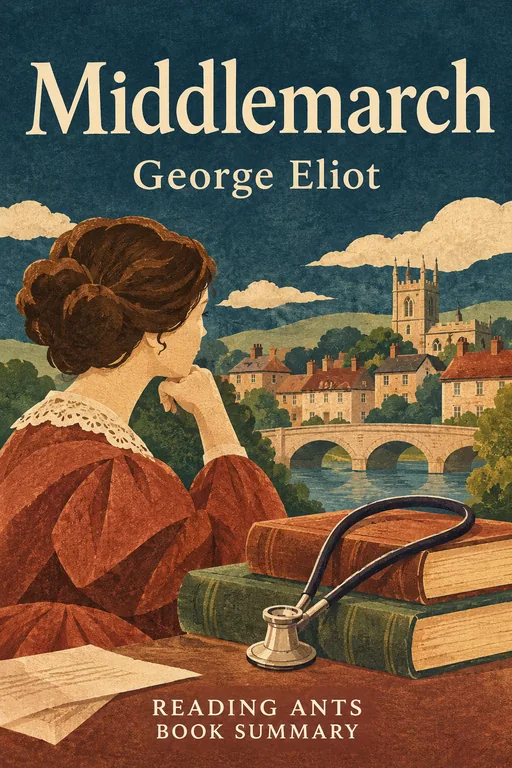
Middlemarch
In a provincial English town around 1830, several ambitious people, above all the idealistic Dorothea Brooke and the gifted doctor Tertius Lydgate, make marriages and choices that fall short of their dreams.
Overview
Middlemarch: A Study of Provincial Life was written by Mary Ann Evans, who published under the name George Eliot, and appeared in eight parts in 1871 and 1872. It is set in a fictional Midlands town in the years just before the Reform Bill of 1832. Instead of following one hero, Eliot weaves together several stories: a young woman who wants a life of purpose, a doctor who wants to reform medicine, a banker with a hidden past, and a young man who must find work. The novel looks closely at marriage, money, reputation and the gap between large hopes and ordinary life. Many critics rank it among the greatest English novels.
Main Characters
- Dorothea Brooke: a serious, generous young woman who longs to do good in the world.
- Edward Casaubon: an older clergyman and scholar who is working on a huge, unfinished study.
- Will Ladislaw: Casaubon’s young cousin, an artistic, restless man who comes to love Dorothea.
- Tertius Lydgate: an ambitious young doctor with ideas about medical reform.
- Rosamond Vincy: the town’s prettiest girl, charming but selfish.
- Fred Vincy and Mary Garth: Rosamond’s brother, who drifts, and the sensible woman he loves.
- Nicholas Bulstrode: a rich banker with strict religious views and a secret in his past.
- Mr. Brooke: Dorothea’s well-meaning, muddled uncle.
Full Summary
Dorothea’s Choice
Dorothea Brooke is young, rich enough to be independent and eager to be useful. She has plans to build better cottages for the poor, and she looks for a husband she can learn from. She rejects the kind, conventional Sir James Chettam and accepts the offer of Mr. Casaubon, a dry, much older scholar, whom she imagines to be a great mind. On their honeymoon in Rome she begins to see that he is anxious, jealous of criticism and unable to share his work. The great book he has been writing for years, the “Key to All Mythologies,” is outdated before it is finished, and Dorothea slowly finds that she has chosen loneliness.
Lydgate and Rosamond
Meanwhile, Tertius Lydgate arrives in Middlemarch, full of ideas about scientific medicine and a plan to open a new fever hospital. He is proud, and believes that he will not be caught in a foolish marriage. Yet he is charmed by Rosamond Vincy, who is graceful, musical and skilled at getting her own way. They marry before he is ready, and Rosamond expects a comfortable social life. Lydgate soon falls into debt, partly because of her spending, and the gap between his ideals and her tastes widens into misery. When he asks her to economize, she goes behind his back to avoid it.
Fred, Mary and the Garths
Rosamond’s brother Fred is expected to become a clergyman, which he does not want, and he is hoping to inherit money from his rich uncle, Mr. Featherstone. He loves Mary Garth, a plain, honest young woman who works as a companion, and she will not marry him unless he finds a worthwhile occupation. When Fred borrows money and cannot repay it, the Garth family, who had signed as guarantors, suffer for it. Fred is ashamed, and slowly, with Mary’s firm encouragement, he changes, learning estate management from her father. Their story is a quiet counterpart to the more troubled marriages.
Casaubon’s Shadow
Casaubon grows ill and suspicious. He resents Will Ladislaw, his cousin, whom he has supported, and he fears that Dorothea admires him. Dorothea tries to help her husband with his work, but he rebuffs her kindness. After he dies, she learns that he has added a codicil to his will: if she marries Will, she will lose her inheritance. The condition humiliates her, and it also makes her realize how closely Casaubon had watched her. Will, who loves her but is proud, leaves town because he will not appear to be after her money.
The Banker’s Secret
Nicholas Bulstrode, the banker, is known for his piety and his power in town. A man named Raffles, who knows about Bulstrode’s earlier life, arrives and threatens to reveal it. Bulstrode built his wealth on a dishonest business arrangement years before, and has hidden it. When Raffles falls ill, Bulstrode, tempted, quietly neglects Lydgate’s instructions and allows brandy to be given to the sick man, and the man dies. Gossip spreads, and many people suspect that Lydgate was involved because he had taken a loan from Bulstrode. The town turns against both men, and Lydgate’s reputation is destroyed.
Dorothea and Will
Dorothea, who has kept faith in Lydgate, defends him, and she offers to help him with money. At the same time, her feelings for Will become clear. A misunderstanding leads her to think that Will loves Rosamond, who has tried to console him, and it takes a painful conversation for the truth to come out. Dorothea realizes that she does love Will, and that he loves her. She gives up the property from Casaubon’s will, which she would lose by marrying Will, and marries him on a more modest income, and the couple go on to a modest life in which Will enters politics.
The Final Reflections
The ending of the novel is quiet. Lydgate moves away and becomes a fashionable doctor, but he dies early, and he always thinks of himself as a failure. Fred and Mary marry and are happy. Eliot closes by reflecting on Dorothea: she did not achieve some great and famous deed, but her kindness spread in small, unseen ways, and the world is better because of people who live faithfully and are forgotten.
Why It Matters
Middlemarch is often called one of the finest English novels, and the writer Virginia Woolf famously described it as one of the few English novels written for grown-up people. Its strength lies in its wide view of a whole community, in which the lives of rich and poor, young and old, are connected. Eliot’s narrator offers shrewd comments on people’s motives, and the book shows how choices, even small ones, reshape lives.
It is widely taught in universities and regularly appears on lists of the greatest novels. It has been adapted for television, notably by the BBC in 1994, and has been read by many readers as a model of moral seriousness without preaching. Its picture of a woman of great ability and few opportunities also helped begin later discussions about women’s lives.
Key Takeaways
- Idealism meets reality. Dorothea and Lydgate both have noble aims that are blocked by choices made in haste.
- Marriage shapes a life. Several marriages in the book show how misunderstanding and selfishness can trap people.
- Hidden pasts return. Bulstrode’s secret shows that reputation built on a lie is fragile.
- Small kindnesses count. Eliot ends by saying that unnoticed, faithful lives do real good.
- Society judges quickly. Gossip can ruin people on thin evidence.
What We Can Learn
Middlemarch encourages us to look carefully at our own motives. Dorothea marries Casaubon because she imagines a great scholar rather than the man he actually is, and her mistake is a reminder to see people as they are before committing our lives to them.
It also shows how much our surroundings and relationships shape what we can achieve. Lydgate is talented, but a poor marriage, debt and small-town gossip undermine him, which teaches us to take seriously the practical conditions of success, such as money and partnership, and not only talent.
Finally, it invites a generous attitude toward others. Eliot shows that people who look foolish or cold often have inner struggles, and she asks the reader to extend sympathy, which is a habit we can practice in everyday life.
Criticism and Counterpoints
Some readers find the novel long and slow, with many characters and long passages of commentary from the narrator. Others feel that the ending is too modest for Dorothea, who is an exceptional person but settles into the role of a politician’s wife, and think that Eliot lets her down. Some criticize the contrast between the deep treatment of Dorothea and the more caricatured treatment of Rosamond, who is made to carry much of the blame for Lydgate’s failure.
A few modern readers also note that Will’s Polish background and his artistic temperament are handled lightly, and that the book’s world is narrow, with little attention to the poor outside the town’s middle classes. Even so, most agree that its insight into character is unmatched.
Who Should Read It
This book suits mature teenagers and adults who enjoy long, thoughtful novels. It is very long and has many threads, so readers may want to read it over several weeks or watch the BBC series alongside it. A modern edition with notes helps with the period background and the political references.
Want the whole book?
A summary is a taste, not the meal. Here is where to find the full book.
You reached the end 🎉
Nicely done. Mark this one as read, and we will suggest what to read next.
Read this next
Pride and Prejudice
Jane Austen
Quick-witted Elizabeth Bennet and the proud, wealthy Mr. Darcy badly misjudge each other, and only by facing their own faults do they find their way to love.
📜 Classics
Jane Eyre
Charlotte Bronte
A poor, plain but fiercely independent orphan becomes a governess, falls in love with her brooding employer, discovers his terrible secret, and refuses to give up her self-respect even for love.
📜 Classics
Anna Karenina
Leo Tolstoy
In imperial Russia, a married aristocrat falls passionately in love with a dashing officer and loses her place in society, while a thoughtful landowner seeks a meaningful life through love, work and faith.
🌍 World Literature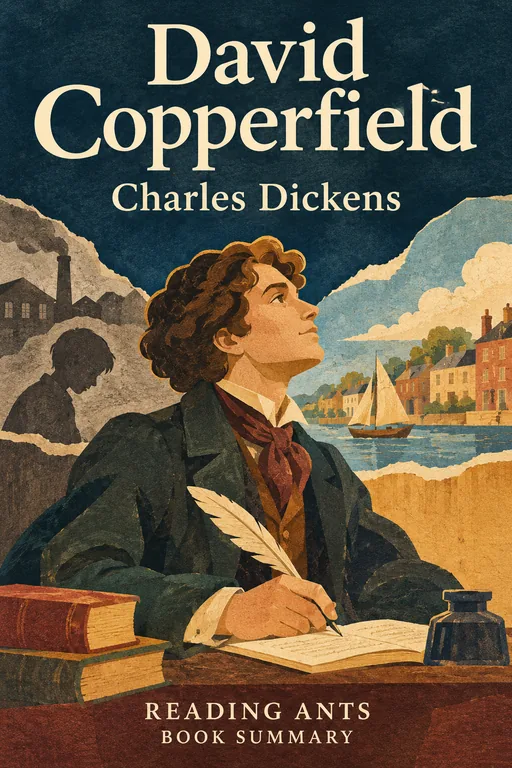
David Copperfield
Charles Dickens
From a sad childhood of cruelty and poverty to adult success as a writer, David Copperfield tells his own life story, with unforgettable friends and villains along the way.
📜 Classics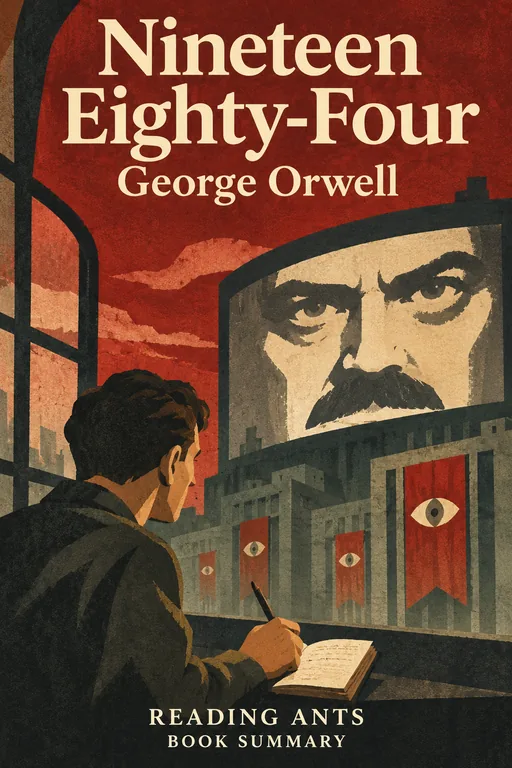
Nineteen Eighty-Four
George Orwell
In a future Britain ruled by an all-seeing Party, one man secretly rebels by keeping a diary and falling in love, and discovers just how completely a totalitarian state can crush the human mind.
📜 Classics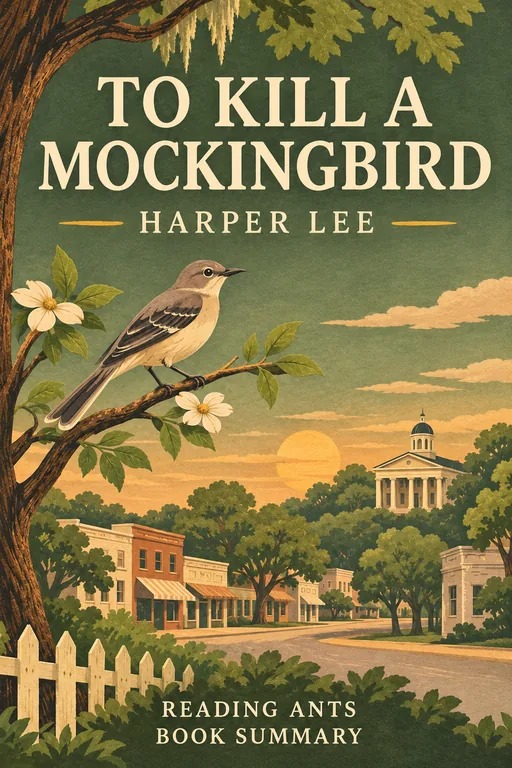
To Kill a Mockingbird
Harper Lee
In a small Alabama town in the 1930s, young Scout Finch watches her father, a lawyer, defend a Black man falsely accused of a crime, and learns hard lessons about prejudice, courage and seeing the world through other people's eyes.
📜 ClassicsWant something different?
Pick another topic and we will show you three books to start with.