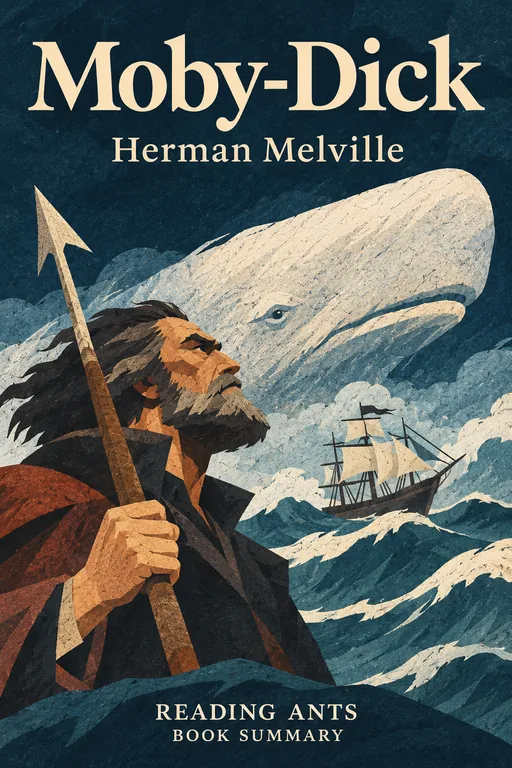
Moby-Dick: the longer summary
Before You Start (No Spoilers)
Moby-Dick is a huge, strange, marvelous book that is also a gripping sea adventure. A sailor signs on to a whaling ship that is led by a captain who has lost his leg to a giant white whale and is determined to hunt it down at any price. The captain, Ahab, is one of literature’s great characters: noble, mad, eloquent and doomed, dragging his crew with him to destruction. The story is told by a sailor who asks to be called Ishmael, who watches and wonders at everything.
But the book is much more than the chase. Melville stops the plot again and again to tell the reader about whales: how they are classified, how they are hunted, how oil is boiled, what the sailors eat, how a ship is steered. These chapters can feel slow, but they are often funny, poetic and full of awe, and they make the sea feel real. The book is also a drama, with speeches and soliloquies like a stage play, and an exploration of ideas about God, fate, race, democracy and obsession.
The novel was published in 1851, and its changes of pace are part of the reading experience rather than a simple delay before the chase. It rewards patience. It can be read in pieces; many readers skim the whale-science chapters on a first reading and return to them later.
It has scenes of whale hunting that are bloody, and the killing of whales is described in detail, as a normal part of the work of the time. A reader of thirteen or older who likes adventure and big ideas will find a lot to enjoy. What follows gives away the whole story, including the ending.
Who’s Who
- Ishmael: the narrator, an observant, humorous schoolteacher turned sailor.
- Queequeg: a tattooed harpooner from a Pacific island, Ishmael’s closest friend.
- Captain Ahab: the commander of the Pequod, with an whalebone leg and a vow of revenge.
- Starbuck: the first mate, a serious, religious Quaker from Nantucket, who opposes Ahab’s plan.
- Stubb: the second mate, easygoing and joking.
- Flask: the third mate, short and combative.
- Tashtego and Daggoo: the harpooners working with Stubb and Flask.
- Fedallah: the Parsee leader of Ahab’s previously concealed boat crew.
- Pip: a young Black cabin boy who loses his mind after being left alone at sea.
- Peleg and Bildad: the Quaker owners of the Pequod.
- Father Mapple: the preacher who gives the sermon on Jonah.
- Moby Dick: the huge white sperm whale.
Part One: Ishmael Goes to Sea
Ishmael’s restlessness. The book begins with Ishmael explaining why he goes to sea: whenever he feels gloomy, whenever he finds himself pausing before coffin shops or wanting to knock off people’s hats, he knows it is time to go to sea. He travels to New Bedford, Massachusetts, planning to sign on to a whaling ship.
The Spouter-Inn and Queequeg. The inn is full, and Ishmael is told he must share a bed with a harpooner who is out for the evening. When the man comes in, a huge, tattooed man with a shrunken head to sell, Ishmael is terrified. But Queequeg turns out to be kind, honest and dignified, and after a night together the two become friends. Queequeg, who is a prince in his own land and a worshipper of a small wooden idol, treats Ishmael as a brother. They decide to ship together.
Father Mapple’s sermon. Before leaving, the two friends go to a whalemen’s chapel where the old preacher, Father Mapple, preaches on Jonah, the prophet who ran from God’s command and was swallowed by a whale. It is an early hint of a main theme: what happens when a man defies a higher power.
Nantucket and the Pequod. They go to the island of Nantucket and sign on to the Pequod, a rough old whaling ship, with her bones decorated with the teeth of sperm whales. Her owners, two Quaker captains named Peleg and Bildad, are shrewd and stingy. They tell Ishmael that the captain, Ahab, is a strange, moody man who has lost a leg to a whale, but is a good man.
Part Two: The Voyage and Ahab
The captain appears. The ship sails on Christmas Day, and for several days there is no sign of Ahab. When he does appear, standing on deck with an whalebone leg and a scar down his face, his scarred face and commanding presence make a powerful impression on Ishmael. He walks the deck, staring into the sea.
The doubloon. One day Ahab gathers the whole crew and nails a gold doubloon to the mast, promising it to the first man to sight the white whale. He reveals his purpose: they are hunting Moby Dick, the whale that took his leg. Starbuck objects that it is blasphemous to take vengeance on a dumb animal, and that they are there to hunt whales for oil, not for revenge. Ahab answers that the whale is the mask of everything that torments him, and he demands the crew’s loyalty. He drinks with the harpooners, who swear to hunt the white whale, using the inverted tops of their harpoons as cups.
The crew. The Pequod has a crew from all over the world: Pacific islanders, Africans, Americans, Europeans, Asians. Among them are Ahab’s own secret boat crew, led by Fedallah, a dark, silent Parsee who is thought to be a kind of prophet or devil, and who has predicted Ahab’s fate.
Whales and whiteness. The first real hunts take place. Ishmael describes the thrill of lowering the boats, the pull of a harpooned whale dragging the boat in a Nantucket sleigh ride, the cutting up of the carcass, and the boiling of oil on deck. In between come the chapters on the species of whales and the history of whaling. One chapter, on the whiteness of the whale, tries to explain why the color white can be as terrifying as it is beautiful.
Part Three: The Gams
On the voyage, the Pequod meets other whaling ships, and each meeting, called a gam, adds to the story.
- The Town-Ho. A story told about a conflict between a sailor and an officer on another ship, ending with the white whale as an agent of vengeance.
- The Jeroboam. A ship whose crew has been struck by an epidemic, and whose prophet, Gabriel, predicts death for anyone who attacks the white whale. Ahab dismisses him.
- The Samuel Enderby. The captain of this English ship has lost an arm to Moby Dick, and he warns Ahab to leave the whale alone. He is more cheerful about it than Ahab.
- The Bachelor. A happy, loaded ship going home, with all its oil barrels full, in contrast to the Pequod.
- The Rachel. A ship whose captain begs Ahab to help him look for his twelve-year-old son, who is lost in a boat chasing Moby Dick. Ahab refuses. It makes his willingness to sacrifice another family’s hope especially clear.
- The Delight. A ship that has just lost men to the whale, and is burying a victim.
Pip. In one of the chases, a young cabin boy, Pip, panics and jumps from a boat. He is left alone for hours in the huge ocean. When he is rescued, he has lost his mind, and talks wildly. Ahab, in whom there is still a glimmer of humanity, takes him into his own cabin and treats him tenderly.
Part Four: The Last Chase
Defiance and warnings. As the voyage continues into the Pacific, Ahab destroys his quadrant because the instrument cannot answer the desire directing him. A later storm lights the rigging with strange fire, and he treats the danger as another occasion for defiance. Starbuck considers using a loaded musket against the sleeping captain but cannot bring himself to kill him. After the storm has reversed the compasses, Ahab makes a new needle, performing mastery before a frightened crew instead of accepting a reason to turn back.
A coffin changes purpose. Queequeg becomes seriously ill and asks the carpenter for a coffin. When he recovers, the object remains aboard. Later, after the ordinary life-buoy is lost during an attempted rescue, the coffin is sealed and adapted to replace it. Its eventual usefulness therefore has a practical preparation before the final wreck.
The first day. Ahab sights Moby Dick and claims the reward he promised. His boat approaches, and the whale breaks it in his jaws. Ahab and his men are left in the water, while the other boats remain afloat nearby. The ship eventually enables their rescue. This first day’s damage is not the destruction of every boat.
The second day. The next pursuit tangles the harpoon lines. Stubb’s and Flask’s boats are smashed together, and Ahab’s boat is thrown over and damaged as well. The crews are recovered, but Fedallah is missing. Ahab learns that the Parsee became caught in the line and went overboard. He refuses Starbuck’s renewed urging to stop.
The third day. The whale rises with Fedallah’s body bound to him by turns of rope. Ahab now sees a terrible meaning in the predicted first hearse: the whale carries the dead man. The chase continues, and Moby Dick turns on the Pequod and strikes her hull. The damaged ship begins to sink before Ahab’s last throw. The American-built vessel supplies the second hearse of the prophecy.
Ahab hurls his harpoon again. As he tries to clear the running line, a loop catches his neck and pulls him from the boat. The sinking ship’s vortex then draws down the remaining boat and wreckage. Tashtego is still fastening a flag to the mast as it disappears. A bird becomes caught with it, adding another disturbing image to the destruction rather than a final sign that anyone has mastered the sea.
The surviving witness. Ishmael had been thrown from Ahab’s boat and dropped astern before the final catastrophe. He is slowly drawn toward the fading vortex, where the coffin life-buoy rises beside him. He stays afloat on it through almost a day and night. On the second day the Rachel, still searching for its own missing people, finds him. He survives to tell a story in which survival is not a reward for commanding the voyage.
More Moments Worth Knowing
The prophecy. Late in the book, Fedallah, the Parsee, tells Ahab that before he dies on this voyage he must see two hearses at sea: the first not made by human hands, and the second made from wood grown in America. He also tells him that he himself will die before Ahab, and that Ahab can only be killed by rope. Ahab, who takes this to mean that he cannot die, becomes bolder, but each part of the prophecy turns out to have a double meaning. It is one of the book’s best examples of how Melville uses ominous predictions to build suspense.
The try-works. In one chapter, the crew boils whale blubber in two huge iron pots on deck at night, and the flames light the sails and the faces of the sailors. Ishmael, who is at the helm, briefly loses his bearings and puts the ship in danger. He realizes that his orientation at the helm has become dangerously confused, and the scene becomes a warning against looking too long into the fire, in other words, into dark thoughts. It is one of the book’s best pieces of writing.
The symphony. Just before the final chase, Ahab has a quiet conversation with Starbuck, in which he thinks of his wife and child back in Nantucket, and of his forty years at sea. For a moment he seems to doubt himself, and Starbuck sees a chance to persuade him to turn back. Then Ahab recovers and rejects the idea, saying that he is driven by something he cannot control. It is a scene of both great sadness and great tension.
A world of work. Besides the story, there are many chapters on the practical business of whaling: the ship’s carpenter, the blacksmith who makes Ahab’s harpoon, the sailors who go aloft to watch for whales, the cook who is scolded by Stubb for overcooking a whale steak. They make the Pequod a fully working world, and they offer a picture of democracy at work, in which highly skilled workers come from many different places, even though the captain retains extraordinary power over the whole community.
Whales and humor. Despite its tragic ending, the book is often funny. Melville teases the reader, makes jokes about academics, mocks his own method, and shows Ishmael laughing at the absurdities of life at sea. The humor makes the tragedy hit harder, because we have grown fond of these people.
Key Scenes Explained
Ishmael and Queequeg. The friendship between the two men is a counter-argument to the book’s darkness. They are from different worlds, but they treat each other with warmth and respect. It is one of the book’s pictures of an ideal, democratic brotherhood.
The doubloon. Ahab’s speech to the crew is a turning point: he binds the ship to his obsession. The coin on the mast becomes a symbol that each man interprets differently.
The whiteness of the whale. Melville’s essay on why white can be terrifying shows that the white whale is not just an animal. It is a blank page on which each person writes their own fears.
The Rachel. Ahab’s refusal to help the captain looking for his lost child shows how far he has gone from humanity.
Pip. The madness of the cabin boy is a human tragedy within the larger one, and Ahab’s tenderness to him is his last moment of grace.
The chase. The three days are among the most exciting sequences in literature, and the ending is not in doubt, but it is no less powerful.
Why It Still Matters
Ahab tries to turn a working voyage into the expression of one will. The mates, harpooners, carpenter, cook and lookouts have practical tasks, yet the captain’s private struggle directs where all that work goes. The doubloon helps convert a grievance into a shared pursuit by giving each observer something to desire.
Ishmael’s account repeatedly interrupts that narrowing vision. It considers tools, bodies, colors, beliefs and the difficulty of knowing what a whale means. Queequeg’s friendship and the coffin’s change of purpose provide alternatives to Ahab’s demand for conquest: an object meant for death becomes support for a survivor. The Rachel supplies another contrast. Its captain searches for a child, Ahab refuses to help, and the continuing search ultimately saves Ishmael. Those connections make obsession a question about obligations to other lives, not simply a spectacular personality trait.
What to Notice While Reading
- The shifts in style. The book moves from comedy to sermon, from science to drama, from adventure to philosophy. Watch how Melville changes voice.
- Ishmael’s role. He is both a character and an observer. Notice when he speaks as a participant and when he steps back.
- Symbols. The whale, the doubloon, the sea, the coffin and the colors black and white all carry meaning. Think about what each stands for.
- The crew. The ship is a small world with sailors from many countries. Notice how Melville portrays them and how they respond to Ahab.
- Foreshadowing. Omens and prophecies appear from the start. Notice how many of them come true.
Questions to Think About
- Why does Ahab hunt the whale, and is his reason one that you understand?
- Why does the crew follow Ahab, even when some of them doubt him?
- What does the white whale represent? Is it good, evil, or neither?
- Why do you think Melville gives so much space to the details of whaling?
- Why is Ishmael the only survivor, and what does that suggest about the book’s message?
How to Read It
Many readers find it helpful to read the plot chapters and the shorter dramatic chapters first, and to treat the whale-science chapters as optional. The first twenty chapters, up to the departure of the Pequod, are the most welcoming. An audiobook can also help, since the language is musical.
If You Liked Moby-Dick
Try Treasure Island for a lighter sea adventure, The Count of Monte Cristo for a story of obsession and revenge, Heart of Darkness for another dark voyage, or Robinson Crusoe for a story of survival.
Want the whole book?
A summary is a taste, not the meal. Here is where to find the full book.