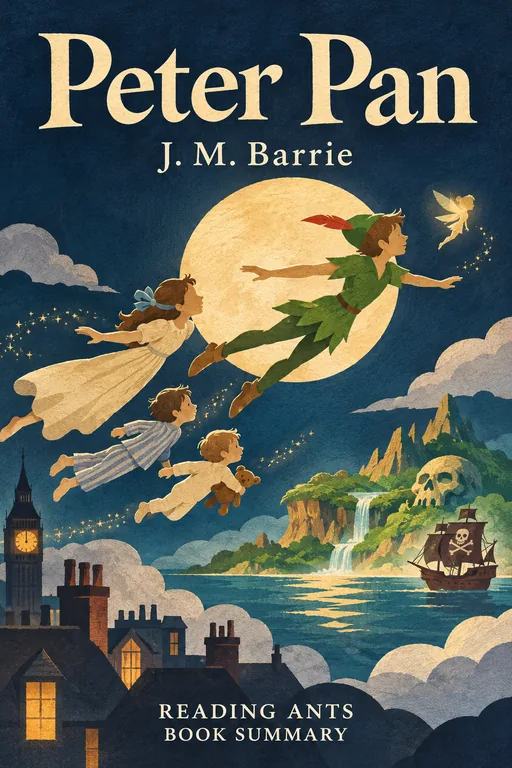
Peter Pan: the longer summary
In One Sentence
A magical boy who refuses to grow up flies three London children to Neverland, where they battle pirates led by the villainous Captain Hook, until Wendy realizes they must go home and grow up.
Before You Start (No Spoilers)
Peter Pan, published as the novel Peter and Wendy in 1911, follows children who leave a London nursery for an island of imagined adventures. Wendy, John and Michael Darling live in London with their parents and their dog-nurse, Nana. One night, Peter Pan, a boy who never grows up, flies into their nursery looking for his lost shadow. He teaches them to fly with the help of the fairy Tinker Bell and takes them to Neverland, an island of mermaids, fairies, Lost Boys and pirates. J. M. Barrie’s story is full of adventure and humor, but it also gently explores the joys and sadness of growing up.
Who’s Who
- Peter Pan: a cocky, brave and forgetful boy who refuses to grow up.
- Wendy Darling: a caring girl who becomes a mother figure to the Lost Boys.
- John and Michael Darling: Wendy’s younger brothers.
- Tinker Bell: a jealous, fiery little fairy.
- Captain Hook: the vain, villainous pirate captain with an iron hook for a hand.
- The Lost Boys: children who fell out of their prams and came to Neverland.
- Tiger Lily: a brave princess of the island’s native tribe.
- The crocodile: who swallowed a clock and hunts Hook.
- Mr. and Mrs. Darling and Nana: the children’s parents and their dog-nurse.
Full Summary
The Shadow
Mrs. Darling has noticed a strange boy at the nursery window. One night, Nana the dog snaps at him as he escapes, catching his shadow, which Mrs. Darling rolls up and puts away in a drawer. Later, while Mr. and Mrs. Darling are out to dinner and Nana has been chained in the yard, Peter returns with the fairy Tinker Bell to find his shadow. Wendy wakes and sews it back on for him.
Peter tells her that he ran away on the day he was born, because he heard his parents talking about what he would become as a man. He lives in Neverland with the Lost Boys, who have no mother to tell them stories. He invites Wendy to come and be their mother. Peter teaches Wendy, John and Michael to fly with wonderful thoughts and a sprinkle of fairy dust, and they fly out of the window toward Neverland, with Peter leading the way to the island.
Neverland
Neverland is full of adventure: the Lost Boys, the pirates led by Captain Hook, a tribe of island people including the princess Tiger Lily, mermaids, wild beasts and a huge crocodile. Long ago, Peter cut off Hook’s hand and fed it to the crocodile, which liked the taste so much that it follows Hook everywhere, hoping for more. It has also swallowed a clock, so its ticking warns Hook when it is near.
Tinker Bell, jealous of Wendy, tricks one of the Lost Boys into shooting her with an arrow. Wendy is saved because the arrow strikes a button Peter gave her. The boys build a little house around her, and Wendy becomes their mother, telling stories and caring for them in their underground home.
Adventures on the Island
The children have many adventures. At Mermaids’ Lagoon, Peter rescues Tiger Lily from pirates who have tied her to a rock to drown. Peter fights Hook and is wounded, and he and Wendy are stranded on the rock as the tide rises. Wendy escapes by holding onto a kite, and Peter floats away on a bird’s nest, facing the danger with his usual reckless curiosity. After this, Tiger Lily’s people guard the children’s home.
Captured by Pirates
As time passes, Wendy worries that her brothers are forgetting their parents. She tells the Lost Boys a story about a mother who always leaves the window open for her children to return. They all decide to go home with her, but Peter refuses to come, insisting he will never grow up.
Captain Hook attacks the island people and captures Wendy and the boys as they leave the underground home. While Peter sleeps, Hook poisons his medicine. Tinker Bell drinks it to save him and nearly dies, but Peter begs children everywhere who believe in fairies to clap their hands, and she recovers.
The Battle on the Ship
Peter boards Hook’s pirate ship, the Jolly Roger, ticking like the crocodile to frighten the pirates. Hidden in the cabin, he defeats the pirates one by one, frees the boys, and the boys win a great battle. Peter and Hook duel. Hook, beaten, desperately wants Peter to violate the code of behavior he prizes. He provokes Peter into kicking rather than stabbing him, and goes over to the waiting crocodile, taking satisfaction in what he considers his opponent’s bad manners.
Home Again
The children fly home. Mr. Darling, ashamed that he chained up Nana on the night they disappeared, has been living in the dog’s kennel as punishment. Mrs. Darling has insisted on keeping the nursery window open. Peter briefly tries to shut the children out so that Wendy will remain his, but relents when he sees their mother’s grief. The children slip back into their beds, and their mother’s joy is overwhelming. The Darlings adopt all the Lost Boys.
Peter refuses to stay and be adopted, because he does not want to grow up. He promises to return each spring to take Wendy to Neverland for spring cleaning, though he often forgets. Years pass, and Wendy grows up, marries and has a daughter, Jane. One night, Peter returns, still a boy, and is sad to see that Wendy is grown. He takes Jane to Neverland instead, and later Jane’s daughter. The cycle continues through new generations, combining the freshness of childhood with Peter’s inability to understand lasting attachments.
The Cost of Never Growing Older
The nursery contains a real family
Before the flight to Neverland, Barrie gives the Darling household everyday worries. Mr. Darling wants respect and is anxious about money and appearances. Mrs. Darling tries to understand her children’s imaginative lives. Nana performs the practical work of keeping them safe. Their home is affectionate, but it is not a place where nobody makes foolish decisions.
Mr. Darling’s treatment of Nana helps create the opening through which the children leave. He wants to assert his dignity and removes a guardian who understands danger better than he does. His later shame shows that the adult world has its own childish behavior. Growing up has not automatically made him wise.
Peter enters this family as someone who seems free from its worries. He can fly, travel between worlds and refuse the future adults expect. Yet he has come back for something as basic as his missing shadow. Wendy helps him repair it. Their first meeting already joins his wonderful independence to his need for care from somebody else.
Wendy is invited to play an unequal game
Peter offers Wendy adventure, but he also offers her a particular job. The Lost Boys want a mother to tell stories, organize their lives and provide comfort. Wendy is pleased by the importance of the role and begins performing it eagerly. Her brothers become part of a make-believe family while she carries much of its work.
This arrangement can feel happy and restrictive at once. Wendy gets authority, but much of that authority is domestic. Peter can remain the exciting boy who leads expeditions while she becomes responsible for remembering, soothing and caring. The novel reflects older expectations about what girls and boys should do, and modern readers can question those expectations without denying Wendy’s affection for the others.
The small house built around her after the arrow incident is a good example. It is both a rescue and a setting for the role the boys imagine for her. They protect her as someone precious, but they also decide what kind of figure she will be among them. Neverland allows invention while carrying familiar social rules into the fantasy.
Fairies and heroes can be cruel
Tinker Bell’s jealousy is not a harmless mood. It nearly leads to Wendy’s death. The fairy acts on an emotion without balancing it against another person’s safety. Barrie makes her tiny size and bright appearance coexist with a real capacity to injure someone. Being magical does not make a character good.
Peter can also be careless. His courage is extraordinary, and he readily undertakes a rescue, but he does not always understand the feelings other people attach to him. He lives strongly in the present, so an adventure that is unforgettable to Wendy can later fade from his mind. His freedom depends partly on not carrying the weight of memory as she does.
That makes the phrase about never growing up more complicated than it first sounds. Remaining a child preserves play, but Peter’s form of childhood can also prevent lasting sympathy. He is not simply the best possible boy. The narrative admires his energy while allowing the reader to see how painful it can be to love someone who keeps forgetting.
Danger gives the island its excitement
Neverland is attractive because it turns imagined games into apparently real events. Pirates, hidden homes, flying journeys and a ticking crocodile give the children dangers they can usually face as an adventure. Yet the possibility of injury and death keeps breaking through. The rescue of Tiger Lily places a person in genuine peril rather than merely providing colorful scenery.
The island’s portrayal of its Indigenous inhabitants reflects harmful stereotypes. They are treated as figures in a British child’s adventure world, rather than as a people described with care. A summary should not replace them with invented historical detail or pretend that the problem disappears because the setting is imaginary. It is part of the book’s limits.
The crocodile makes time itself part of the danger. Hook fears the sound that announces its approach. Peter seems to stand outside ordinary aging, while Hook hears a reminder that his life can end. Their conflict is therefore more than a contest between a mischievous boy and a villain. It brings together two very different relationships to time and fear.
Wendy’s story changes the direction of travel
The story Wendy tells about the parents waiting at home is meant as a familiar domestic tale. As she tells it, however, she realizes that her brothers are forgetting the people they left. Neverland’s pleasures have a cost: staying can weaken the ties that once seemed permanent.
Peter responds with a memory of returning to find a closed window and another child in his place. His story may explain his resistance to family life, but it does not prove that the Darlings have stopped loving their children. Wendy decides to act before the possibility becomes a permanent loss. She wants adventure to remain part of life, not replace every other relationship.
The Lost Boys’ decision to accompany her shows that a home offers something Peter cannot provide. They choose the chance to be adopted and to grow older. Peter’s refusal is not a victory shared by everyone. The group separates because they want different futures, and Wendy has to accept that she cannot make him want hers.
Rescue depends on sacrifices Peter did not plan
Tinker Bell’s response to the poisoned medicine reverses her earlier behavior toward Wendy. She now risks her own life to protect somebody she loves. Peter’s distress reveals how much he needs her, even when he normally behaves as though he can manage anything. The appeal to believing children makes the rescue reach beyond the island and into the audience.
The defeat of Hook is triumphant, but returning home brings a different emotional climax. Mrs. Darling has kept the window open, and the children can reclaim their places. Her waiting contradicts Peter’s assumption that mothers inevitably forget. Mr. Darling’s time in the kennel is comic, yet it also acknowledges that his pride helped cause the disappearance.
The final years are bittersweet rather than purely happy. Wendy changes; Peter does not. When he returns to find her grown, he has missed a life she can never repeat. Jane and then another generation become his companions. The cycle preserves Neverland, but it also leaves Peter outside the deeper continuity of a family. He can return to childhood indefinitely while the people who loved him learn to live beyond it.
Why It Still Matters
The book places a wish for permanent childhood beside evidence of what that wish excludes. Peter can repeat an adventure, but he cannot share Wendy’s growth through the years. His freedom is exciting partly because he does not experience memory and obligation as she does. That difference can also make him thoughtless about other people’s pain.
Wendy’s story moves in another direction. She experiments with being a mother in a make-believe household and then returns to a real family. Readers can question how narrowly that imagined role defines a girl’s future while still recognizing the care she offers the boys. The book gives her affection real force without making Peter capable of returning it on her terms.
The narrator also unsettles any easy division between childish fantasy and sensible adulthood. Mr. Darling’s vanity, the theatrical pirates and Hook’s obsession with appearances all show grown people behaving absurdly. Neverland is not the only place where a game can become dangerous. The shifts between comedy and loss make the novel an opportunity to think about what growing up should preserve and what it should change.
Key Takeaways
- Childhood is magical but brief. Neverland is wonderful, but children must grow up.
- Growing up brings love and responsibility. Wendy chooses home and family.
- Imagination is powerful. Belief and wonderful thoughts make flying possible.
- Mothers and home matter. The open window shows a parent’s endless love.
- Never growing up has a cost. Peter stays young but forgets the people he loves.
What We Can Learn
Peter Pan reminds us to treasure childhood and imagination. Playing, pretending and having adventures are important, and adults can keep a little of that joy and wonder too.
It also shows that growing up isn’t something to fear. Wendy’s choice to go home means gaining family, love and new experiences. Change can be sad, but it brings good things as well.
Finally, the open nursery window teaches about unconditional love. Families can forgive and welcome each other back, even after mistakes or long absences, and a home where someone is always waiting is a great gift.
Criticism and Counterpoints
The island’s Indigenous inhabitants are presented through demeaning stereotypes. The fantasy setting does not turn those descriptions into a careful account of any real people. Readers can recognize the role they play in the adventure while refusing the assumptions used to depict them.
Wendy’s domestic work also deserves attention. Peter and the boys want stories, comfort and household care, and those duties restrict the part she is invited to play. Her affection does not remove the inequality. Finally, the narrator’s tenderness is mixed with a severe judgment of children’s forgetfulness. The ending can feel sad because Neverland survives by replacing one generation with another, while Peter remains unable to share their lasting attachments. These tensions belong to the text itself; no claim about particular adaptations is needed to identify them.
Who Should Read It
This book is lovely read aloud to children from about 6 upward, and older readers can enjoy its humor and deeper themes alone. Adults often find it surprisingly moving. Families may want to talk about its old-fashioned stereotypes together.
What to Notice While Reading
- Who remembers. Wendy carries stories and family ties; Peter often forgets. Memory is one of the main differences between growing older and remaining unchanged.
- Care as work. Nana, Mrs. Darling and Wendy keep others safe in ways that attract less attention than sword fights or flying. Ask which activities make adventure possible.
- Shifts in tone. A joke can become sad or frightening within a paragraph. Barrie’s narrator does not let the story settle into uncomplicated cheerfulness.
- Hook’s concern with manners. His interest in correct behavior can sit beside cruelty. Looking respectable and acting morally are not the same achievement.
- The open window. It stands for the possibility of return, but also for the risk Peter believes he has already suffered: finding that one’s place has gone.
Questions to Think About
- Does Wendy choose her role freely, or do the boys limit her choices?
- When does Peter’s lack of memory seem delightful, and when does it hurt someone?
- Why does Wendy decide that her brothers must return home?
- What does Tinker Bell’s sacrifice reveal that her jealousy does not?
- At the end, would you rather share Peter’s unchanging life or Wendy’s changing one?
Want the whole book?
A summary is a taste, not the meal. Here is where to find the full book.