 Reading Ants
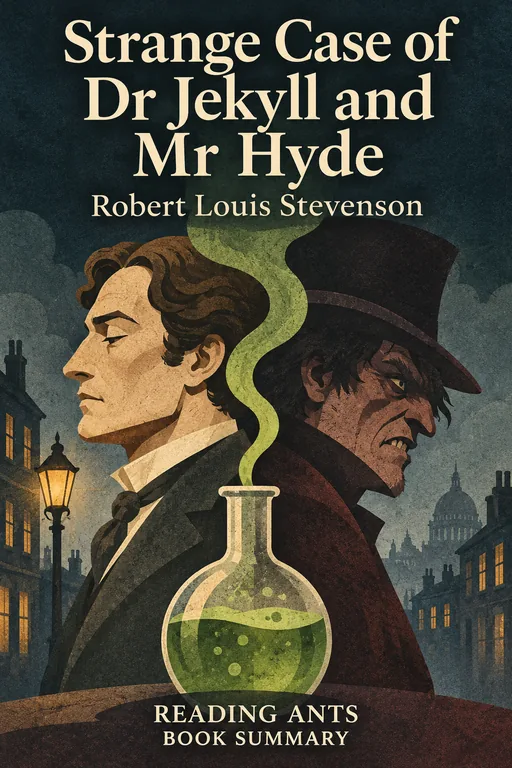
Strange Case of Dr Jekyll and Mr Hyde: the longer summary
In One Sentence
A respected London doctor creates a potion that gives his worst impulses a different bodily form, the brutal Mr. Hyde, but the darker self grows stronger until it takes control completely.
Before You Start (No Spoilers)
Strange Case of Dr Jekyll and Mr Hyde is a short gothic novella by the Scottish writer Robert Louis Stevenson, published in 1886. The story is told mostly through the eyes of Mr. Utterson, a calm, respectable lawyer in Victorian London, who becomes worried about his old friend, the kind and wealthy Dr. Henry Jekyll. Jekyll has made a strange will leaving everything to a mysterious man named Edward Hyde, who is small, ugly and violent, and who fills everyone who meets him with disgust. Utterson sets out to discover the connection between the two men. The narrative delays its answer through witnesses, letters and a final personal account, making the connection a mystery before explaining the experiment.
Who’s Who
- Dr. Henry Jekyll: a respected, kind-hearted doctor and scientist.
- Mr. Edward Hyde: a violent, cruel man who seems almost evil itself.
- Mr. Gabriel John Utterson: a loyal, reserved lawyer and friend of Jekyll.
- Dr. Hastie Lanyon: a doctor and former friend of Jekyll.
- Mr. Richard Enfield: Utterson’s distant relative.
- Poole: Dr. Jekyll’s faithful butler.
- Sir Danvers Carew: a kindly elderly politician.
Full Summary
A Violent Stranger
On a Sunday walk through London, Mr. Utterson and his relative Mr. Enfield pass a shabby door in a side street. Enfield tells a disturbing story: late one night, he saw a small, strange man knock down a young girl and trample over her as if it were nothing. A crowd forced the man to pay compensation, and he went through that door and returned with a check signed by a highly respected gentleman. The man’s name was Hyde.
Utterson is alarmed. He has in his safe a will written by his friend Dr. Jekyll, which leaves all of Jekyll’s property to Edward Hyde, and even says that if Jekyll disappears for more than three months, Hyde should inherit everything. Utterson fears that Hyde is blackmailing his friend.
An Uneasy Connection
Utterson waits near the door until he meets Hyde. Hyde is small and pale, with a sense of deformity that nobody can quite describe, and Utterson feels a deep disgust. He discovers that the door leads to the old laboratory at the back of Dr. Jekyll’s house. When he asks Jekyll about Hyde, Jekyll becomes uncomfortable and claims he can end his dealings with Hyde at will, asking Utterson to protect Hyde’s rights if anything happens.
A Death in the Street
About a year later, a maid looking out of her window sees Hyde beat a kind elderly gentleman, Sir Danvers Carew, to death with a cane in the street. Part of the broken cane is found, and Utterson recognizes it as one he gave to Jekyll. He leads the police to Hyde’s apartment, but Hyde has vanished.
When Utterson visits Jekyll, the doctor looks ill and swears he is finished with Hyde. He shows Utterson a letter supposedly from Hyde. But when Utterson’s clerk compares the handwriting with a note from Jekyll, he notices that the two scripts are almost the same, slanted differently.
A Friend Refuses to Explain
For a while, Jekyll seems happier, socializing with friends again. Then he suddenly shuts himself away. Utterson visits their mutual friend Dr. Lanyon, who has fallen gravely ill after a terrible shock. Lanyon refuses to speak of Jekyll and dies within weeks, leaving Utterson a sealed letter to be opened only after Jekyll’s death or disappearance.
The Locked Laboratory
One evening, Jekyll’s butler, Poole, comes to Utterson in terror. For days, Jekyll has been locked in his laboratory, sending out notes demanding a particular chemical, and the voice behind the door no longer sounds like his master. Utterson and Poole break down the door. They find Hyde dead on the floor after apparently taking poison, and wearing clothes far too big for him. There is no sign of Jekyll. On the desk lies a new will naming Utterson as heir, and a letter telling him to read Lanyon’s account and then Jekyll’s own confession.
What Lanyon Witnesses
Lanyon’s letter explains that Jekyll had asked him to fetch a drawer of chemicals from his laboratory and give it to a man who would come at midnight. The man was Hyde. Hyde mixed a potion in front of Lanyon and drank it. Before Lanyon’s eyes, Hyde’s body twisted and swelled, and he transformed into Henry Jekyll. The horror of what he saw destroyed Lanyon’s health.
Jekyll’s Account of His Choices
In his confession, Jekyll explains everything. He had always felt that humans have two natures, one good and one evil, constantly at war. He created a potion that could separate them. When he drank it, he became Edward Hyde, a pure form of his evil side, smaller because that side had been less used. At first Jekyll enjoyed the freedom of indulging his worst desires as Hyde, then returning to his respectable life.
But Hyde grew stronger. One morning, before the Carew murder, Jekyll wakes in Hyde’s body without having taken the potion. Alarmed, he avoids transforming for two months, then deliberately drinks again. It is during that return to Hyde that he murders Carew.
Afterward, Jekyll tries to give up Hyde and resumes a more sociable, charitable life. He later admits returning to unspecified wrongdoing in his ordinary identity, without deliberately transforming. While sitting in Regent’s Park, he changes into Hyde involuntarily. Unable to reach his chemicals safely, he appeals to Lanyon. Once restored to Jekyll, he finds that further changes keep coming without his consent and that he needs repeated doses to remain himself. New supplies of a necessary ingredient fail to work; he concludes that an unknown impurity in the original supply made the potion effective. He finishes his confession under the influence of the last remaining old powders, facing the loss of his own identity.
Interpretation: How the Mystery Builds Its Answer
The respectable lawyer begins with a plausible mistake
Utterson is a useful guide because he cares about other people without easily displaying emotion. He is willing to remain friends with men whose conduct he does not approve, and he prefers to avoid scandal. Those habits make him loyal, but they also encourage him to explain disturbing evidence in ways that preserve an ordinary social world.
Enfield’s story presents a puzzle about influence. Hyde behaves cruelly, yet he can obtain money carrying the authority of a respected name. Utterson knows that Jekyll has made unusual arrangements for Hyde in his will. Blackmail therefore seems more likely to him than an impossible physical transformation. It is an understandable theory built from incomplete evidence.
The lawyer’s error guides the reader. For much of the story, the question appears to be what hold a bad man has over a good one. The final documents change that question: why has a single man constructed a way to describe chosen wrongdoing as somebody else’s behavior? The mystery is moral as well as physical.
The house offers two entrances into one life
Jekyll’s comfortable home and the neglected laboratory entrance appear to belong to different worlds. One offers hospitality, status and friends; the other allows Hyde to enter with less public notice. Their connection gives a visible shape to the arrangement Jekyll wants for himself.
Utterson’s first encounter with Hyde does not produce a clear description. Witnesses feel something wrong but struggle to name a definite deformity. The repeated difficulty matters because the novella makes dislike seem immediate and bodily. Modern readers may question its association between a disturbing appearance and moral evil, even while recognizing how that device creates unease.
Hyde also has access. He is not simply a stranger haunting Jekyll’s door. The servants have instructions to obey him, and the will gives him a future claim. Those practical arrangements show preparation. Jekyll has not only discovered a transformation; he has organized a social space in which the transformed person can act with protection.
Murder makes concealment more difficult
The killing of Carew brings Hyde into a wider investigation. An elderly gentleman who appears to be behaving courteously meets sudden, excessive violence. The lack of an adequate practical motive makes Hyde’s conduct more frightening. He acts with a freedom from restraint that destroys the victim rather than gaining something necessary.
The broken cane links the crime to Jekyll without immediately explaining how. Utterson recognizes it because it was his own gift. An object from an ordinary friendship has become evidence in a murder inquiry. The clue makes the respectable household harder to separate from the violence outside it.
The handwriting comparison adds another connection. Guest can observe a likeness that Utterson does not know how to interpret. The evidence points toward shared identity, but the available social explanation is forgery or protection of a criminal. Stevenson lets readers see clues that remain almost impossible to understand within the assumptions the characters use.
Jekyll’s return to society is real but unstable
After Hyde disappears, Jekyll seems willing to live among his friends again. His renewed sociability suggests that he understands ordinary affection has value. It would be too simple to say that every generous act is a mask concealing a wholly wicked person. Jekyll’s problem is that care and destructive desire coexist in him.
He later withdraws again, and the change spreads fear through those who know him. Utterson cannot force an explanation from a friend who insists on privacy. The conventions protecting a gentleman’s independence now help keep an increasingly dangerous secret concealed.
The scene in which Utterson and Enfield speak to Jekyll at his window makes that concealment visible. For a moment the men seem close to ordinary conversation, then something on Jekyll’s face stops it. They retreat without being able to name what they have seen. The novella repeatedly puts recognition almost within reach before delaying a full account.
Lanyon’s account provides the impossible observation
Lanyon does not share Jekyll’s approach to scientific inquiry. Their estrangement begins before the final crisis, so his testimony comes from someone who is not eager to endorse Jekyll’s theories. His sudden illness is a consequence of an experience his previous understanding cannot contain.
The emergency request for chemicals makes him an unwilling participant. He retrieves the drawer and receives the visitor, but does not initially understand the purpose of either action. Hyde then offers him a choice about whether to witness the result. Curiosity brings the doctor past the last point at which he could remain ignorant.
The transformation supplies direct evidence of what the earlier clues only suggested. Hyde and Jekyll are not associates who can be separated by the police. Lanyon’s response shows knowledge itself becoming destructive within the gothic story. Seeing the truth does not equip him to live comfortably with it.
Jekyll mistakes separation for freedom from responsibility
His statement explains that the potion does not create a perfectly good counterpart to Hyde. Jekyll remains a mixture of motives, while Hyde concentrates the impulses he wants to indulge without damaging his public self. The experiment is therefore unequal from the start. It offers an outlet for wrongdoing without an equivalent creation of independent goodness.
At first, Jekyll treats the return transformation as a secure boundary. He can enjoy Hyde’s freedom, then recover his body, home and reputation. The arrangements surrounding Hyde allow him to imagine that consequences belong to the other name. Yet the desire to use those arrangements is Jekyll’s own.
The involuntary changes destroy the distinction he has relied on. Waking as Hyde and later changing in Regent’s Park mean that the supposed private outlet can appear where the respectable man expects safety. He must carry the means of reversing it and increasingly organizes his life around preventing exposure. What began as a promise of freedom becomes dependence.
The final shortage defeats the experiment’s claim to mastery
Jekyll assumes he knows the necessary ingredients, but fresh supplies no longer produce the desired effect. He concludes that an unknown impurity in the original material made the potion work. This is a crucial limitation: the scientist who has transformed his life cannot reliably reproduce or even fully identify the process.
Poole’s desperate errands show the failure from outside. The servants receive increasingly urgent demands and hear a voice that frightens them. Their concern is not a theoretical disagreement about the soul. They believe someone may be in mortal danger inside a room they cannot enter.
When Utterson and Poole break in, they find Hyde’s body and the documents needed to explain the absence of Jekyll. The story ends with Jekyll’s statement rather than with a long account of the community afterward. The reader is left with his effort to understand and partially excuse himself. His explanation is indispensable evidence, but it does not remove the need to judge the choices he describes.
Why It Still Matters
The mystery changes the reader’s question. At first Utterson seems to be investigating a bad man’s hold over a good friend. The final accounts require him, and the reader, to consider how one man has arranged opportunities to act under another name. The will, the servants’ instructions and the separate entrance make concealment a practical system, not merely an inward wish.
Jekyll’s account supplies essential evidence without becoming an excuse. He wants to distinguish his respectable self from Hyde’s acts, yet he describes having prepared and enjoyed the arrangement. His failure to reproduce the potion exposes another limit: obtaining an extraordinary result does not mean understanding it sufficiently to control it. The story combines these moral and technical failures. A reading focused on responsibility asks what Jekyll chooses before the transformations cease to obey him, as well as what happens once control is lost.
Key Takeaways (Interpretation)
- Jekyll cannot escape responsibility. His theory of divided motives does not make his chosen actions belong only to another name.
- Hiding our faults can make them stronger. Jekyll’s secret indulgence lets Hyde grow.
- Bad habits can take control. What starts as a choice becomes an addiction.
- Respectability can mask darkness. Victorian society’s obsession with reputation hides secrets.
- Science without ethics is dangerous. Jekyll’s experiment destroys him.
What We Can Learn
The story teaches us that we cannot simply separate ourselves from our mistakes or bad impulses. As a moral reading, his failure encourages admitting responsibility and accepting correction rather than treating a concealed identity as permission to harm.
It also shows how small choices can grow into habits that are hard to break. Jekyll believes he can stop whenever he wants, but each time it becomes harder. This is true of many habits, from excessive gaming to unhealthy behaviors.
Finally, Utterson’s loyalty reminds us to look out for friends who seem to be struggling. Asking questions and offering support can make a difference.
Criticism and Counterpoints
Hyde’s disturbing appearance repeatedly prompts moral disgust before witnesses can explain what they see. That association deserves questioning; a body that looks unusual is not real-world evidence of wrongdoing. The documents also leave many of Jekyll’s earlier pleasures unspecified, so readers should avoid supplying particular crimes or diagnoses that the story does not name. The unequal transformation matters as well: Jekyll is not made purely good when Hyde appears, and reducing the novella to two completely separate moral halves loses part of its argument.
Who Should Read It
This short book suits teens and adults who enjoy gothic horror, mysteries and psychological stories. It can be read in an evening. Readers who know the central secret can follow how the witnesses gradually assemble evidence, and how the final explanation changes earlier scenes.
What to Notice While Reading
- The order of information. The story gives witnesses, objects and documents before its full explanation. A rereading changes the meaning of apparently ordinary clues.
- Privacy and protection. Friendship and professional discretion help Utterson remain loyal, but can also delay intervention.
- Jekyll’s pronouns. Notice when he treats Hyde as another person and when he admits a shared desire or memory. The language can shift responsibility.
- The asymmetry of the experiment. Becoming Hyde does not make the remaining Jekyll purely good. This prevents the story from being a simple picture of two equal halves.
- Uncontrolled science. The unknown impurity exposes the distance between producing a result once and understanding it well enough to control it.
Questions to Think About
- Why is blackmail a reasonable explanation for Utterson to consider?
- What do the two entrances to Jekyll’s property suggest about his life?
- Does creating Hyde make Jekyll less responsible for Hyde’s actions?
- Why does the failure of the new chemical supplies matter beyond the immediate plot?
- How much should readers trust the final statement as an account of Jekyll’s motives?
Want the whole book?
A summary is a taste, not the meal. Here is where to find the full book.