 Reading Ants
The Adventures of Tom Sawyer: the longer summary
Before You Start (No Spoilers)
The Adventures of Tom Sawyer is a comic novel about boyhood on the Mississippi River in a small Missouri town, written by Mark Twain and based partly on his own childhood in Hannibal. The hero, Tom, is a clever, restless, mischievous boy who hates school and church and loves games of pirates and robbers. He is funny, vain, brave and sometimes selfish, and he gets into almost every kind of trouble a boy can.
The book is not just a collection of pranks. In the second half, the story turns serious: Tom sees a murder, hides a terrible secret and eventually has to decide what is more important, his own safety or doing what is right. Twain mixes comedy and real danger with great skill, and the final cave scenes are some of the most suspenseful in American fiction.
It was written in the 1870s, and it reflects the attitudes and language of the time. Some characters, especially the Native American and Black characters, are portrayed in ways that now seem unfair, and some editions use an offensive word. Twain was gently mocking his own world in places, but not always as sharply as modern readers would like. It is a good idea to read it with that in mind. For readers of about ten and older, it is a classic adventure with a lot of humor.
What follows gives away the whole story, including the ending.
Tom and the Town
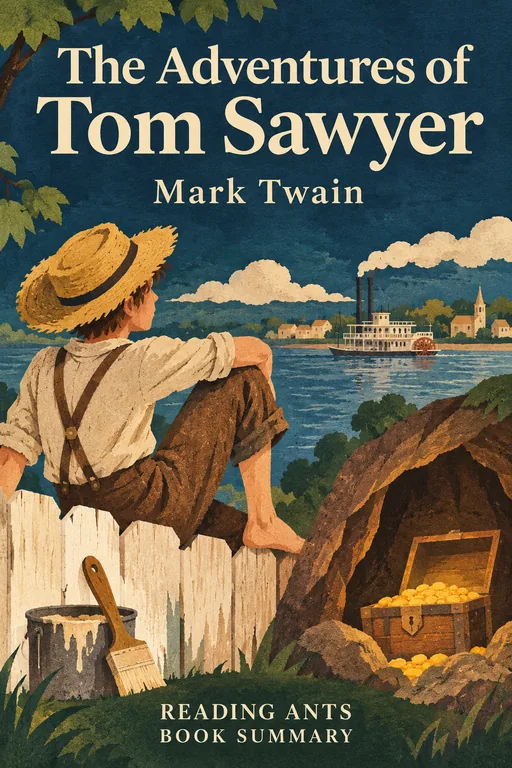
Aunt Polly and her nephew. Tom lives in the town of St. Petersburg with his Aunt Polly, a kind woman who loves him but is constantly trying to catch him in mischief. His younger half-brother Sid is the model child, though a tattletale, and his cousin Mary is kind. Tom is caught stealing jam and escapes, plays hooky from school and gets into a fight with a new boy in town. As a punishment, Aunt Polly orders him to whitewash the long fence on a Saturday morning. Tom is miserable until he has an idea. When friends come by, he pretends that whitewashing is so much fun that he would not trade it for anything. One by one, the other boys beg to take a turn and even pay him in apples and marbles for the privilege. By the afternoon, the fence is painted three times over, and Tom has become rich in boyhood treasures. It is a famous scene about how people want what seems hard to get.
Becky and the church. Tom falls in love with Becky Thatcher, the new girl in town and the daughter of Judge Thatcher. He tries to impress her with tricks and by showing off. At Sunday school, he trades the tickets he got for whitewashing for the Bible prize, a trick that is soon found out when he is asked a simple question. In church, a pinch-bug that Tom brings in his pocket gets loose and causes chaos during the sermon.
Huckleberry Finn. Tom’s friend Huckleberry Finn is the son of the town drunk. He lives outdoors, never goes to school and is the envy of all the boys because he is free. Tom and Huck share an interest in superstitions and cures, such as using a dead cat to cure warts at midnight in the graveyard.
The Graveyard
A murder. At midnight, Tom and Huck go to the cemetery with their dead cat. They hide as three men arrive: Dr. Robinson, who has come to dig up a body, and two companions, Injun Joe, a half-Native American troublemaker, and the town drunkard Muff Potter. There is an argument over money. Injun Joe stabs the doctor with Muff Potter’s knife while Potter is knocked unconscious. When Potter wakes up, Joe tells him he did it. Tom and Huck, terrified, flee. They swear an oath in blood never to speak a word of what they have seen.
The secret. The next day, the town is full of the news. Muff Potter is arrested and, when he is shown the knife and the body, he believes he did it. Tom is full of guilt, because he knows the truth. He avoids school, has nightmares and even sneaks food to Potter in jail.
Pirates on the Island
Running away. After Becky is angry at him and Aunt Polly punishes him, Tom decides life is not worth it and runs off with Huck and his friend Joe Harper to be pirates. They paddle to Jackson’s Island in the middle of the river, set up camp and enjoy the freedom of eating when they like and sleeping where they like. At first it is a wonderful life, but they start to feel homesick.
Their own funeral. The boys overhear people in the town searching for their bodies, and learn that everyone believes they have drowned. A funeral service is planned. Tom sneaks home at night, hides under Aunt Polly’s bed and hears how much she and Joe’s mother grieve for them. He nearly gives himself away but decides to wait. On Sunday, as the town gathers in the church to mourn, the three boys walk in the door. The congregation is overjoyed, and the boys are celebrated as heroes. Tom, however, is thrilled with his own adventure.
The Trial
Muff Potter’s day in court. The trial of Muff Potter begins. The lawyer for the defense makes a poor case. Then, to everyone’s surprise, he calls Tom to the stand, and Tom, after hesitating, tells the story of what he saw, naming Injun Joe as the murderer. Injun Joe leaps up and escapes through a window. Potter is freed, and Tom is hailed as a hero. But Tom and Huck are afraid, because Joe is still at large.
The Treasure Hunt
Digging for gold. Tom and Huck decide to look for buried treasure, as they have read in stories. They try several spots with no luck. Then they decide to look in a haunted house, which turns out to be where Injun Joe and another man are hiding. The boys hide upstairs and overhear the men uncover a box of gold coins buried under the floor. The men decide to move the treasure to a safer place, a place they call Number Two. The boys cannot find out where that is, and Huck begins to follow Joe around town to find out.
The picnic and the cave. Becky and Tom, who have made up, go on a picnic with the other children to McDougal’s Cave, a large, well-known cave near the town. Tom and Becky wander away from the group, get lost, and run out of candles. For days they are lost in the dark. Tom is brave and tries to find the way, and at one point he sees a figure in the distance: it is Injun Joe, hiding in the cave. Finally Tom finds a way out. The town is overjoyed at the rescue, and the judge orders the cave entrance to be sealed with an iron door.
Injun Joe’s end. When Tom hears about it, he is horrified. He tells the judge that Joe was inside. When they open the door, Injun Joe is dead of starvation, with his knife worn down from trying to cut his way out. Tom is moved despite himself.
The money. Tom and Huck realize that Number Two was a place inside the cave. They find the treasure, a large amount of gold, and become the richest boys in the town. The money is invested for them, and the judge looks after Tom’s share. Huck is adopted by the Widow Douglas, who tries to give him an education, although he finds being civilized very hard.
More Scenes Worth Knowing
Becky’s torn book. Becky Thatcher secretly peeks into the schoolmaster’s private book, an anatomy text that he keeps locked in his desk, and tears a page when Tom startles her. She is terrified of the punishment, and Tom, who sees what happened, says nothing at first. When the schoolmaster demands to know who did it, Tom suddenly stands up and takes the blame and the whipping. Becky is moved and from then on sees Tom as a hero. It is one of the sweetest moments in the book and one of the first signs that Tom’s loyalty is real.
Examination Day. On the last day of the school year, the townspeople gather to watch recitations. Tom and the other boys have decided to get back at the schoolmaster, a stern man who is secretly vain about his appearance. A cat is lowered from the attic on a string and snatches the schoolmaster’s wig, revealing a bald head that has been painted gold by a sign painter. The schoolmaster is humiliated and the children are delighted. The scene shows the book’s love of mischief and its sharp view of authority.
The Spaniard in the haunted house. When the boys hide upstairs in the old haunted house, they see Injun Joe disguised as a deaf Spanish stranger. They overhear him and his partner talking about an earlier crime and then digging up a hidden box of gold coins. A floorboard breaks under the boys, and they are nearly discovered. Terrified, they decide that they must find out where the gold is going. Huck follows the men through the town night after night.
The Widow Douglas saved. One night Huck overhears Joe and his partner plan to take revenge on the Widow Douglas, a wealthy and kind woman who is the widow of a man who once punished Joe. Huck, brave but frightened, runs to the nearby house of an old Welshman and tells him, and the Welshman and his sons arrive in time to scare the men off. The widow is spared. Huck, in return, is cared for during a fever, which gives him his first taste of kindness from adults. He later becomes her ward.
The long dark. In the cave, Tom and Becky lose track of time, and their candles burn low. Tom tries one passage after another and marks each with smoke from his candle. At one point he hears voices and sees Injun Joe, and Tom keeps his own counsel, to avoid giving them away. When he finally sees a speck of daylight through a narrow opening, it is a half-mile away from the main entrance. The story is exciting, but it also shows Tom behaving responsibly: he comforts Becky, shares the last of the cake and tries to keep her hopeful.
Huck and the new life. At the end, Huck, now rich, has to live in a house, wear shoes and attend church. He is not happy, and he runs away. Tom finds him and persuades him to return, on the condition that he join a band of robbers. It is a typically Twain-like ending: comic, and a hint at the questions that would be taken up in Huckleberry Finn.
Who’s Who
- Tom Sawyer: the hero, imaginative, vain, clever and loyal when it counts.
- Huckleberry Finn: Tom’s friend, a free-spirited outcast with practical sense.
- Aunt Polly: Tom’s guardian, strict but loving.
- Sid and Mary: Tom’s half-brother and cousin, who are better behaved than he is.
- Becky Thatcher: the judge’s daughter, with whom Tom is infatuated.
- Judge Thatcher: Becky’s father, a respected man in the town.
- Injun Joe: the murderer and villain.
- Muff Potter: a kind-hearted drunk who is wrongly accused.
- Dr. Robinson: the doctor who is murdered in the graveyard.
- Joe Harper: Tom’s friend and fellow pirate.
- The Widow Douglas: a wealthy, kind widow who takes in Huck.
Key Scenes Explained
The whitewashed fence. It is the book’s most famous scene and a joke about human nature: the more difficult something seems, the more people want it. It also shows Tom’s cleverness, which is the basis of his charm.
The graveyard. The tone changes here. The boys’ pranks are replaced by a real crime, and Twain uses the contrast to show that childhood games and the adult world exist side by side.
Their own funeral. This scene is both funny and moving. It shows how Tom’s love of attention conflicts with his love for the people who care for him, and it is the first time he sees himself as others see him.
The trial. Tom has to choose between safety and honesty, and, though scared, he speaks. It is his first truly brave act.
The cave. The darkness and the sense of being lost are very effective. Here Tom shows his bravery and kindness, and the story shows that he has grown up a little.
A Note on Language and Attitudes
Twain wrote in the voices of his time and place, and the dialogue is full of regional speech that may look strange on the page. Reading a few lines aloud makes it easier. Some characters use words and ideas about race that are offensive today, and Twain does not always challenge them in this book. If you read it with a parent, teacher or friend, it can lead to a good conversation about how books from the past should be read.
Why It Still Matters
Tom Sawyer is probably the most famous American boyhood story. Its picture of a free childhood by the river has shaped how Americans think of the Midwest and of growing up. It is also a very funny book, with Twain’s sharp observations of schools, churches and small-town manners. Its sequel, Adventures of Huckleberry Finn, is a deeper and more serious book, and many readers think it is Twain’s masterpiece, but Tom Sawyer is the gentler and easier of the two.
What to Notice While Reading
- Showing off. Tom does almost everything to be noticed. Notice how often he is trying to impress someone.
- Superstition. The boys believe in cures, omens and charms. Twain treats them with gentle humor.
- Childhood and danger. The book moves between comic scenes and dark ones. Look at what each type of scene tells us about Tom.
- Courage. Tom does not always do the right thing at once. Notice when he does, and what it costs him.
- Adults. The adults in the book are often foolish or unfair. Think about how Twain wants us to see them.
Questions to Think About
- Why does Tom keep his secret for so long, and what makes him finally speak?
- Is Tom a good person? How does he change over the course of the book?
- Why is Injun Joe both frightening and, in the end, pitiable?
- What does the whitewashing scene tell us about people?
- How should a modern reader deal with the book’s attitudes about race and class?
If You Liked Tom Sawyer
Try Adventures of Huckleberry Finn for the darker, deeper sequel, Treasure Island for another story of boys and buried treasure, Anne of Green Gables for a different kind of mischief, or The Wind in the Willows for another story of friends and freedom.
Want the whole book?
A summary is a taste, not the meal. Here is where to find the full book.