 Reading Ants
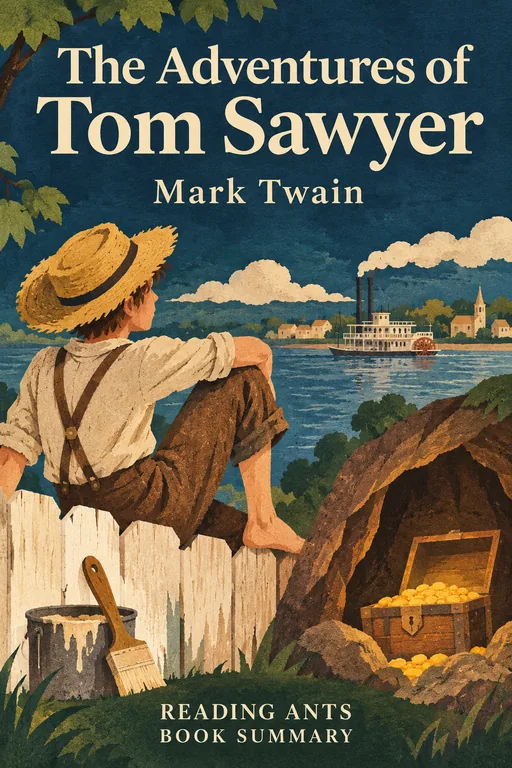
The Adventures of Tom Sawyer
Tom Sawyer, a mischievous, imaginative boy in a small Mississippi River town, tricks his friends into doing his chores, witnesses a murder, runs off to be a pirate and eventually finds treasure in a cave.
Overview
The Adventures of Tom Sawyer is a novel by Mark Twain, published in 1876. It is set in the fictional town of St. Petersburg, Missouri, based on Twain’s boyhood town of Hannibal, in the 1840s. The story follows a series of adventures of Tom, a clever, restless boy who lives with his Aunt Polly and half-brother Sid, and who loves tricks, games and make-believe. The book is both a comic celebration of boyhood and, in its darker episodes, a story about fear and conscience. It gave rise to a sequel, Adventures of Huckleberry Finn, which many consider Twain’s masterpiece.
Main Characters
- Tom Sawyer: a clever, imaginative and mischievous boy who loves adventure.
- Aunt Polly: Tom’s loving, strict aunt who is raising him.
- Huckleberry Finn: the son of the town drunk, a free and ragged boy who is Tom’s friend.
- Becky Thatcher: the judge’s daughter, who is the object of Tom’s affection.
- Joe Harper: Tom’s best friend.
- Injun Joe: a violent, vengeful criminal who is the villain of the story.
- Muff Potter: a drunken man who is framed for a murder.
Full Summary
Tricks and Punishments
Tom is always in trouble. His Aunt Polly punishes him for playing hooky and for fighting by making him whitewash a long fence on a Saturday. Instead of working, Tom pretends that painting is a wonderful privilege, and gets his friends to give him treasures to take a turn. By the end of the day, the fence is painted three times, and Tom is richer. At school, he falls in love with the new girl, Becky Thatcher, whom he tries to impress. Tom shows off in class, performs tricks and tries to make her jealous, and in doing so gets into trouble with his teacher. When they briefly become engaged, he makes a mistake by mentioning another girl, and Becky is hurt and angry.
The Graveyard
One night, Tom and Huck go to the graveyard to try a superstitious cure for warts. There they witness a murder: Injun Joe kills Dr. Robinson, and frames the drunk Muff Potter. The boys are terrified, and swear a secret oath to tell no one. They write the oath in blood, thinking it will protect them from the murderer. But the horror of what they have seen weighs on them, and Tom cannot sleep or eat properly. Muff Potter is arrested, and Tom is tormented by guilt, as he knows the truth. He and Huck are afraid that Injun Joe would kill them if they speak.
Pirates
After a quarrel with Becky, and with Aunt Polly, Tom runs away with Joe Harper and Huck to Jackson’s Island in the river, where they play at being pirates. They enjoy the freedom, but soon become homesick. Meanwhile, the town thinks the boys have drowned, and prepares a funeral. The boys sneak back and hide in the church gallery, watching their own funeral, and then appear to the astonishment and joy of everyone.
The Trial
At the trial of Muff Potter, Tom’s conscience overcomes his fear, and he testifies against Injun Joe. Injun Joe escapes through a window. The town hails Tom as a hero. But the boys’ fear of Injun Joe does not end, and he is believed to still be in the area, plotting revenge. Tom has nightmares about him, and Huck, who lives on the edge of town, keeps his eyes open. The boys hear rumors that a stranger has been seen near the old houses.
Treasure and the Cave
Tom and Huck hunt for buried treasure, and stumble across Injun Joe and a partner hiding stolen gold. Becky persuades her mother to give the long-promised picnic, and Tom goes with the crowd of children by ferry to McDougal’s Cave, a vast cavern. That night, while the children head home, Huck overhears a plot against the Widow Douglas and, with the help of a Welsh farmer, saves her. Meanwhile, Tom and Becky have wandered away from the others and are lost in the dark, and the town only realizes the next morning that they are missing. They spend days in the cave and nearly starve. Tom glimpses Injun Joe there, hiding in the dark, and at last finds a distant opening, through which they escape. The town celebrates.
Fortune
After the rescue, Judge Thatcher, Becky’s father, has the cave’s main entrance sealed. When Tom tells him that Injun Joe was inside, the entrance is opened and Injun Joe is found dead. Later, Tom and Huck go back to the cave and find the stolen treasure of Injun Joe. The treasure, a large sum of money, is invested for them, and Huck is taken in by the Widow Douglas, though he finds civilized life stifling. Tom promises that they will form a gang of robbers when Huck is ready, and the story ends on a note of friendship.
Why It Matters
The Adventures of Tom Sawyer is one of the best-known American novels, and the character of Tom has become a symbol of boyish mischief and imagination. The whitewashing scene is one of the most famous in literature, and has become an expression of how to make work seem like fun. The book has been adapted many times for stage, film and television.
It also helped to define a new kind of American writing based on the speech and scenes of ordinary life, and made Twain’s early reputation, though it was less successful at first than his other books.
Key Takeaways
- Imagination can turn work into play. Tom persuades his friends to paint the fence.
- Conscience can overcome fear. Tom testifies to protect an innocent man.
- Childhood is full of adventure. Games, pirates and treasure fill Tom’s days.
- Friendship is loyal. Tom, Huck and Joe stand by each other.
- Society imposes rules. Huck struggles with respectability.
What We Can Learn
The story shows that creativity and a sense of fun can make dull tasks more interesting. Tom’s trick, though dishonest, reveals something about human psychology: people value what seems rare or hard to get.
It also shows moral courage. Tom’s decision to tell the truth in court, despite danger, is the turning point of his growth.
Finally, it reminds us of the freedom and imagination of childhood, and the importance of the friends who share it. Reading it can make us nostalgic for summers when the biggest problem was a chore and the biggest adventure a day on the river.
Criticism and Counterpoints
Modern readers criticize the book’s racial language and attitudes, particularly its use of offensive terms and the portrayal of Native American and Black characters, such as Injun Joe, who is a stereotyped villain. The book has been challenged in schools for this reason, and some editions have changed words.
Others find the episodic plot loose, and the tone changing from comedy to horror. Some say that Tom is a trickster who is rewarded for deceit. Still, the book’s humor and its picture of boyhood remain appealing.
Who Should Read It
This book suits readers from about age ten up to adults. The language is old-fashioned, and some of the vocabulary and attitudes are outdated, so adults may want to discuss them. It has some scary scenes, such as the murder and the cave.
Want the whole book?
A summary is a taste, not the meal. Here is where to find the full book.
You reached the end 🎉
Nicely done. Mark this one as read, and we will suggest what to read next.
Read this next
Adventures of Huckleberry Finn
Mark Twain
A runaway boy and an escaped enslaved man float down the Mississippi River on a raft, and as they face swindlers, feuds and danger, the boy learns to follow his conscience rather than the racist rules of his society.
📜 Classics
Little Women
Louisa May Alcott
Four very different sisters grow up together in a loving but poor family in New England during and after the American Civil War, learning about love, ambition, loss and finding their own paths in life.
📜 Classics
Treasure Island
Robert Louis Stevenson
A boy who finds a pirate's treasure map sails to a distant island, only to discover that the ship's charming one-legged cook is the leader of a band of pirates who want the gold for themselves.
🧸 Children's Books
Anne of Green Gables
L. M. Montgomery
A talkative, imaginative red-haired orphan is sent by mistake to an elderly brother and sister who wanted a boy, and she wins their hearts and fills their quiet farm with life.
🧸 Children's Books
The Call of the Wild
Jack London
Buck, a big, pampered dog stolen from his comfortable California home, is sold into the freezing Yukon gold rush as a sled dog, where he learns to survive and eventually answers the call of the wild.
📜 Classics
Pride and Prejudice
Jane Austen
Quick-witted Elizabeth Bennet and the proud, wealthy Mr. Darcy badly misjudge each other, and only by facing their own faults do they find their way to love.
📜 ClassicsWant something different?
Pick another topic and we will show you three books to start with.