 Reading Ants
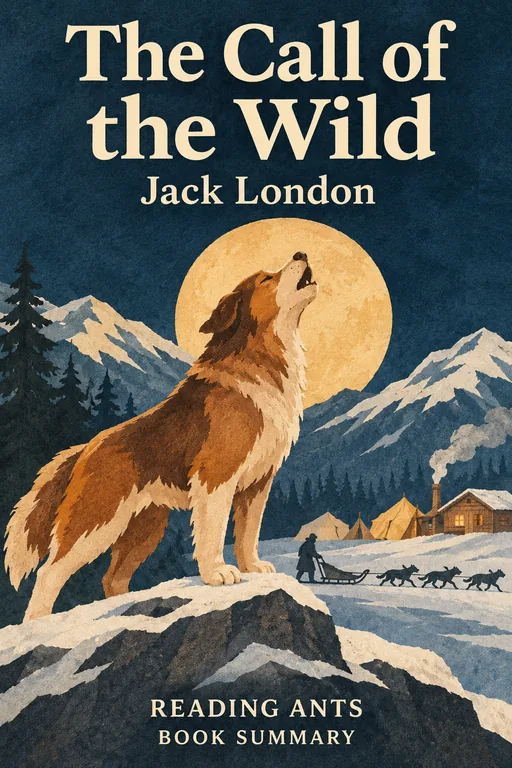
The Call of the Wild: the longer summary
In One Sentence
Buck, a big, pampered dog stolen from his comfortable California home, is sold into the freezing Yukon gold rush as a sled dog, where he learns to survive and eventually answers the call of the wild.
Before You Start (No Spoilers)
The Call of the Wild is a short adventure novel by Jack London, published in 1903. It is set in the 1890s during the Klondike Gold Rush, when thousands of people rushed to northwest Canada to look for gold, and strong dogs were in great demand as sled animals. The narrative follows northern work through Buck’s changing senses, habits and relationships. Told from Buck’s point of view, the story shows how a civilized dog learns the law of club and fang, and how his instincts reawaken. It is a story about survival, natural selection and the pull of wildness, with different kinds of human authority repeatedly tested against the animals’ actual needs.
Who’s Who
- Buck: a large St. Bernard and Scotch shepherd mix who is strong, intelligent and proud.
- Judge Miller: Buck’s kind first owner in California.
- The man in the red sweater: the man who trains Buck with a club.
- Spitz: the cruel, cunning lead dog who is Buck’s rival.
- François and Perrault: French-Canadian mail couriers who drive the sled.
- Hal, Charles and Mercedes: inexperienced and careless gold seekers.
- John Thornton: the kind man who saves Buck’s life and wins his love.
Full Summary
Stolen
Buck lives happily on Judge Miller’s estate in the Santa Clara Valley of California, ruling over the other dogs. But a gardener’s helper, who has gambling debts, sells him to a stranger. Buck is put in a crate and shipped north, where he is beaten with a club by a man in a red sweater, who teaches him that a man with a club is a master to be obeyed, but not necessarily befriended. Buck is sold to two couriers, Perrault and François, who take him to the frozen Yukon.
The Law of Club and Fang
In the north, Buck sees brutal sights. He watches in horror as a friendly dog, Curly, is killed by a pack of huskies in a few seconds. He learns that in this land, there is no mercy, and that the strong survive. He learns to sleep in the snow, to find food and to steal to stay alive. He pulls a sled, and learns to work in a team. His old instincts begin to wake up.
The Rivalry with Spitz
Spitz, the lead dog, resents Buck’s growing strength and leadership qualities. The rivalry grows, with Buck undermining Spitz’s authority, and eventually erupts in a fierce fight after a hare chase, in which Buck defeats Spitz, whom the rest of the pack then finishes off, and Buck takes his place as leader. He becomes an exceptionally effective lead dog. When the two couriers are reassigned, the team passes to other mail drivers, who are competent but work the dogs to exhaustion.
Hal, Charles and Mercedes
Buck’s team is then sold to three inexperienced travelers, Hal, Charles and Mercedes, who overload the sled, ignore the advice of others, feed the dogs badly and treat them cruelly. The dogs are starving and exhausted. When they reach the camp of John Thornton, he warns them that the ice is rotten, but they do not listen. Buck, too weak to rise, refuses to go onto the ice. Hal beats him, and Thornton cuts him free. The party continues and the sled breaks through the ice, and Hal, Charles, Mercedes and the dogs still harnessed to the sled are lost, while Buck stays behind with Thornton.
John Thornton
Thornton nurses Buck back to health, and Buck develops a passionate attachment unlike the more formal relationships he had in California. He saves Thornton’s life, and Thornton, in turn, takes pride in Buck. In a bet, Buck pulls a sled loaded with a thousand pounds, breaking its runners free from the frozen snow and winning a large sum for Thornton, who uses it to search for a lost gold mine. Buck is devoted to him, but he begins to hear a call from the forest, and to roam out into the wild.
The Call
While Buck is away hunting, a group of Yeehat Indians attack the camp and kill Thornton. Buck, furious, kills several of them and finally wins revenge. With no ties to humankind, he answers the call of the wild and joins a pack of wolves. He becomes their leader, and in the years that follow, he is known as a legend, the Ghost Dog of the Yukon, who returns each summer to the valley where Thornton died.
Buck’s Changing Education
The theft destroys an entire set of expectations
In California, Buck’s strength supports his confidence because the estate is a place where that strength is respected. He understands the people and animals around him and expects his position to continue. Being sold removes not only his home but the rules by which he knows how to behave. Human beings who once seemed predictable become captors with purposes he cannot understand.
The journey north teaches him helplessness before it teaches him adaptation. Confinement and rough handling prevent him from using the authority he enjoyed at Judge Miller’s. When he fights the man with the club, physical courage does not protect him. He has to learn that a weapon changes the balance between bodies.
His submission is practical rather than affectionate. He understands that continued attack will bring continued pain, but he does not mistake the man’s power for goodness. That distinction matters throughout the book. Buck can recognize an order he must obey while reserving trust and love for someone who treats him differently. His intelligence includes the ability to distinguish kinds of human authority.
The team is a workplace with dangerous rules
Curly’s death shows Buck that behavior suited to friendly company can be fatal in another setting. Falling among the fighting dogs leaves her exposed, and the attack becomes collective. Buck learns to avoid the same position. The incident changes how he moves and how he judges other animals, making alertness a condition of survival.
Learning the harness is less spectacular but equally necessary. Dave and Sol-leks are experienced workers who correct mistakes because a tangle delays and exhausts the team. Their stern instruction makes sense within a shared task. They are not interchangeable with Spitz’s attempts to dominate Buck through rivalry. London gives the dogs different temperaments and different relationships to work.
Buck also learns how to preserve heat and energy. Sleeping in snow, eating quickly and finding extra food become skills. These changes do not happen because someone explains a northern rulebook to him. He observes what succeeds, suffers when he fails and adjusts. His body and habits change together under pressure.
Becoming a leader includes a choice about work
The conflict with Spitz develops while the team still has to travel. Buck’s resistance undermines discipline before he is able to replace the leader. That means his rise has costs for the group as well as benefits for himself. The eventual fight is the culmination of a struggle over authority, not merely an isolated encounter between two angry dogs.
After Spitz is gone, Buck refuses to accept a lesser position. The drivers try to manage the team according to their own expectations, but he makes clear that he intends to lead. His insistence shows confidence earned through the conditions he has survived. Once placed at the front, he demonstrates ability by improving the team’s performance.
Yet successful leadership cannot protect the dogs from the demands imposed on them. Competent drivers can understand animals and still work them beyond reasonable limits. The mail service needs movement, and the exhausted team continues because the system demands it. Buck’s growing strength exists inside an economy that values the dogs largely for what they can carry.
Dave’s suffering complicates the meaning of endurance
Dave is closely attached to his place in the traces. When illness makes pulling painful, being removed from work distresses him. He struggles to remain where he knows how to function. The scene makes labor part of identity, rather than simply a burden imposed from outside.
The drivers recognize his wish and allow him to continue for a time. Their sympathy cannot cure the illness, and the result is heartbreaking. A creature may want to perform a task even when doing so is destroying him. London does not turn Dave’s endurance into a simple example of admirable effort rewarded by success.
This episode also interrupts the idea that the strongest always prosper. Experience, discipline and devotion do not save Dave. The northern world contains accidents and bodily limits that no amount of will can overcome. Buck survives partly because he adapts, but survival should not be treated as proof that those who die lacked character.
Bad management becomes a form of cruelty
Hal, Charles and Mercedes bring possessions and assumptions unsuited to the trail. They do not understand how much a team can carry, how food must be planned or why experienced advice matters. Their mistakes accumulate. An overloaded sled slows travel; slow travel uses more supplies; bad feeding weakens the dogs further.
The humans respond to failure by quarreling and using force. They mistake the animals’ inability to continue for unwillingness. That error is central to their cruelty. A whip cannot replace food or rest, and an angry command cannot make dangerous ice safe. Their claim to authority has become detached from knowledge.
Thornton’s intervention breaks this pattern at the moment Buck can no longer move. Buck’s refusal to rise is not laziness. His body and instinct are registering a limit that Hal will not acknowledge. Cutting him free makes care a concrete action with immediate consequences. The other travelers’ decision to proceed then turns ignored knowledge into catastrophe.
Affection does not weaken Buck’s independence
Life with Thornton introduces a human bond unlike simple obedience. Buck watches him closely, seeks contact and worries about losing him. His devotion is active: he is willing to face danger for Thornton rather than merely remain near a source of food.
The great pulling wager makes that relationship visible in public. Other men measure Buck through weight, distance and money, while Thornton appeals to the connection between them. Buck’s effort wins resources for a new journey. The scene celebrates extraordinary strength, but the emotional center is his response to a person he loves.
During the later expedition, Buck has more freedom to roam. His attachment does not disappear when he explores, hunts or encounters the wolf. Instead, two attractions coexist. The forest offers a life increasingly suited to his instincts, while Thornton’s presence keeps drawing him back. The book takes time over this tension instead of pretending that one feeling immediately cancels the other.
The wilderness is neither a holiday nor a simple moral ideal
Buck’s hunting becomes demanding work. Pursuing the great moose requires patience, stamina and attention to the herd. He is moving toward a different way of living, but it still involves struggle and death. The forest is not a place where all limits disappear.
Thornton’s killing ends the relationship that has held Buck to human life. His violent response shows the depth of the loss, yet the portrayal of the attackers needs scrutiny. London gives Indigenous people a threatening role near the ending while directing the reader’s strongest sympathy toward Buck and the white prospector. The group and its later legend are presented through this animal-centered adventure; the passage is not an account of Indigenous lives from their own perspective.
After joining the wolves, Buck becomes a figure of local fear and wonder. The narrative moves from close attention to an individual animal into something resembling a legend. His return to the valley where Thornton died preserves memory within that transformation. He does not simply become a creature with no past.
The ending is therefore both an arrival and a loss. Buck gains a life in which his abilities can fully develop, but he reaches it only after separation, exploitation and grief. The title’s call has been present throughout his changing body and dreams. Answering it completes the journey without making the human bond that preceded it worthless.
Why It Still Matters
Buck’s changes are traced through practical lessons rather than a single decision to become wild. The club teaches him the limits of strength against a weapon; the sled teaches cooperation, speed and endurance; Spitz makes leadership a dangerous contest. Dave’s death shows that discipline does not make a body unlimited, and the inexperienced travelers show that authority without knowledge can be fatal.
Thornton’s care adds something those earlier lessons cannot supply. Buck can remain powerful and independent while loving a particular human being. His roaming does not cancel the attachment; he repeatedly returns until Thornton’s death removes it. The final movement into wolf life is therefore a loss as well as an achievement. Reading the work and affection together gives a richer account than treating the book as proof that strength alone deserves to rule. Several dogs die despite loyal effort, while Buck’s survival depends on rescue as well as adaptation.
Key Takeaways
- Instinct runs deep. Buck’s wild nature emerges as he adapts.
- Survival requires adaptation. Buck learns quickly or dies.
- Cruelty and kindness shape character. Buck is changed by both.
- Loyalty and love are powerful. Buck is devoted to Thornton.
- Nature is harsh and beautiful. The Yukon tests those who enter it.
What We Can Learn
The story shows that adaptability is crucial. Buck’s comfortable life gives him no tools for the Yukon, and he survives because he learns fast and uses his intelligence.
It also invites us to think about our own relationship with nature and civilization. How much of our behavior is learned, and how much is instinct?
Finally, it shows that love can be the strongest bond. Buck’s affection for Thornton shows that even a hardened creature can feel deep loyalty, which is why his final choice feels both sad and inevitable.
Criticism and Counterpoints
The story’s descriptions of strength and inherited instinct can make dominance appear inevitable or admirable. Yet the deaths of Curly and Dave complicate that reading: being friendly, experienced or devoted does not guarantee safety. The novel should not be treated as a scientific account of what animals remember or as a rule for organizing human society.
The final attack also gives Indigenous people a narrow role as threats to Thornton and Buck. The narration directs much more attention to the dog’s grief than to their lives or motives. That imbalance can be examined while still recognizing the emotional force of Buck’s loss. The fights, beatings and hunting are severe; the adventurous pace does not make the suffering slight.
Who Should Read It
This book suits readers from about age ten up to adults. It is short and exciting, but it contains violent scenes and animal suffering. Younger readers may need a parent’s guidance.
What to Notice While Reading
- Knowledge behind commands. Compare the experienced couriers, the mail drivers, the inexperienced travelers and Thornton. Authority can involve skill, exploitation, ignorance or care in different proportions.
- Buck’s own judgments. He does not respond identically to every human. The distinction between fearing someone and loving someone is one of his most important forms of understanding.
- Labor and identity. Dave’s refusal to leave the traces adds sadness to the work scenes. Ask whether a meaningful task can also become dangerous.
- The imagined ancestral past. Buck’s dreams and instincts connect his present life to a larger story of survival. These passages are London’s imaginative account, not direct access to what animals remember.
- The shift into legend. The final pages no longer feel like the estate scenes. Notice how reputation and repeated visits help turn an individual dog into a story others tell.
Questions to Think About
- What does Buck learn from the club that he does not learn from affection?
- How is Dave’s authority different from Spitz’s?
- Why does physical punishment make the inexperienced travelers’ failures worse?
- Does Buck have to stop loving Thornton in order to feel the forest’s attraction?
- How should readers respond to the ending’s treatment of Indigenous people while still appreciating Buck’s story?
Want the whole book?
A summary is a taste, not the meal. Here is where to find the full book.