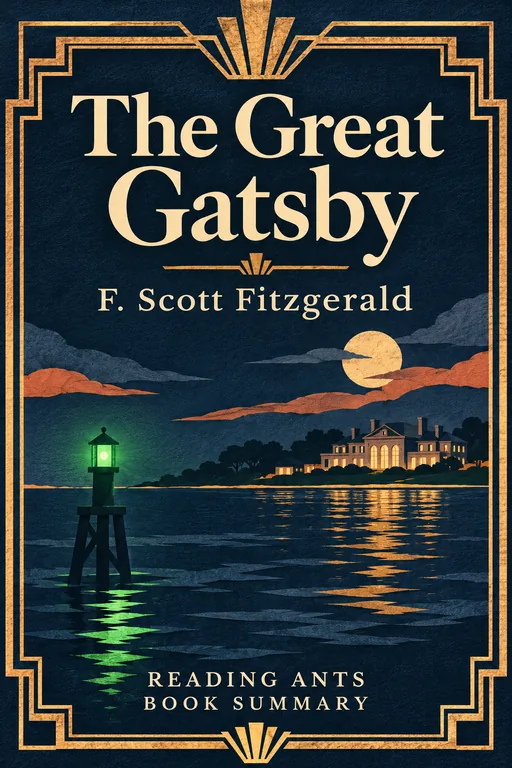
The Great Gatsby: the longer summary
In One Sentence
A mysterious millionaire throws lavish parties on Long Island in the hope of winning back the woman he loved years ago, but his dream collides with the careless cruelty of the rich.
Before You Start (No Spoilers)
The Great Gatsby takes place in the summer of 1922, in the glittering, reckless Jazz Age of New York. Nick Carraway, a young man from the Midwest, rents a small house on Long Island next to the enormous mansion of Jay Gatsby, a wealthy stranger famous for his wild parties and the strange rumors about his past. Across the bay lives Nick’s cousin Daisy and her rich, arrogant husband, Tom. Nick soon discovers that Gatsby’s whole life has been built around one goal: to win Daisy back. F. Scott Fitzgerald’s short, beautifully written novel is a love story, a tragedy and a portrait of the American Dream, the belief that anyone can reinvent themselves and become anything through wealth.
Who’s Who
- Nick Carraway: the narrator, a polite, observant young bond salesman.
- Jay Gatsby: a mysterious, hopeful millionaire with a hidden past.
- Daisy Buchanan: Nick’s charming, beautiful cousin, Gatsby’s lost love.
- Tom Buchanan: Daisy’s wealthy, powerful and bullying husband.
- Jordan Baker: a professional golfer and Daisy’s friend, whose honesty Nick questions.
- Myrtle Wilson: Tom’s lover, eager to escape her dull life.
- George Wilson: Myrtle’s husband, a worn-out garage owner.
- Meyer Wolfsheim: Gatsby’s shady business partner.
Full Summary
West Egg and East Egg
Nick Carraway moves to West Egg, Long Island, home of the new money, people who have recently become rich. Across the bay is East Egg, where old, established families live, including Nick’s cousin Daisy and her husband Tom Buchanan, a former college football star. At dinner with them, Nick meets Jordan Baker and learns that Tom has a mistress in New York.
That night, Nick sees his neighbor, Gatsby, standing alone on his lawn, stretching his arms toward a small green light across the water: the light at the end of Daisy’s dock.
The Valley of Ashes
On the way to New York, the train passes through the valley of ashes, a gray wasteland of industrial dust watched over by a giant billboard with a pair of huge eyes, an advertisement for an eye doctor. Here Tom introduces Nick to his mistress, Myrtle Wilson, the wife of a struggling garage owner. At a drunken party in an apartment Tom keeps in the city, Myrtle insists on repeating Daisy’s name, and Tom breaks her nose with one blow.
Gatsby’s Parties
Gatsby’s mansion fills every weekend with hundreds of guests, most of whom have never met their host. Rumors fly: some say he killed a man, others that he was a German spy. When Nick finally meets Gatsby, he is charming and uses an affected familiarity when speaking to people. Gatsby tells Nick a polished story about inheriting money and studying at Oxford, which Nick only half believes. He also introduces Nick to Meyer Wolfsheim, a gambler who is said to have fixed the 1919 World Series.
Jordan explains Gatsby’s secret. In 1917, when he was a young army officer without money, he fell in love with Daisy. They were separated by the war, and she eventually married Tom. Gatsby bought his mansion just to be across the bay from her, and he throws his parties hoping she will one day appear.
The Reunion
Gatsby asks Nick to invite Daisy to tea. The meeting begins awkwardly, but soon Gatsby and Daisy are glowing with happiness. Gatsby shows Daisy his mansion and throws piles of expensive shirts on a bed. Daisy cries, saying she has never seen such beautiful shirts. Nick notices that Gatsby’s dream of Daisy has grown so large that no real woman could match it.
Nick later learns the truth about Gatsby’s past. He was born James Gatz to poor farmers in North Dakota and reinvented himself as Jay Gatsby at seventeen, working for a rich yachtsman who taught him the ways of the wealthy. His current fortune comes from illegal business with Wolfsheim, such as selling alcohol during Prohibition.
The Plaza Hotel
On a scorching summer day, the group drives into New York and takes a suite at the Plaza Hotel. Tom, who now suspects the affair, confronts Gatsby. Gatsby insists that Daisy never loved Tom and wants her to say so. Daisy admits she loves Gatsby but cannot say she never loved Tom. Tom reveals Gatsby’s criminal dealings, and Daisy pulls away. Gatsby’s dream begins to crumble.
The Accident
Driving home, Daisy is at the wheel of Gatsby’s yellow car. As they pass the Wilsons’ garage, Myrtle, who has been fighting with her husband, runs into the road, perhaps thinking Tom is in the car. Daisy hits her and does not stop. Myrtle is killed instantly. Gatsby decides to take the blame to protect Daisy. That night he waits outside her house in case Tom hurts her, while Daisy and Tom sit together inside, calmly eating, already reunited.
The End of the Dream
George Wilson, mad with grief, tracks down the owner of the yellow car with Tom’s help. The next afternoon he shoots Gatsby while Gatsby is using an air mattress in his swimming pool, then kills himself. Tom and Daisy leave town without a word.
Almost no one comes to Gatsby’s funeral: a small group including Nick, Gatsby’s father, servants, the local postman and one former party guest. Almost none of the hundreds of people who enjoyed his parties appear. Disgusted with the East, Nick decides to return to the Midwest. On his last night, he looks across the bay at Daisy’s green light and reflects that Gatsby believed in a future that was always slipping away. Nick connects that failed ambition with the difficulty of building a new life while remaining attached to earlier hopes.
Behind the Parties and the Dream
Nick is a participant as well as a witness
Nick presents himself as someone other people trust with their private stories. That helps explain why he becomes the link between Gatsby and Daisy, but it also shapes how we read everything else. He decides which memories to include, when to explain Gatsby’s background and which people deserve sympathy. The novel is an account assembled afterward, when he already knows the terrible ending.
His first dinner with the Buchanans introduces the difference between charm and security. Daisy can make a visitor feel uniquely welcome while remaining difficult to understand. Tom speaks with the confidence of someone who expects his position to go unchallenged. The telephone interruption, connected with his affair, reveals that the attractive household already contains open humiliation. Its wealth has not produced trust or happiness.
Nick is uncomfortable, yet he keeps accepting invitations. He goes with Tom to meet Myrtle and later helps Gatsby arrange the reunion. His judgments are often sharp, but he is not outside the society he condemns. He is curious about its pleasures, drawn to its important people and sometimes slow to intervene. This tension makes his narration worth examining rather than treating as a completely neutral report.
Myrtle imagines a way out of her life
The Wilsons’ garage sits between the wealthy communities on Long Island and the city where those wealthy people seek entertainment. George works in a place that others pass through. Myrtle wants to leave it, and Tom appears to offer entry into a more glamorous world. In the apartment, she changes her clothes and manner as though she can change her social position at the same time.
Tom’s violence shows the limits of that escape. He is willing to use Myrtle’s company but will not allow her to treat Daisy as an equal rival. The blow that breaks her nose makes his authority physical. Myrtle’s hopes depend on a man who can injure her and then continue his ordinary life.
Her ambitions mirror Gatsby’s in an uncomfortable way. Both attach a desired future to a person from a wealthier social world. Both overestimate how fully that person will choose them. The resemblance does not make their situations identical: Gatsby has money and a grand house, while Myrtle has far fewer protections. It does show how dreams of entering another class can make people dependent on those who already belong to it.
Gatsby turns desire into a performance
The parties create a public identity before Nick knows the private man. Guests produce stories about Gatsby because his money seems to demand an explanation. They eat his food and use his house without needing to know whether any rumor is true. Their freedom depends on his hospitality, but most feel little obligation toward him.
Gatsby’s carefully prepared account of his past works in the same world of appearances. He knows which signs impress people: an important family, an education abroad, military distinction and useful connections. Some parts of the story have a real basis, but the overall image hides the poor young man who first invented a different name for himself.
That invention begins before Daisy. His encounter with the wealthy yachtsman Dan Cody gives him a model of how a rich man lives, and he studies it. Daisy then becomes the emotional center of the future he is building. Loving her and wanting the status surrounding her become difficult to separate. He is not merely collecting possessions for their own sake; he wants them to prove that he can now occupy a life that once excluded him.
The reunion cannot erase elapsed time
Before the tea at Nick’s house, Gatsby becomes anxious over details that would normally seem small. He wants the place, timing and appearance of the meeting to be right. The contrast with the confident party host is striking. Faced with the actual Daisy, he is a frightened man asking whether a plan built over years can work.
Their tour of his mansion lets him show what he has accumulated. The expensive shirts matter because they turn wealth into something Daisy can touch. Yet possession cannot establish what she felt during the years they were apart. Nick senses that Gatsby has imagined the reunion so intensely that it may be impossible for reality to satisfy him.
Gatsby wants more than a new relationship. He wants Daisy to cancel her marriage emotionally by declaring that she never loved Tom. That demand turns the past into a test. Daisy can be moved by Gatsby and still have a complicated history with her husband. Gatsby’s refusal to allow that complexity leaves almost no room for the real woman to choose an imperfect future with him.
Tom wins control of the story
At the Plaza, the confrontation begins as a struggle over Daisy and becomes a struggle over legitimacy. Tom attacks Gatsby’s business and social background. His own adultery does not prevent him from presenting himself as a defender of family order. He uses the advantages of established wealth to make Gatsby’s newly acquired money look suspect.
Daisy’s inability to make the declaration Gatsby wants is the emotional turning point. She does not match the unwavering figure in his imagination. As Tom becomes more confident, Gatsby repeats his claims with less effect. The argument exposes how much his dream requires other people to obey a script he has written for them.
The fatal drive then joins the two romantic triangles. Myrtle has earlier seen Tom using the yellow car, and the vehicle becomes a misleading sign of identity. Gatsby’s willingness to shield Daisy makes him vulnerable to a mistake that Tom helps direct toward him. Outside the Buchanan house, Gatsby imagines himself still protecting her. Inside, Daisy and Tom have already returned to a shared understanding from which he is excluded.
A funeral measures the value of the glitter
After Gatsby’s death, Nick tries to gather the people who surrounded him. Their absence changes the meaning of the parties. A crowd was never the same thing as a community. Some guests used Gatsby as a source of entertainment; others want to avoid inconvenience or involvement now that his life has ended.
Gatsby’s father brings a different picture. The old book containing the young Gatsby’s schedule and resolutions shows ambition before the mansion, Daisy and the criminal fortune. He had worked at becoming someone else through discipline as well as fantasy. The detail preserves something hopeful about him without erasing the harmful choices he later makes.
Nick finally leaves because the summer has changed what the East means to him. His closing reflections connect Gatsby’s private longing with a wider human tendency to imagine a perfect future. The novel does not simply ridicule aspiration. It mourns the energy people spend pursuing a future that is secretly an effort to recover a vanished past.
Why It Still Matters
The story sets a private wish beside a whole arrangement of wealth and power. Gatsby can buy an impressive house and entertain hundreds of people, yet he cannot require Daisy to remember the past as he does. Money supplies opportunities without producing the belonging or emotional certainty he wants.
Nick’s account also makes responsibility difficult to separate from storytelling. Tom directs suspicion toward Gatsby; Gatsby offers to protect Daisy; Wilson acts on a mistaken understanding; Nick later arranges the evidence for the reader. The tragedy depends on those unequal shares of knowledge as well as on strong feeling. The funeral then tests the meaning of the parties by showing how few guests return when hospitality has ended. These connected scenes support a reading about failed aspiration, social exclusion and the difference between using someone and caring about them.
Key Takeaways
- You can’t repeat the past. Gatsby’s attempt to recreate his romance with Daisy is doomed.
- Wealth doesn’t buy belonging. New money never fully gains acceptance from the old elite.
- The rich can be careless. Tom and Daisy destroy lives and retreat into their money.
- Dreams can become illusions. Gatsby loves an idea of Daisy more than the real person.
- Appearances hide emptiness. The glittering parties conceal loneliness and lies.
What We Can Learn
Gatsby’s story reminds us to be careful not to build our whole lives around a single dream, especially one about another person. Dreams give us energy, but they should leave room for reality, change and growth.
It also asks us to think about what we admire. Gatsby’s guests love his parties but not him. In our own lives, it is worth asking whether our friendships are based on real care or just on what people can offer.
Finally, the novel shows the importance of responsibility. Tom and Daisy avoid the consequences of their actions. Owning up to our mistakes, even when we could hide behind money or excuses, is a mark of true character.
Criticism and Counterpoints
The principal characters repeatedly act selfishly, and Daisy and Myrtle reach us through a male narrator with loyalties of his own. A critical reading also needs to examine anti-Jewish stereotyping in the description of Meyer Wolfsheim and Tom’s racist language. Nick’s distaste for Tom does not remove every prejudice from the account.
Nick is a participant who helps arrange meetings, accepts hospitality and decides afterward which memories to tell. His affection for Gatsby should therefore be examined alongside the evidence he supplies. The story allows sympathy for Gatsby’s hope without requiring approval of his criminal business or his refusal to accept Daisy’s complicated past.
Who Should Read It
This book is great for teenagers and adults who enjoy beautiful writing, tragic love stories and questions about wealth and success. Its compact plot still asks readers to attend closely to what Nick knows and what he merely assumes. Readers who want fast-paced action may find it slow, but its final pages are among the most memorable in American literature.
What to Notice While Reading
- Who knows what. Nick often learns the truth after an event. Notice when he withholds information so that readers first encounter a rumor or a misleading appearance.
- The geography of class. East Egg, West Egg, the city and the industrial wasteland are different social worlds. The characters move between them with very unequal freedom.
- Cars and responsibility. Driving allows speed, display and escape. Accidents and careless behavior make that freedom dangerous to people with less protection.
- Daisy’s independent reality. Compare what she actually says with what Gatsby insists she must feel. The gap is central to the tragedy.
- The father’s evidence. Gatsby’s childhood schedule complicates the image of a man made entirely of lies. It gives his self-invention a long history.
Questions to Think About
- Which of Nick’s actions make him more than an observer?
- How are Myrtle’s hopes similar to Gatsby’s, and how are they different?
- Why is being rich still insufficient to make Gatsby acceptable to Tom?
- What does Gatsby ask Daisy to erase, and why can she not simply agree?
- Does Nick’s admiration excuse Gatsby’s behavior, or can admiration and criticism exist together?
Want the whole book?
A summary is a taste, not the meal. Here is where to find the full book.