 Reading Ants
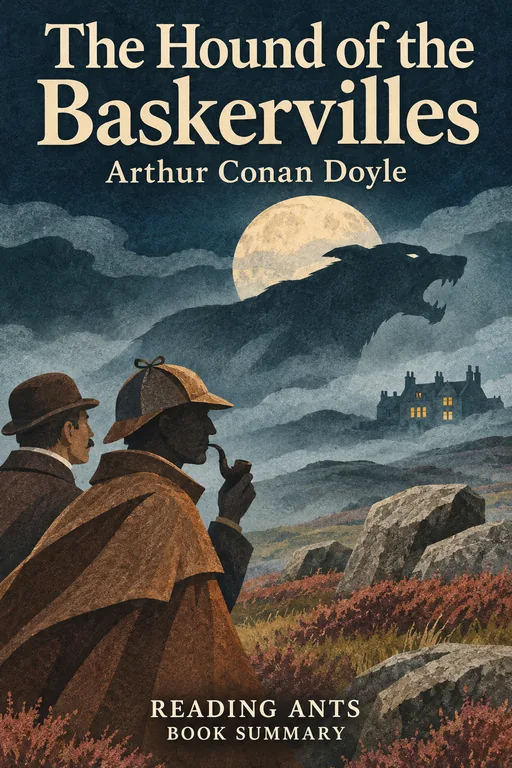
The Hound of the Baskervilles: the longer summary
In One Sentence
Sherlock Holmes and Dr. Watson investigate a family curse involving a monstrous spectral dog on the dark, foggy moors of Devon, while a new heir faces the danger that terrified his predecessor.
Before You Start (No Spoilers)
The Hound of the Baskervilles, by Arthur Conan Doyle, brings Sherlock Holmes and Dr. Watson into a mystery shaped by a frightening family legend. A country doctor asks Holmes to look into the mysterious death of Sir Charles Baskerville, whose body was found in the yew alley at Baskerville Hall with a look of terror on his face; enormous hound prints were discovered some distance away. According to an old legend, the Baskerville family has been haunted by a giant hound ever since an ancestor’s wickedness. Now the heir, Sir Henry, has arrived from Canada, and he may be next. Dr. Watson goes to Devon to protect him, while Holmes seems to stay in London.
Who’s Who
- Sherlock Holmes: the brilliant, observant London detective.
- Dr. John Watson: Holmes’s loyal friend and the story’s narrator.
- Sir Henry Baskerville: the young heir, newly arrived from Canada.
- Dr. James Mortimer: the country doctor who brings the case to Holmes.
- Mr. Stapleton: a neighboring naturalist who collects butterflies.
- Miss Stapleton: his quiet, nervous companion, said to be his sister.
- Barrymore and Mrs. Barrymore: the Baskerville Hall butler and housekeeper.
- The convict Selden: a dangerous escaped prisoner hiding on the moor.
Full Summary
The Curse
Dr. Mortimer visits 221B Baker Street with an old manuscript describing the legend of the Baskerville hound. In the seventeenth century, a cruel nobleman, Hugo Baskerville, kidnapped a farmer’s daughter and was killed on the moor by a huge, glowing hound. Since then, the family has been said to suffer from the curse. Dr. Mortimer explains that Sir Charles Baskerville died recently in the yew alley at his estate, and that he himself saw enormous paw prints some distance from the body.
The doctor is worried about the heir, Sir Henry Baskerville, who arrives from Canada and is to take up residence at Baskerville Hall. In London, Sir Henry receives an anonymous warning largely made of words cut from a newspaper, and one of his boots is mysteriously stolen. Holmes realizes that someone is watching him.
Watson on the Moor
Holmes tells Watson he is too busy to go, and sends Watson with Sir Henry to Devon, asking him to report everything in detail. Baskerville Hall is a gloomy old mansion at the edge of the Grimpen Mire, a dangerous marsh. Watson discovers that the butler, Barrymore, behaves strangely at night, and that someone is hiding on the moor. He hears the terrible baying of a hound, and meets the Stapletons, a naturalist and his sister, who tries to warn Sir Henry to leave, and then takes back her words.
Barrymore’s secret turns out to be that his wife’s brother, the escaped convict Selden, is hiding on the moor. Barrymore and his wife are sending him food. Watson also finds the camp of a mysterious figure who has been watching him from the moor.
After discovering that the hidden observer is Holmes, Watson and his friend find a man’s body at the bottom of a rocky slope, killed in a fall, wearing Sir Henry’s old clothes, which Barrymore had given to Selden. For a moment, they fear it is Sir Henry. It is Selden, apparently chased by the hound.
Holmes Appears
The hidden figure turns out to be Holmes himself, who has secretly come to Devon, living in a stone hut and observing from a distance. He reveals that the Stapletons are not brother and sister but husband and wife. He suspects the naturalist, but still needs evidence that can prove the crime. Later, a family portrait at the Hall reveals Stapleton’s resemblance to Hugo Baskerville and supplies a likely inheritance motive. The attack and the final explanation establish how he uses a huge hound and a luminous preparation to exploit the family legend.
The Plan
Holmes and Watson, with Inspector Lestrade, arrange a trap. Sir Henry will walk home alone across the moor at night after dining with the Stapletons, to lure Stapleton into releasing the hound. Holmes uses Sir Henry as bait because he wants direct evidence, accepting a risk that the approaching fog makes worse.
The Hound
On the foggy night of the trap, Holmes, Watson and Lestrade wait in the dark. The huge beast, with glowing jaws, leaps toward Sir Henry. Holmes and Watson shoot it dead. Stapleton, seeing his plan fail, runs into the Grimpen Mire and is presumed to have been swallowed by the marsh. Holmes finds Mrs. Stapleton tied up in a room at the Stapleton house, punished for refusing to help her husband any longer.
Explanation
Back in London, Holmes explains the details: Stapleton, who lived under a false name, had first tried to claim the estate by killing Sir Charles with fear, using the hound to frighten the old man, who had a weak heart. He had manipulated a woman, Laura Lyons, into asking Sir Charles to meet her at the moor gate that night, which lured him out to his death. Holmes also reveals that the hound’s phosphorus gave it its terrible appearance. Sir Henry recovers and takes a long journey with Dr. Mortimer to restore his nerves.
The Investigation in Greater Detail
A legend becomes a practical danger
The old manuscript matters because it gives the investigators a story that somebody can use. The legend links the family name with a frightening animal and with punishment for an ancestor’s cruelty. When Sir Charles dies in terror, the people around him already possess a possible explanation. A murderer does not need to create a belief from nothing; he can exploit the belief that is waiting for him.
Mortimer is a useful witness precisely because he is neither simply foolish nor entirely free from fear. He is a doctor who notices physical evidence, but the unusual footprints trouble him. Holmes has to distinguish what Mortimer actually observed from what the family story encourages him to imagine. This distinction between fact and interpretation drives the whole case.
Sir Henry’s arrival makes the inquiry urgent. He is inheriting a fortune, a house, a position in the community and a danger that he does not understand. Leaving England would reduce the immediate risk, but it would also let fear decide what he can do with his own life. His wish to take possession of Baskerville Hall is reasonable even though it makes protecting him difficult.
London provides clues before the moor does
The warning letter is constructed to conceal its writer. Its cut-out words suggest someone who wants to communicate while avoiding recognition through handwriting. Holmes examines not only what it says but how it was made. A warning can come from an enemy, a frightened ally or somebody playing a double game, so its apparent purpose does not settle who sent it.
The missing boots seem less serious than the letter, yet their sequence is significant. A new boot is taken and later an older one disappears. For an ordinary thief this is odd. For somebody who needs the owner’s scent, the difference is important. The small domestic inconvenience eventually becomes evidence of how a physical animal could be directed toward a particular victim.
The watcher in the cab shows that the opposition can operate in London as well as on the moor. Holmes is facing a planner who follows the investigation and can alter his behavior. This makes the case more than a puzzle about an old death. It is a contest in which the person arranging the next attack knows that detectives are involved.
Watson works without the whole explanation
In Devon, Watson must become an investigator rather than merely a recorder of Holmes’s deductions. His letters and reports preserve details of conversations, movements and impressions. He does not know which observation will later matter, so careful description is more useful than a quick dramatic conclusion.
The setting makes this hard. A light in a distant window, a figure on a ridge or a sound crossing the moor can look threatening before its cause is known. The open landscape contains hidden routes and places where a person can disappear. The mire is not supernatural, but misunderstanding it can kill someone just as surely as a monster could.
Watson also has to judge people with competing private concerns. Barrymore’s night signals look like evidence of a conspiracy against Sir Henry. In fact, the household servants are helping a relative. Their secrecy creates a misleading pattern without making them the principal villains. Doyle allows a suspicious clue to be genuine evidence of one secret and still irrelevant to the central motive.
Sympathy and jealousy distort the witnesses
The Stapletons present a household arranged around a lie. By calling his wife his sister, Stapleton makes it possible for Sir Henry to court her. Her attempts to warn the intended victim are limited by her husband’s control and by what she fears he will do. Her contradictory behavior is easier to understand once the investigators know that her apparent freedom is false.
Laura Lyons has also been manipulated through hope. She needs assistance and believes Stapleton can help her secure a different future. He persuades her to write to Sir Charles and then to stay away from the meeting. Her letter draws Sir Charles into the right place without requiring her to intend his death.
The crime therefore depends on more than a dangerous dog. Stapleton uses affection, financial need, fear and respectable appearances. The hound is the final instrument, but the human arrangements place the victims in its path. Holmes must uncover these relationships before the physical explanation becomes a convincing account of the whole scheme.
A death shows the cost of a mistaken identity
When the dead man on the moor seems to be Sir Henry, the investigation briefly appears to have failed. The clothing points toward the wrong person. Once the body is recognized as Selden’s, the apparent relief contains a darker truth: another man has died because the hound followed the scent associated with those clothes.
Selden is an escaped prisoner, but his death does not become harmless because he has committed other crimes. The scene shows the uncontrolled force of Stapleton’s method. A weapon trained through scent cannot make the moral distinctions a human murderer might claim to make. Watson’s shock also reminds readers that solving the puzzle cannot undo its casualties.
Holmes’s concealment has its own cost. He has protected the secrecy of his movements, but he has let Watson believe that he is carrying responsibility alone. Watson is hurt when he learns the truth. Their friendship survives because Holmes acknowledges the value of his work, yet the episode leaves room to question whether efficient investigation justifies keeping a trusted partner uninformed.
The portrait supplies a family connection
The picture of Hugo Baskerville helps Holmes see Stapleton’s relationship to the family. An image that belongs to the house’s history becomes evidence for a present financial motive. The old legend and the old portrait have opposite uses: one helps the criminal produce terror, while the other helps Holmes identify him.
The final trap is dangerous because the investigators need the hound released while Sir Henry remains within reach of it. Fog threatens their control of the scene. Holmes’s confidence does not remove the possibility that timing, visibility or the animal’s speed will defeat the plan. Sir Henry survives, but his suffering makes clear that he has been used as bait.
The explanation afterward brings together the scent, the stolen boot, the manipulated meeting and the disguised marriage. Stapleton’s presumed death in the mire remains an inference rather than a body presented in court. Doyle closes the logical pattern without pretending that the investigators can recover every event directly. Sir Henry’s need for rest likewise prevents the solution from feeling like an instant return to normal.
Why It Still Matters
The novel makes fear a problem of evidence without making fear foolish. Mortimer has observed something extraordinary, Watson hears a frightening sound, and Sir Henry has reasons to feel threatened. Their error would be to treat a possible explanation as a proven one. Holmes needs the observations while resisting the conclusion that the legend encourages.
The investigation also depends on human relationships. A warning can be genuine even when its writer conceals her identity, and suspicious servants can be hiding a family secret rather than a murder plot. The hound becomes understandable only when the investigators connect physical clues with coercion, inheritance and deception.
Watson’s account keeps this reasoning emotionally difficult. He does not know everything Holmes knows, and the dead body briefly appears to be the man he was meant to protect. The solution supplies an explanation, but Sir Henry’s damaged nerves remain. Discovering how a crime works does not cancel what its victims have experienced.
Key Takeaways
- Reason defeats superstition. The supernatural legend has a logical explanation.
- Careful observation reveals truth. Holmes notices small details others miss.
- Appearances can deceive. The friendly naturalist is the villain.
- Teamwork matters. Holmes and Watson solve the case together.
- Greed can drive crime. Stapleton kills for an inheritance.
What We Can Learn
The story encourages us to think carefully before accepting frightening explanations. When something seems supernatural, looking for evidence and logical reasons often reveals a simpler cause.
It also shows the value of paying attention to details. Holmes solves the case by noticing small things, such as a missing boot, the footprints and a forgotten letter. Practicing careful observation can improve our everyday thinking.
Finally, the story reminds us that charming people may hide bad intentions. Judging others by their actions over time, rather than first impressions, is wise.
Criticism and Counterpoints
Some readers find that Holmes is absent for a long part of the book, with Watson narrating most of the action, which can feel slow compared with the short stories. Others note that Stapleton’s scheme is complicated and depends on many coincidences.
Modern readers may also object to the way the story treats the moor’s locals and the convict, or to the fate of Mrs. Stapleton, who is a victim of her husband’s control. The ending also invites readers to question the danger Holmes accepts on Sir Henry’s behalf.
Who Should Read It
This novel suits readers from about 10 upward who enjoy mysteries and suspense. It is a good introduction to Sherlock Holmes, and its atmospheric setting appeals to fans of gothic stories. Younger readers may find the hound scary.
What to Notice While Reading
- Two uses of the past. Compare the manuscript about Hugo with the family portrait. The same household history can encourage superstition or help establish a fact.
- Watson’s reports. Notice how often he records something accurately but does not yet know its meaning. Observation and correct interpretation are different achievements.
- Secrets beside the main secret. The Barrymores have something to hide, but their motive is family loyalty. Not every deceptive person belongs to the same plot.
- The stolen footwear. An object that looks trivial becomes important because a real animal needs a physical way to identify its target.
- The human cost of the trap. Sir Henry is not merely an heir to be kept alive. His fear and later recovery complicate the detective’s successful performance.
Questions to Think About
- Why is the family legend such an effective tool for Stapleton?
- What does Watson do well even before he has Holmes’s explanation?
- Which witnesses behave inconsistently because they are frightened or being manipulated?
- Was Holmes justified in hiding his presence from Watson?
- Does a rational explanation make the hound less frightening, or does it make the human crime worse?
Want the whole book?
A summary is a taste, not the meal. Here is where to find the full book.