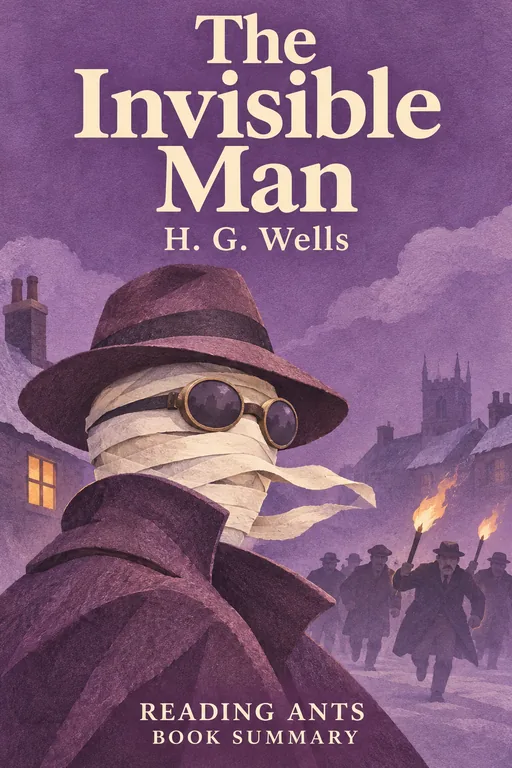
The Invisible Man: the longer summary
In One Sentence
A brilliant scientist who has discovered how to make himself invisible finds that the power isolates him and drives him toward cruelty, until a frightened community hunts him down.
Before You Start (No Spoilers)
The Invisible Man is a science fiction novel by H. G. Wells, published in 1897, and it is one of his early scientific romances, alongside The Time Machine and The War of the Worlds. It begins in a quiet English village, where a mysterious stranger arrives, wrapped in bandages, and it gradually reveals the secret of his experiment. Wells combines humor, suspense and horror, and uses the idea of invisibility to ask what a person might do when no one can see them, and what science without ethics might become.
Who’s Who
- Griffin, the Invisible Man: a brilliant, ill-tempered scientist, who is also an albino, and has made himself invisible.
- Mrs. Hall: the innkeeper at Iping, who is curious and talkative.
- Mr. Hall: her husband, the landlord of the Coach and Horses.
- Thomas Marvel: a tramp who is forced to become Griffin’s helper.
- Dr. Kemp: a doctor and scientist, whom Griffin knew from University College, who tries to stop him.
- Colonel Adye: the chief of police in Port Burdock.
- The villagers of Iping: a curious, gossiping community.
Full Summary
A stranger at the inn
On a snowy winter day, a stranger arrives at the village of Iping in Sussex, his face wrapped in bandages, with big blue glasses and a hat. He takes a room at the Coach and Horses inn, and demands to be left alone. He conducts experiments in his room, which fill the house with strange smells, and many bottles arrive for him. Mrs. Hall, the landlady, is curious, and the villagers gossip about him. Some guess that he is a criminal hiding from the law, and others that he is an anarchist in disguise. A burglary at the vicarage adds to the suspicion, and he grows more bad-tempered as his money runs out.
The unmasking
When the stranger cannot pay his bill, Mrs. Hall confronts him. In a fury he pulls off his false nose, bandages and glasses in front of the astonished villagers, revealing nothing underneath. He is invisible. The village constable arrives with a warrant, and the stranger fights him and the others, strips off his clothes so that nobody can hold him, and escapes, hitting out at those around him. Iping is thrown into uproar. The Invisible Man, naked, cold and hungry, now roams the countryside, furious at the nuisance of a body that cannot be seen.
Marvel the tramp
On the downs, the Invisible Man forces a tramp, Thomas Marvel, to be his assistant. Marvel is sent back to the inn at Iping to fetch the clothes and three notebooks that Griffin left behind. Terrified, he is kept in line with threats and bruises, and the two travel on together, while Marvel gathers up money that Griffin takes from shops and tills. Eventually Marvel slips away with the notebooks, and runs into the town of Port Burdock, where he begs for protection in an inn, saying that the Invisible Man is after him and will kill him.
Griffin’s story
Meanwhile, the Invisible Man, whose name is Griffin, is wounded in a fight at the inn, and makes his way to the home of Dr. Kemp, a scientist he knew from University College. He tells Kemp his story: a poor and ambitious young scientist, he worked in secret for years on a way to change the refractive index of the body, so that it no longer bends or reflects light. To pay for his work he robbed his own father, who then killed himself. He tested the process on a cat and then on himself, and set fire to his lodgings to cover his tracks. He now finds that invisibility brings cold, hunger and danger, and that he cannot move easily in public.
The Reign of Terror
Griffin tells Kemp that he plans a Reign of Terror, in which he, the invisible one, will rule by fear, and that Kemp will be his partner. Kemp, who is horrified and has already sent word to the police, refuses to agree. When Colonel Adye and his men arrive, Griffin escapes. A man named Wicksteed is later found murdered, and the narrator attributes the killing to Griffin while distinguishing the physical evidence from a speculative reconstruction of their encounter. He sends a letter announcing that the Terror begins with the execution of Kemp, and he besieges Kemp’s house, smashing its windows, shooting Colonel Adye and breaking in with an axe, while Kemp escapes and runs for the town.
The hunt and death
Before the final pursuit, Kemp and Adye discuss a hunt: they talk of bloodhounds, of locking up food so that Griffin cannot eat, of hiding anything he could use as a weapon, and even of powdered glass on the roads. Griffin, who is wounded and tired, is still dangerous. Finally, he chases Kemp through the streets, and the townspeople, shouting and armed with whatever they have, strike him down. As he dies, his body slowly becomes visible: beginning with the hands and feet and gradually revealing the structures of the limbs and then the rest of his body, revealing a battered, naked young man with the white hair and red eyes of an albino. The people look at him, and the story ends with Marvel, now an innkeeper, secretly studying Griffin’s notebooks without being able to make sense of them.
The Experiment and Its Consequences
The village meets a mystery it cannot classify
The stranger’s first advantage is money. Mrs. Hall is willing to tolerate unusual clothes and unfriendly behavior because he rents a room during a quiet season. Her response is practical rather than foolish: an inn needs paying guests. Griffin initially purchases the privacy that he later demands as a right.
His appearance also gives people a familiar way to misunderstand him. Bandages suggest an injury, and dark glasses appear to protect damaged eyes. The objects conceal an absence by encouraging observers to imagine a wounded body beneath them. He can move among other people only by constructing the image of a person they are reluctant to examine closely.
That arrangement breaks down when the bills cannot be paid and the village experiences theft and unexplained movement. The community answers uncertainty with gossip, competing theories and attempts at ordinary law enforcement. The early comedy depends on people applying everyday explanations to an impossible event. Yet their questions are reasonable: Griffin is using their rooms, food and labor while insisting that they have no claim on his behavior.
Invisibility does not abolish the body
Once Griffin removes his disguise, his supposed freedom becomes physically uncomfortable. Clothes reveal a shape that the body itself does not reveal. Without clothes he is exposed to cold. Food, dirt, injuries and movement can create signs of his presence. He has solved an optical problem without solving the practical problem of living.
Wells keeps returning to these limitations because they prevent the invention from becoming a simple wish fulfilled. Griffin imagines escaping social restrictions, but the need for shelter and nourishment drives him back toward other people. He cannot remain an independent intelligence floating above the world. He still has feet that touch the road, hands that need objects and a body that can be struck.
His response is to regard these needs as reasons that somebody else should serve him. Instead of rebuilding a cooperative relationship, he seeks an assistant who can carry visible things and enter buildings openly. His technical power therefore produces a new dependency. The person who wants to answer to nobody discovers that he cannot function without help.
Marvel becomes a reluctant servant
Thomas Marvel has little security before Griffin finds him. That vulnerability makes him a convenient target. Griffin does not persuade Marvel through trust or a shared purpose. He uses blows and threats, treating a poorer man as equipment needed to support an experiment.
The recovery of the notebooks matters because they are the written record of Griffin’s discovery. They could support further work, including his hope of reversing the process. To the villagers, the books are simply possessions taken during confusion. To Griffin, they are both intellectual property and a possible route back to an ordinary body.
Marvel’s escape shows that being controlled by an unseen aggressor does not remove all possibility of resistance. He looks for the protection of other people and buildings. His behavior is frightened and self-interested, but those are understandable responses to coercion. The alliance fails because Griffin never creates a reason for Marvel to remain once a chance of safety appears.
Griffin tells his history on his own terms
At Kemp’s house, the narrative changes from public confusion to a long private account. Griffin can finally describe the thinking behind the experiment. He expects another educated man to understand his importance. His technical explanation is also a request for recognition: he wants Kemp to see genius where the villagers have seen a violent stranger.
The account undermines that defense. Griffin admits taking money from his father, whose death follows. He describes his early experiments and his determination to hide the work. Other people’s losses appear in the story largely as obstacles, inconveniences or events that fail to concern him. His cruelty does not begin when the villagers chase him. It is already present in how he finances and protects the project.
The experiment on the cat extends this pattern. Another living creature becomes material for a discovery whose consequences Griffin is determined to control alone. When his lodgings threaten his secrecy, he destroys evidence through fire. He does not merely seek knowledge; he repeatedly avoids the claims that fellow creatures and neighbors could make on the pursuit of that knowledge.
Kemp recognizes the political danger
Kemp’s initial hospitality gives Griffin an opportunity to rest and explain himself. That does not commit Kemp to accepting the plan that follows. Griffin proposes deliberate terror as a way to make the community obey him. His invisibility will allow punishment without warning, and fear will compensate for the physical resources he lacks.
This proposal changes the issue from whether society can tolerate an unusual scientist to whether it must protect itself from a declared attacker. Kemp’s choice to alert the authorities is not simply betrayal of an old acquaintance. He has heard a plan to use murder as government. Scientific understanding gives him a reason to recognize the limits of the invention and help others resist it.
Griffin experiences opposition as proof that other people are enemies. Instead of asking whether his demands are wrong, he escalates. The killing of Wicksteed is especially disturbing because the man’s death cannot be justified as a direct defense against Kemp. The narrator cannot fully reconstruct every moment of the encounter. This gap reminds readers that invisibility makes evidence harder to obtain while leaving the victim just as dead.
The hunter becomes the hunted
The measures discussed against Griffin turn ordinary needs into weaknesses. Food can be guarded, doors locked and objects watched. The community can work together to make an invisible man less free. This reverses Griffin’s belief that remaining unseen will let him escape every form of social control.
His pursuit of Kemp becomes increasingly personal. Breaking windows and forcing entry make his presence detectable through damage even when his body cannot be seen. Violence supplies an outline that light cannot supply. The chase also draws in people who have not heard the entire scientific explanation. They respond to immediate danger, using numbers and physical contact against a single attacker.
The crowd’s final assault is brutal. Wells does not make the return of visibility a triumphant unveiling of a monster. The body becomes that of a young man who has been hurt and killed. Readers are left with both his responsibility for terror and the distressing sight of the human being beneath it. The scientific marvel ends in an ordinary vulnerable body.
The notebooks keep a different uncertainty alive
Marvel’s later prosperity adds an ironic ending. The coerced helper survives and runs an inn, while the celebrated discovery remains hidden in books he cannot understand. He protects them with the secrecy Griffin once used, hoping that they contain a route to power or wealth.
The final pages do not promise that Marvel can reproduce the experiment. His inability to read the work matters. Technical knowledge does not automatically pass to the person who owns its physical record. Yet the possibility remains unsettling because Griffin’s death has not destroyed the idea. The danger was partly in his character, but the invention could outlast him and acquire another user.
Why It Still Matters
Invisibility gives Griffin an unusual power while leaving his ordinary needs intact. The contrast makes the fantasy useful for thinking about dependence. He needs meals, warmth, a place to work and people willing to act openly for him. His attempt to escape accountability repeatedly brings him back into relationships he cannot manage by optics alone.
The novel also lets him provide evidence against his own defense. At Kemp’s house he explains the experiment as a great achievement, but his account reveals theft, indifference to his father’s death and the destruction of other people’s property. Scientific ability does not supply moral judgment.
The final change back into a visible body prevents the chase from ending as a simple defeat of an impersonal force. Griffin remains responsible for his violence, yet the crowd has killed a vulnerable human being. Marvel’s hidden notebooks leave another question open: possessing a discovery is different from understanding it or using it responsibly.
Key Takeaways
- Power without accountability corrupts. Griffin turns to violence.
- Science needs ethics. The discovery brings no wisdom with it.
- Isolation harms. Invisibility cuts Griffin off from humanity.
- Fear drives mobs. The community responds with force.
- Ambition can blind a person. Griffin neglects the human cost of his experiment.
What We Can Learn
You can learn from Griffin that talent and knowledge are not enough, and that responsibility toward others matters. The story asks what we would do if no one could see us, and whether our behavior would change. Griffin’s treatment of other people shows the consequences of his repeated choices to threaten and exploit; loneliness alone does not explain or excuse those choices. If you read it, notice how Wells blends comedy and terror, and how the science is explained in a convincing way. It is a good introduction to early science fiction.
Criticism and Counterpoints
The shift from village comedy to pursuit and murder can make the novel feel uneven. Griffin’s long account at Kemp’s house interrupts the chase, though it also reveals motives that the earlier villagers could not know. His technical explanation belongs to the imagined conditions of the story; this account does not treat it as a verified scientific method.
The handling of his albinism also deserves attention. His coloring helps explain the disguise and the final visual recognition, but linking bodily difference with menace can reinforce a troubling association. The last scene partly resists that effect by showing a battered young man rather than a supernatural monster. The narrative’s uncertainty about Wicksteed’s death also limits how confidently readers can reconstruct every act of violence.
Who Should Read It
This book is for readers from about ten or twelve who enjoy science fiction, mystery and classic adventure. It is short and fast-moving. Readers who like it may go on to Wells’s other novels, such as The Time Machine and The War of the Worlds.
What to Notice While Reading
- The comedy before the horror. Everyday arguments over rooms, bills and luggage establish Griffin’s dependence on people before the violence grows.
- The visible disguise. His clothes make him socially recognizable while also giving other people something to seize. The same objects help and limit him.
- Griffin’s own evidence. Listen to how he tells the story of his father. A speaker can reveal moral failures while trying to prove his brilliance.
- Kemp’s obligations. Scientific sympathy does not require accepting Griffin’s plans. Kemp must choose between an acquaintance and the safety of others.
- Marvel’s cupboard. The hidden notebooks prevent the ending from closing every question. Ownership, understanding and responsible use are three different things.
Questions to Think About
- Which problems does invisibility solve, and which ordinary needs does it leave unchanged?
- Is Griffin corrupted by the experiment, or does his account show earlier cruelty?
- How does Griffin’s treatment of Marvel weaken his own plans?
- What makes Kemp’s decision defensible despite Griffin’s accusation of betrayal?
- Why does Wells end with the notebooks instead of ending at Griffin’s death?
Want the whole book?
A summary is a taste, not the meal. Here is where to find the full book.