 Reading Ants
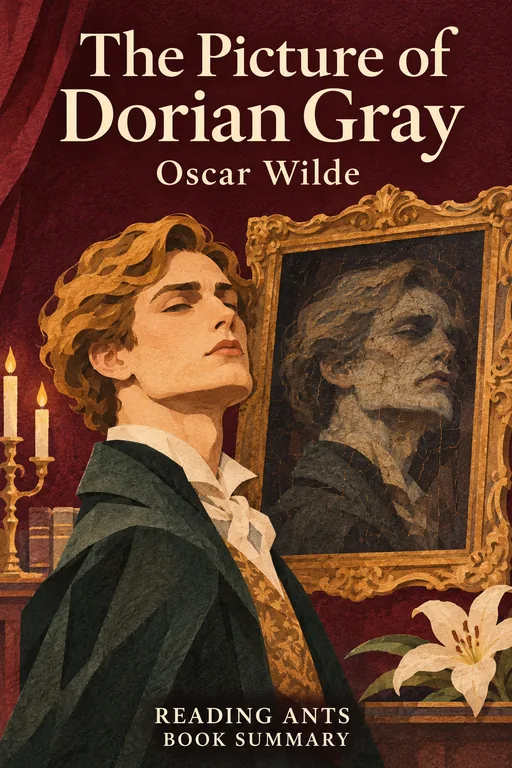
The Picture of Dorian Gray: the longer summary
In One Sentence
A beautiful young man wishes that his portrait would grow old instead of him, and as he lives a life of selfish pleasure and cruelty, his face stays perfect while the painting reveals the ugliness of his soul.
Before You Start (No Spoilers)
The Picture of Dorian Gray first appeared in 1890; this summary follows the expanded, twenty-chapter book text in the downloaded Gutenberg edition. In London’s high society, the painter Basil Hallward creates a stunning portrait of Dorian Gray, a young man of extraordinary beauty. Dorian meets Basil’s witty friend, Lord Henry Wotton, who fills his head with the idea that youth and beauty are the only things worth having, and that life should be devoted to pleasure. Dorian wishes that he could stay young forever while the picture aged. Mysteriously, his wish comes true. A gothic tale of sin and conscience, the novel links an apparently impossible wish with ordinary choices about cruelty, concealment and responsibility.
Who’s Who
- Dorian Gray: a strikingly handsome young man who becomes corrupt.
- Basil Hallward: a sincere artist who paints Dorian’s portrait.
- Lord Henry Wotton: a witty, cynical aristocrat who influences Dorian.
- Sibyl Vane: a young actress whom Dorian falls in love with.
- James Vane: Sibyl’s protective brother, a sailor.
- Alan Campbell: a scientist and former friend of Dorian.
Full Summary
The Portrait and the Wish
In his London studio, Basil Hallward finishes a portrait of Dorian Gray, whose beauty has inspired his art. Basil’s friend, Lord Henry, meets Dorian and charms him with dazzling talk: youth is fleeting, beauty is everything, and one should give in to every temptation. When Dorian sees the finished portrait, he realizes that he will grow old while the painting stays young. In despair, he wishes the reverse: that he would remain young and the portrait would age. He is willing to risk his spiritual future for that impossible exchange.
Sibyl Vane
Dorian falls in love with Sibyl Vane, a poor young actress who plays Shakespeare’s heroines with great talent in a shabby theater. They become engaged. But when Dorian brings Basil and Lord Henry to see her perform, she acts terribly. She explains that, now she knows real love, she can no longer pretend. Dorian, who loved her art rather than her, cruelly rejects her.
When he returns home, he notices that the face in the portrait has changed: there is a cruel twist around its mouth. Frightened, he decides to return to Sibyl and apologize. But the next day, Lord Henry brings news that Sibyl killed herself that night. Under Lord Henry’s influence, Dorian decides to treat her death as a beautiful tragedy rather than his responsibility.
A Hidden Life
Dorian hides the portrait in a locked room at the top of his house. Inspired by a poisonous book Lord Henry gives him, he devotes himself to pleasure and new experiences. Over the next eighteen years, he remains as young and beautiful as ever, while dark rumors spread about his influence on young people, many of whom are ruined after knowing him. In secret, he visits the portrait and watches it grow older and more hideous with each sin.
Murder
On the night before Basil leaves for Paris, he visits Dorian to warn him about the terrible rumors. Dorian leads him upstairs and shows him the portrait. Basil is horrified by the monstrous face and begs Dorian to pray. In a sudden rage, Dorian stabs Basil to death.
Dorian blackmails Alan Campbell, a former friend and scientist, into destroying the body using chemicals. Before Campbell performs that work, Dorian notices bloodlike staining on a hand in the portrait. Campbell later takes his own life.
James Vane
Seeking to forget, Dorian visits an opium den in the docks of London. There, Sibyl’s brother, James Vane, who has sworn to avenge his sister, hears someone call Dorian Prince Charming, Sibyl’s name for him, and attacks him. Dorian saves himself by pointing out that he looks far too young to be the man who knew Sibyl eighteen years ago. A woman from the den tells James that Dorian has looked young for many years, undermining the excuse. Later, James follows Dorian to his country estate, but he is accidentally shot and killed by a hunting party. Dorian feels relieved.
The End of Dorian Gray
Dorian decides to become good. He spares a village girl he could have seduced and hopes the portrait will show improvement. But when he looks, he sees a new appearance of cunning and hypocrisy. He examines his motives and concludes that vanity and curiosity, rather than genuine concern, guided his restraint.
In despair, he decides to destroy the painting, the only evidence of his crimes and his conscience. He takes the knife he used to kill Basil and stabs the portrait. The servants hear a terrible cry. When they break in, they find the portrait restored to its original beauty, and on the floor lies a withered, wrinkled, hideous old man with a knife in his heart. Only by his rings do they recognize him as Dorian Gray.
The Life Hidden by the Beautiful Face
The portrait begins as someone else’s discovery
Basil believes Dorian has changed his art. His interest is intense enough that he worries about exposing too much of himself by exhibiting the portrait. Before Dorian has made his wish, the painting already carries a private emotional meaning that its subject does not fully understand. It is more than a handsome likeness made for display.
Lord Henry enters as a very different influence. He treats conversation as a performance, offering surprising claims that make ordinary moral caution seem dull. His confidence gives Dorian a vocabulary for fears and desires the young man has not yet learned to examine. The ideas feel liberating partly because they arrive in such elegant language.
The first temptation is not simply pleasure. It is the realization that pleasure, youth and admiration can be lost. Looking at the completed portrait, Dorian becomes frightened of his future body. His wish attempts to solve an ordinary human problem by separating appearance from consequence. The rest of the novel explores what happens when that impossible separation seems to succeed.
Sibyl is first loved as a work of art
Dorian meets Sibyl through the roles she performs. He sees her as Shakespeare’s heroines and falls in love with the range and beauty of her acting. She calls him by a romantic name because she also knows him through an imagined story rather than a fully developed shared life.
When love changes her relationship to the stage, Dorian treats her poor performance as a betrayal. Sibyl believes that real feeling has made theatrical imitation seem empty. Dorian wants the actress who can produce beautiful emotion for him. Their ideas of love point in opposite directions, even though they have both assumed that being deeply moved means understanding one another.
His rejection shows what happens when a person is valued chiefly for an experience they provide. Once Sibyl cannot supply that experience, her own happiness seems unimportant. The altered mouth in the portrait makes his cruelty visible before he is ready to admit it. The supernatural change records an ethical fact that his handsome face conceals.
An explanation can become an escape from responsibility
News of Sibyl’s death briefly confronts Dorian with the consequences of his conduct. Lord Henry offers another interpretation, treating it as an artistically satisfying tragedy. The elegance of the explanation gives Dorian emotional distance from a person who has died. He can admire the shape of the event instead of asking what he owes her memory.
Basil’s response is different. He expects grief and cannot understand Dorian’s quick return to entertainment. The contrast places two possible kinds of friendship around the young man. One makes his choices easier to excuse; the other asks him to remain morally recognizable. Dorian increasingly prefers the influence that does not interrupt his pleasures.
Hiding the portrait gives that preference a physical arrangement. He can live publicly among beautiful objects while keeping evidence of change in a locked room. He has not eliminated conscience; he has moved its image somewhere he can control access to it. Each visit to the picture can become both a moment of horror and a private fascination.
Collecting experience replaces an ordinary life
The book Lord Henry gives Dorian encourages a view of life organized around sensation. Dorian explores fabrics, jewels, music, perfumes and other refined interests. These pursuits are not all harmful in themselves. Their danger lies in the way he uses them to fill time and avoid confronting the lives damaged around him.
The narrative leaves many of those injuries indirect. Rumors, broken friendships and ruined reputations suggest a pattern without providing a complete list of acts. A careful summary should preserve that limit rather than invent scandalous episodes. Dorian’s corruption is partly understood through its effects on other people and through the portrait’s worsening appearance.
His unchanged youth protects him socially. People find it difficult to connect the beautiful young-looking man with ugly stories about his behavior. Wilde makes a society’s confidence in appearances serve the same separation Dorian wished for. The supernatural bargain works so well because ordinary prejudice helps it: beauty is treated as evidence of innocence.
Basil’s visit makes secrecy unbearable
Basil comes because he is disturbed by what he has heard and still wants to believe in Dorian. His concern is not simply curiosity about gossip. The younger man has become important to his understanding of beauty and art, and he wants an answer that will preserve that belief.
Showing him the portrait should make honesty possible, but Dorian experiences the revelation as exposure. Basil sees that the picture is still his work, despite its horrifying change, and urges repentance. Dorian instead turns resentment toward the painter. The person who could have helped him face responsibility becomes the person he blames for making his hidden condition visible.
The murder then requires another person’s coerced assistance. Alan Campbell is forced to dispose of the evidence through blackmail. Dorian’s secrecy spreads suffering outward: protecting his own social life means trapping someone else in knowledge and action he does not freely choose. Campbell’s later suicide is another death that Dorian tries to place safely behind him.
Fear and vanity survive an apparent escape
James Vane’s pursuit brings a direct human reckoning for Sibyl’s death. Dorian escapes the first confrontation by using his youthful appearance as evidence that he could not have known her years earlier. The argument succeeds because the impossible truth cannot fit the witness’s ordinary understanding of aging.
James’s accidental death removes a threat, but does not make Dorian free. His fear shifts inward again. He tries to perform a good act and then inspect the picture for proof that he has improved. That method reveals the continuing problem: he wants moral change to serve his comfort and self-admiration, just as earlier pleasures did.
Destroying the portrait is his final attempt to abolish evidence rather than accept responsibility. He attacks it with the same weapon used against Basil, joining the two efforts to silence what confronts him. The result reunites body and consequence. The painting becomes beautiful again, and the dead man’s appearance carries the history that his public face escaped. Recognition by his rings supplies the final irony: possessions identify the person whom beauty had concealed.
Why It Still Matters
The portrait makes consequences visible while allowing Dorian to hide them from most people. The device creates a gap between what readers know and what the society around him is prepared to believe. His beauty becomes a kind of misleading evidence, protecting him from suspicion that an older or less admired face might attract.
The novel also places competing responses to art beside one another. Basil’s attachment to his subject, Lord Henry’s enjoyment of ideas and Dorian’s hunger for experience do not have the same moral effects. Sibyl’s rejection becomes especially revealing because Dorian values the emotions her performances give him more than the person who has produced them.
A reader does not need a list of every rumored offense to see the growing pattern. Secrecy requires coercion, cruelty becomes easier to explain away, and each apparent escape increases Dorian’s isolation. The last attack on the picture repeats the effort to silence evidence instead of accepting responsibility. The supernatural ending gathers together habits the earlier social scenes have already made recognizable.
Key Takeaways
- Outer beauty can hide inner corruption. Dorian’s face stays perfect while his soul decays.
- Influence matters. Lord Henry’s ideas lead Dorian toward ruin.
- Our actions leave marks. The portrait shows the true cost of every sin.
- Pleasure without conscience destroys. A life devoted only to pleasure becomes empty.
- We cannot escape ourselves. Dorian’s attempt to destroy his conscience destroys him.
What We Can Learn
The novel warns against valuing appearance above character. In a world of filtered photos and social media, it is easy to focus on looking perfect. Kindness, honesty and responsibility matter far more than how we look.
It also shows how much the people around us can influence our choices. Lord Henry’s clever words lead Dorian astray. Choosing friends who encourage our best selves is important.
Finally, it reminds us to take responsibility for our mistakes rather than hide them. Dorian tries to escape the consequences of his actions, but they catch up with him.
Criticism and Counterpoints
The long account of Dorian’s collections deliberately slows the story. Fabrics, perfumes, jewels and music show a life organized around acquiring sensations, but the accumulation can also feel remote from the people hurt by his conduct. That tension is part of the reading experience, not proof that every described pleasure is itself wicked.
Basil and Lord Henry receive sustained conversation, while Sibyl is often seen through Dorian’s admiration and disappointment. The novel exposes his failure to value her as a person, yet gives readers comparatively little access to the life she might have had beyond him.
The unspecified rumors also set a limit on certainty. They should not be expanded into invented acts or treated as a complete record of Dorian’s private life. Likewise, the suggestive emotional bonds between the men can be discussed as features of this text without making unverified claims about other editions, censorship or the author’s legal history.
Who Should Read It
This novel suits older teens and adults who enjoy gothic stories, witty dialogue and moral questions. It is relatively short and very readable. Readers interested in art, beauty and society will find much to think about.
What to Notice While Reading
- Influence and choice. Lord Henry supplies arguments, but Dorian acts on them. The novel invites debate about influence without making it a complete excuse.
- Looking and knowing. People repeatedly infer character from a face, a performance or a stylish remark. The portrait challenges that habit by displaying another kind of truth.
- Rooms with different functions. The elegant public rooms and the locked private room divide Dorian’s social identity from his secret history.
- The limits of the account. Many rumors remain unspecified. Avoid assuming that an adaptation’s added scenes are part of Wilde’s novel.
- Self-improvement as display. Dorian’s later wish to become good still centers on what the picture will tell him about himself. Compare that with genuine concern for somebody else’s welfare.
Questions to Think About
- Does Dorian fall in love with Sibyl herself or with her performances?
- Why is Lord Henry’s account of her death so tempting to him?
- What could Basil offer that Lord Henry does not?
- How does the society around Dorian help him avoid suspicion?
- Why does attacking the picture fail to free him from his past?
Want the whole book?
A summary is a taste, not the meal. Here is where to find the full book.