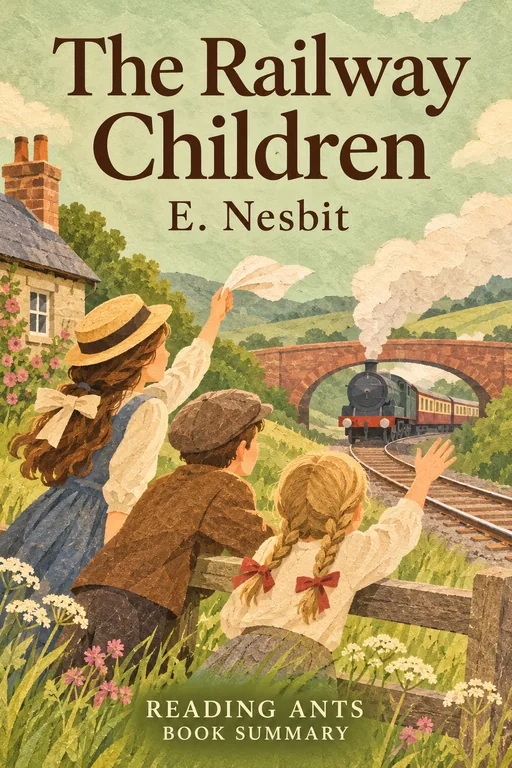
The Railway Children: the longer summary
In One Sentence
When their father is mysteriously taken away, three children move with their mother to a house beside a railway line, where they find friends, adventure and a chance to help others, while they wait for their father’s return.
Before You Start (No Spoilers)
The Railway Children is a children’s novel by the English writer E. Nesbit, published in 1906. It tells the story of Roberta, Peter and Phyllis, who have lived comfortably in London until their father suddenly disappears. Their mother takes them to a small house in the countryside near a railway, where the children become fascinated by the trains and the people who work on them. The book is warm, funny and moving, and it gives the children both ordinary quarrels and moments of practical courage.
Who’s Who
- Roberta, called Bobbie: the eldest, thoughtful and kind, who is the most observant of the children.
- Peter: the brother, energetic and fond of engines, who longs to do something useful.
- Phyllis: the youngest, cheerful and quick to help.
- Mother: a loving, brave woman who writes stories to earn money.
- Perks: the friendly station porter who becomes a friend to the children.
- The Old Gentleman: a kind, well-off man who travels on the morning train and takes an interest in them.
- Father: the children’s father, who is taken away for reasons that are only explained later.
Full Summary
The sudden change
The three children live in a pleasant London villa with their parents. One evening, two men come to the house and take Father away, and Mother tells the children that he has gone on business. The family’s comfortable life ends. Mother explains that they must live more simply, and they move to a small house called Three Chimneys, in the country. The children are puzzled and sad, but Mother asks them to be good and happy, to stop quarrelling, and not to ask questions about Father’s trouble.
Life by the railway
At their new home, the children find that the railway line runs near the house. They become friends with Perks, the station porter, and with the station master, after an early scrape over some coal that Peter took, and they wave each day to the morning train, which they imagine carrying their love to Father. One day a hand waves back from a first-class carriage, and the children come to know the owner as the kind old gentleman who always travels on that train. They like to think that he may know Father. The railway becomes a place of adventures, and they grow fond of the workers, and learn about the ways of the station.
The red petticoats
One day, the children discover that heavy rain has caused a landslide that has blocked the railway line, and that a passenger train will soon come around the bend. Bobbie and Phyllis take off their red flannel petticoats and, with Peter, tear them into flags on sticks, and the three of them wave them on the line. The driver sees the signals and brings the train to a halt in time. The children are celebrated as heroes, and later the railway company honors them at a small ceremony, where each of them is given a gold watch.
Helping others
The children continue to find ways to be kind. One wet day they meet a Russian writer at the station, who had been imprisoned for a book about poor people, and Mother takes him in. Bobbie asks the old gentleman, who turns out to be a director of the railway, to help find the man’s wife and children, and he succeeds. The children also plan a birthday for Perks, with gifts from the neighbors, which at first offends him because he takes it for charity until Bobbie explains. Later a schoolboy named Jim breaks his leg in the railway tunnel during a paper chase. The three children go to his rescue, and Bobbie stays with him while the others fetch help. He is carried to Three Chimneys and nursed by Mother, and he turns out to be the old gentleman’s grandson. The children’s good deeds reveal their character, and make them dear to the village.
The truth about Father
Meanwhile, Mother is working hard, and the family is short of money. Bobbie learns from an old newspaper, wrapped around a parcel, that her father had been convicted of selling state secrets to the Russians and sent to prison, and she is horrified but sure that he is innocent. Mother tells her the whole story and says that someone must have planted the evidence. Bobbie writes to the Old Gentleman, who is a person of influence, and asks him to help. He tells her that he had already doubted the verdict and has been looking into the case. Thanks to the Old Gentleman’s efforts, the guilty man is caught and Father is freed.
Father comes home
One morning, villagers greet Bobbie in odd and friendly ways because they have seen the news in the papers. She goes down to the station and waits for the train, not knowing what to expect. A train arrives and only three passengers get out, and the third is her father. She cries out in joy, and runs to him, and the family is reunited. The story ends with the children’s happiness, and with the sense that the kindness they gave to others has been returned to them, and that their patience and trust in their father have been justified.
Interpretation: How the Children Build a New Home
The missing father changes ordinary life
The opening gives the children a comfortable home before taking its security away. Their father’s disappearance is frightening partly because they are not told enough to understand it. They can see that Mother is distressed, but she asks them to accept an explanation that leaves many questions unanswered.
Moving to Three Chimneys changes things that previously seemed automatic. There is less money for food, clothes and household help. Mother must earn by writing, and her work needs time in which the children cannot simply demand her attention. Their new freedom outdoors grows out of her need to keep the family going.
The children are not naturally patient all the time. They quarrel, become bored and make mistakes. Nesbit allows those ordinary feelings to remain beside their generosity. Learning to help Mother does not mean that they stop being children; it means that they gradually notice needs beyond the immediate thing they want.
The railway turns strangers into familiar people
At first the trains are objects to watch. Their movement provides excitement and suggests a connection to the absent father, whom the children imagine somewhere beyond their view. Waving becomes a small daily ritual. When a passenger waves back, the distant system begins to contain an individual friend.
Their relationship with the workers requires a different kind of learning. Peter’s taking of coal comes from a wish to solve a household problem, but a good motive does not make it harmless. The railway has owners, rules and people responsible for its materials. Understanding that helps him move from treating the place as an adventure ground to recognizing it as somebody else’s workplace.
Perks becomes especially important because he talks to them without pretending they are adults. His work, family and sense of pride give the children access to a life unlike the one they knew in London. Their friendship grows through repeated ordinary meetings, not simply because a child performs a single impressive rescue.
Asking for help is more complicated than it looks
When Mother becomes ill, the children discover that affection alone cannot provide everything she needs. Food, medicine and rest cost money. Their effort to obtain help from the Old Gentleman grows out of real concern, yet it also shows that they do not fully understand their mother’s feelings about being supported.
She values independence and does not want the family to become a public object of pity. From the children’s viewpoint, a kind person has resources and can help; from hers, the request may expose a painful loss of privacy. Both feelings are understandable. The episode makes charity a relationship between people, not merely the movement of useful goods.
Later they encounter the same difficulty from another side. Their plan for Perks’s birthday seems obviously generous to them. His first response surprises them because they have not expected a gift to feel insulting. They have to explain that the neighbors’ contributions express affection and gratitude, rather than a belief that his family cannot manage. Good intentions need respectful understanding if they are to be received as kindness.
The red flags turn knowledge into action
Discovering the landslip gives the children very little time. They know a train will approach, and the driver cannot see the obstruction soon enough without a warning. Their familiarity with the railway lets them understand the danger instead of treating the fallen earth as an interesting sight.
The red clothing becomes a tool because they recognize its possible meaning as a signal. The plan is simple, but carrying it out means remaining near a frightening situation while the train comes closer. Their courage has a practical aim: making another person understand a message quickly enough to act.
The later ceremony gives them public praise, but the rescue grows from habits formed before it. They have spent time watching trains, speaking to workers and learning how the line functions. The story shows knowledge becoming useful at an unexpected moment. Heroism is not separated from attention to ordinary details.
A foreign stranger makes the father’s absence newly visible
The Russian writer arrives distressed and unable to make himself understood by most people around him. The children cannot immediately solve his problem, but they can see that he needs someone to listen. Mother’s ability to communicate with him changes a confused station scene into the beginning of help.
His story involves political punishment and separation from family. Those themes echo the children’s own situation without being identical to it. He has been treated as dangerous because of his writing, while Father has been condemned through a false accusation. In both cases, official action has broken a household apart.
The children’s response also challenges a simple division between familiar people who deserve care and outsiders who may be ignored. Their mother welcomes him despite limited resources. Help from the Old Gentleman makes the search for his family more effective, but the first necessary act is the decision to treat a bewildered stranger as a person with a history.
Bobbie learns a secret she cannot share freely
The newspaper account gives Bobbie information that the younger children do not have. She has to carry the shock of Father’s imprisonment while continuing ordinary life with them. Her relationship with Mother changes because they now share knowledge of the family’s real trouble.
Believing Father innocent is an act of trust, but clearing his name requires more than trust. Someone must examine the case and find the truth. Bobbie’s appeal to the Old Gentleman connects her private certainty with a person who has the means to investigate. Her action matters even though she cannot personally perform all the adult work involved.
The novel does not ask her to become the head of the household. She remains a child who needs reassurance. Its interest lies in the way she becomes more observant and considerate without losing her fear or hope. Growing responsibility is shown through what she notices and whom she thinks to ask, rather than through a sudden transformation into a miniature adult.
The tunnel rescue depends on staying with someone
The injured runner offers a different test from the approaching train. The immediate danger has already happened, and the task is to keep him safe until help can arrive. One child must remain while the others go for assistance. Bobbie’s willingness to stay means facing darkness and uncertainty without the comfort of the whole group.
Bringing him to Three Chimneys also shows how well the children have learned Mother’s values. They believe she will want a hurt stranger cared for, even though taking him home interrupts her work and creates more labor. Her earlier welcome of the Russian has taught them what kindness looks like in practice.
The discovery that Jim is the Old Gentleman’s grandson makes the network of relationships visible. People helped in one situation turn out to be connected with those who help in another. The coincidence is part of the book’s hopeful design, though real kindness cannot depend on knowing that a grateful benefactor will eventually appear.
Father’s return restores privacy as well as happiness
On the last morning, Bobbie meets unusual warmth from people who have read news she has not yet seen. Their knowledge makes her feel that something is about to happen without giving her a clear expectation. The familiar station becomes charged with suspense through small changes in everyday behavior.
The reunion begins publicly, on the platform, but the ending moves toward the house. Father explains that the true culprit has been found, and the long uncertainty finally gains an answer. The child who has tried to protect Mother must now carry happy news to her carefully.
The narrator stops outside the family’s private reunion. After a book in which readers have shared secrets, fears and adventures, that restraint is meaningful. The family no longer has to perform its suffering for an audience. Closing the door allows them something the absence has taken away: ordinary time together that belongs to them alone.
Why It Still Matters
The railway joins the children’s private trouble to a wider working world. At first it offers moving objects to watch and a direction in which to imagine their absent father. Through Perks, the Old Gentleman and other encounters, the line becomes a network of particular people. Their adventures depend on knowledge and help from that network rather than independence from adults.
The book also makes giving more complicated than good intentions. Mother dislikes public dependence, and Perks initially experiences his birthday presents as an insult. The children must learn to respect how another person receives a gesture. Bobbie’s final appeal similarly combines trust with practical action: believing Father does not itself prove the case, so she asks someone able to investigate. The reunion rewards a web of care, but the narrator’s withdrawal at the door also restores the family’s right to happiness that need not be watched or explained.
Key Takeaways (Interpretation)
- Kindness comes back. The children’s good deeds bring them help later.
- Courage can be practical. The red petticoats save a train.
- Family loyalty endures hardship. The children trust their father.
- Cheerfulness helps in difficulty. Mother’s brave example holds the family together.
- Everyone’s contribution counts. Even young children can make a difference.
What We Can Learn
You can learn from the children to meet change with courage, and to look for ways to help others even when your own life is hard. The story shows that trust and loyalty matter when the truth is not yet known, and that asking for help from the right person can resolve a problem. It also encourages curiosity about how things work, whether trains or other systems. Try doing a small act of kindness each day, as the children do, and notice how it changes the people around you and yourself.
Criticism and Counterpoints
Several useful connections turn out to meet at the Old Gentleman, whose influence helps resolve problems the children could not solve alone. The pattern gives the book hope but is also convenient. The account of Father’s exoneration remains brief compared with the children’s adventures, leaving little detail about the investigation. Class differences also shape which characters can request, give or refuse help. Perks’s reaction to the presents is a useful complication of any reading in which charitable gifts are automatically easy to receive.
Who Should Read It
This book is for children from about eight, for families who like to read together, and for adults who enjoy classic stories. It can be read aloud over many evenings. Some of the language and customs are old-fashioned, but the feelings are timeless.
What to Notice While Reading
- Work behind adventure. Mother writes, Perks works at the station, and the Old Gentleman uses influence. The children’s actions sit within a world sustained by adult labor.
- Pride and gifts. Compare Mother’s response to outside help with Perks’s first reaction to his birthday presents. Kindness needs tact as well as enthusiasm.
- Learning before heroism. The children can warn the train because they have watched and listened. Their interest becomes useful knowledge.
- Different kinds of confinement. Father’s imprisonment, the Russian’s history and Jim’s injury all involve separation or helplessness, inviting different forms of care.
- The narrator’s final distance. Notice why the story ends outside the door rather than following everyone into the house.
Questions to Think About
- Why does Mother initially hide the reason for Father’s disappearance?
- How can a helpful gift accidentally hurt somebody’s feelings?
- What do the children learn from the people who work on the railway?
- How does Bobbie’s behavior change after reading the newspaper?
- Why might leaving the family alone be the kindest possible ending?
Want the whole book?
A summary is a taste, not the meal. Here is where to find the full book.