 Reading Ants
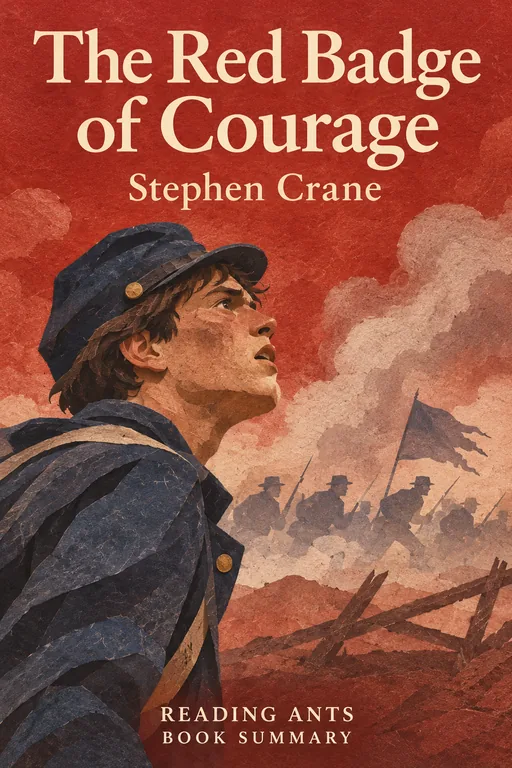
The Red Badge of Courage: the longer summary
In One Sentence
A young Union soldier in the American Civil War, who is afraid that he will run in battle, flees during his first battle, is ashamed, and then in later battles finds courage and a new understanding of himself.
Before You Start (No Spoilers)
The Red Badge of Courage is a short novel by Stephen Crane, published in 1895. It is about the psychological experience of a young soldier, Henry Fleming, in the Civil War, and does not name the battle or the places. Crane avoids glorifying war, and focuses on the confusion, fear and illusions of a single man. Its descriptions stay close to Henry’s sensations, so smoke, movement and uncertainty can overwhelm any clear account of military strategy.
Who’s Who
- Henry Fleming: a young recruit, called “the youth,” who dreams of glory and fears cowardice.
- Jim Conklin: a tall, steady fellow soldier whom Henry knows, who is mortally wounded.
- Wilson: a loud young soldier, who becomes Henry’s close friend.
- The tattered man: a gently spoken wounded soldier, whose innocent questions torment Henry.
- The cheery man: a soldier who helps Henry return to his unit.
- The lieutenant and the colonel: officers who lead the regiment.
- Henry’s mother: a farm woman, who tries to dissuade him from enlisting.
Full Summary
Dreams and fears
Henry Fleming, a farm boy, has enlisted in the Union army, against the wishes of his mother, who tells him to be good and to avoid bad company. Waiting in camp, he is bored and anxious. He dreams of heroism, but he starts to doubt whether he will have the courage to stand and fight, or whether he will run. He asks his old friend Jim Conklin whether he might run, and Jim admits that he might if others did. The loud Wilson boasts that he will do his share, but Henry cannot be sure of either of them, or of himself.
The first battle
When the regiment finally goes into action, Henry finds that, in the din of the guns, he fights with a kind of fury, and he holds his ground. The enemy retreats, and he feels a rush of pride. But when a second attack comes, he sees some of his comrades running away, and, in panic, he turns and runs too. He flees through the woods, and, when he stops, he is in the rear, among the wounded, filled with a confused sense of relief and shame. He tries to justify his action to himself, and he is stung when he learns that the regiment held its ground after all.
The wounded
In the woods, Henry comes upon a dead soldier and flees in horror. He then joins a stream of wounded men heading to the rear. Among them is the tattered man, who is wounded and kind, but who asks him where he is hurt, a question which Henry cannot bear. Henry envies the wounded and wishes that he, too, had a wound, a red badge of courage. He then discovers that one of the wounded, walking in a daze, is Jim Conklin, who has been shot in the side. Jim wanders off into a field and dies there in a terrible scene, while Henry and the tattered man watch. Henry is overcome with grief. The tattered man, who is growing weak himself, keeps asking about Henry’s wound, and Henry abandons him in the field.
The red badge
As Henry wanders on, a panicked column of Union troops comes streaming out of the woods, and he is struck on the head by a rifle butt when he grabs a fleeing soldier and asks what is happening. The blow gives him a wound, which he comes to see as a kind of red badge, a proof that he has been in the fight. A cheery stranger leads him back to his regiment. Wilson greets him, says that he thought Henry was dead, and bandages him. Henry says nothing about his flight, and the others assume that he was grazed by a bullet in battle.
Gaining courage
The next morning Wilson, who seems calmer and more modest than before, cares for Henry, and the two are now close friends. When the regiment is attacked, Henry fights with a fury that astonishes his comrades, and the lieutenant praises him. Later, while fetching water, Henry and Wilson overhear an officer dismissing their regiment as an inferior force that can be spared. The regiment is ordered to charge. In the attack, the color sergeant is killed, and Henry and Wilson wrench the flag from his hands. The charge falls short, and the regiment withdraws under the scorn of other troops. Afterward the officer in command of the charge rebukes the regiment’s colonel, and the lieutenant boldly defends his men. Henry and Wilson hear that they were singled out as the best fighters in the regiment. In a later fight, Henry carries the colors and urges the men to charge a line of the enemy behind a fence, and Wilson seizes an enemy flag. Henry feels himself a new man, and he is proud of his conduct. The memory of his shame seems to fade.
The end of the battle
After the fight, the regiment is ordered to march back toward the river, and Henry is haunted by the memory of his desertion of the tattered man, which still troubles him. He is also troubled by his ideals of glory, which he now sees as childish. He begins to take a more modest view of himself, and he accepts that he is a man with both faults and virtues. As the weary soldiers march in the rain, a golden ray of sun breaks through the clouds over the river, and Henry feels a sense of peace and a quiet understanding of what he has learned.
Interpretation: Fear, Reputation and the Meaning of Courage
Waiting gives Henry room to invent himself
Before he fights, Henry has already imagined an audience for his courage. Stories about battle have taught him to expect a moment when his inner worth will become visible. Enlisting seems to offer a way out of ordinary farm life and into a grander identity. His mother’s practical warnings do not fit the scene of farewell he would have preferred.
Camp life delays the test he both wants and fears. Rumors circulate, soldiers argue, and the promised movement toward battle repeatedly seems uncertain. Henry listens for proof that the other men share his anxiety, but he cannot see into their minds. Wilson’s confidence makes him feel more isolated, while Jim’s matter-of-fact answer offers only partial comfort.
The problem is not simply whether he possesses a fixed quality called bravery. He is trying to predict how his body will act under conditions he has never experienced. No amount of private thinking can fully answer that question. Crane keeps the reader close to this uncertainty, showing how anticipation can become as exhausting as the danger it anticipates.
His first success does not settle the question
When the regiment first stands against an attack, Henry finds himself acting with the group. Noise, smoke and motion reduce the distance between an order and a response. He fights without the calm self-examination he has practiced in camp. Belonging to the line briefly replaces his fear of being exposed as an individual.
The next attack destroys that confidence. Seeing men run supplies both an example and an apparent reason to escape. Henry reacts before he can develop the heroic story he would like to tell about himself. Once away, he works hard to turn the flight into a reasonable decision.
His efforts to justify himself are revealing. A natural impulse to preserve life seems to support him, and he looks for confirmation in the world around him. Yet learning that the regiment has held its ground leaves him without the explanation that escape was necessary. He becomes angry at the men who stayed because their success makes his own choice harder to defend. Shame changes how he interprets other people’s actions.
The wounded men turn an imagined badge into actual suffering
Henry envies a wound because it would give him a visible story to show the regiment. He is thinking of injury as proof rather than pain. The men he meets force those two meanings together. Their damaged bodies are not theatrical decorations; they are people attempting to get away from the fighting and find help.
The tattered man’s questions are innocent. He assumes Henry belongs among the wounded and asks where he is hurt. Henry hears an accusation because he knows the answer would reveal his flight. The difference between intention and reception makes the exchange painful: a kindly person becomes unbearable to him precisely because kindness includes attention.
Jim’s death gives Henry a loss that is harder to turn into an argument about himself. The familiar tall soldier behaves strangely as his injuries overwhelm him, and Henry cannot restore the steadiness he knew in camp. The scene breaks the comforting idea that courage makes a person safe. Jim has stayed in the battle, yet that has not produced a noble rescue or a useful reward.
A real wound supports a false explanation
Henry receives his head injury while trying to get information from a fleeing soldier. The blow comes from his own side, outside the glorious circumstances he has wanted. Its cause is confusion and panic rather than an attack by the enemy. That accident lets Crane separate the visible mark from the moral meaning people give it.
The helpful stranger who guides him back does not know his whole story. Wilson, too, treats him with care on the basis of incomplete information. Henry finds shelter, a bandage and a place among his comrades without having to admit what happened. Their assumption protects him, but it also leaves him dependent on a misunderstanding.
This makes his later anxiety different from his earlier fear of battle. He now worries about questions, memory and exposure. The regiment can see his wound but cannot see the action that produced it. Public reputation and private knowledge have separated, leaving him eager for a future performance that might make the admired version of himself feel true.
Wilson’s change offers a quieter alternative
Before the fighting, Wilson gives Henry a packet to be sent to his family if he dies. The gesture reveals fear beneath his loud confidence. When Henry remembers the packet later, he briefly enjoys knowing that his friend has also been vulnerable. That knowledge seems to give him a defense against possible criticism.
He decides not to use it to humiliate Wilson. Even so, his satisfaction shows how quickly insecurity can become a wish for power over somebody else. Crane does not let Henry’s development move in one clean direction. Sympathy and vanity can operate in the same moment.
Wilson’s conduct has become gentler and more restrained. He cares for Henry instead of boasting about what he will do. The contrast gives the story another measure of maturity: usefulness to a companion can reveal more than a loud declaration of courage. Henry begins learning from a friend whose behavior has changed rather than from a formal lesson about manhood.
Fighting well has mixed motives
Henry’s later determination grows out of several feelings at once. Loyalty to the regiment matters, but so do anger, wounded pride and the desire to escape his earlier shame. Overhearing an officer dismiss the men gives him an outside target for emotions he has been directing inward. He wants the regiment’s performance to refute the insult.
Carrying the flag makes him visible in a new way. He can no longer hide easily within a line of men. The object gives his movement a shared purpose, and his willingness to keep advancing helps the group. Wilson’s capture of an enemy flag produces another public sign of accomplishment.
The praise they receive does not make all military judgment reliable. At different moments officers misunderstand the regiment’s position or treat its losses as an acceptable cost. Henry’s limited view and the commanders’ broader calculations do not meet neatly. The soldiers experience exhaustion and danger directly, while orders can describe them as units available to be moved.
The final calm remains open to interpretation
At the end, Henry still remembers abandoning the tattered man. That memory differs from his fear of having run. His later fighting may help repair a reputation for courage, but it does not return the vulnerable stranger to safety. The book gives no reassuring account of what becomes of that man.
Henry gradually puts the recollection at a distance and believes he has acquired a steadier understanding of himself. Readers can take this as growth while also questioning how completely he has faced his responsibility. The narration stays near his feelings, and the relief he experiences is not automatically a final verdict on every choice he has made.
The movement from battle toward images of peaceful land recalls the farm world he wanted to leave. Ordinary life no longer seems too small for him. Having encountered death, he desires quiet rather than spectacle. The last light across the river supplies a moment of beauty without changing the fact that the army continues moving and that war has not ended around him.
Why It Still Matters
Henry’s injury separates an outward sign from the action people suppose it proves. His comrades see a wound and infer battlefield courage, while readers know the blow came from a fleeing soldier on his own side. The same gap between public appearance and private memory continues when he fights well later. A genuinely brave action does not erase every motive or earlier failure.
The close attention to Henry’s changing perceptions makes the battle difficult to see as a single, ordered event. Fear, anger, pride and exhaustion alter what he notices. Wilson’s quieter care offers a different measure of growth from conspicuous military performance. At the end, Henry wants peace and believes he has changed, but the unresolved fate of the tattered man prevents complete moral reassurance. The novel invites readers to examine that final confidence rather than simply adopt it as the narrator’s unquestionable verdict.
Key Takeaways (Interpretation)
- Courage is complicated. Henry runs, and later fights bravely.
- Fear is human. The novel treats cowardice with sympathy.
- War is chaotic. Soldiers see little of the whole battle.
- Shame can shape growth. Henry’s guilt makes him think.
- Glory is an illusion. Real battle is different from dreams.
What We Can Learn
You can learn from Henry that being afraid is normal, and that courage is not the absence of fear but how you act despite it. The novel also shows how easy it is to hide our faults from others, and how that can trouble us, and it suggests that honesty with ourselves is the first step toward maturity. If you read it, notice how Crane describes the confusion of battle, and how it differs from the heroic stories you may have heard. It may lead you to think about the human cost of war.
Criticism and Counterpoints
The story stays so close to Henry’s impressions that readers receive little strategic explanation of the campaign. That choice makes confusion immediate but may frustrate someone seeking a military history. His final peace also remains morally incomplete: he does not recover the tattered man or confess every earlier deception. The ending can therefore be read as genuine development, self-protective relief, or a mixture. The text’s attention to color and changing perception supports those competing readings without settling them through a final external judgment.
Who Should Read It
This book is for readers from about thirteen or fourteen who are interested in war stories, American history and psychological fiction. It is short, and can be read in a few sittings. Those who like it may continue with All Quiet on the Western Front or The Things They Carried.
What to Notice While Reading
- The distance between feeling and fact. Henry often interprets an event before he understands it. Watch how new information changes his emotional account.
- Public marks of private conduct. A wound or flag can be read as proof, yet the action behind it may be complicated or unknown.
- Animals and machinery. Crane’s comparisons can make battle feel both instinctive and impersonal, reducing the grand language Henry brought from home.
- Wilson’s quieter behavior. His care for Henry is an alternative to the loud boasting that first made him seem brave.
- The missing tattered man. The absence of a resolved fate keeps a moral difficulty alive after Henry’s military success.
Questions to Think About
- Why does Henry feel angry when he learns that the regiment did not need to retreat?
- What does a wound prove, and what can it not prove?
- How is Wilson’s change different from Henry’s?
- Which motives help Henry fight well later in the book?
- Does the ending show complete maturity, temporary relief, or some mixture of the two?
Want the whole book?
A summary is a taste, not the meal. Here is where to find the full book.