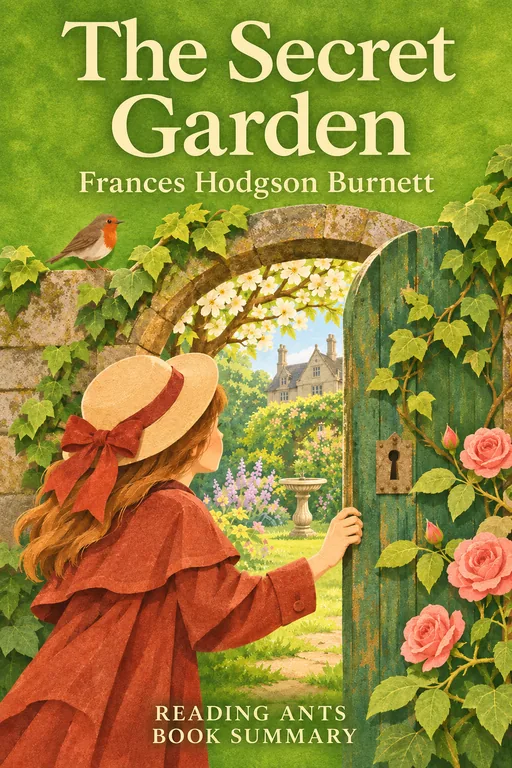
The Secret Garden: the longer summary
In One Sentence
A lonely, spoiled orphan sent to live in a gloomy English mansion discovers a locked, forgotten garden, and as she brings it back to life with two new friends, she and her sickly cousin are healed too.
Before You Start (No Spoilers)
The Secret Garden begins in India, where Mary Lennox, a sour, sickly and neglected ten-year-old girl, has been raised by servants and ignored by her parents. When a cholera epidemic kills her parents, she is sent to England to live with her uncle, Archibald Craven, in Misselthwaite Manor, a huge, gloomy house on the Yorkshire moors. Her uncle is rarely home, and the house is full of locked rooms and secrets. Mary hears of a garden that has been locked for ten years, and with the help of a friendly robin, she finds the key. Frances Hodgson Burnett’s beloved novel is about friendship, nature and the healing power of fresh air, hope and love.
Who’s Who
- Mary Lennox: a lonely, bad-tempered girl who slowly becomes kind and healthy.
- Colin Craven: Mary’s cousin, a spoiled boy who believes he is dying.
- Dickon Sowerby: a cheerful country boy who can charm animals.
- Archibald Craven: Mary’s uncle, a grieving and withdrawn man.
- Martha Sowerby: a warm-hearted young maid, Dickon’s sister.
- Ben Weatherstaff: a grumpy old gardener.
- Mrs. Medlock: the strict housekeeper.
- Susan Sowerby: Dickon’s wise and loving mother.
- The robin: a friendly bird who leads Mary to the garden.
Full Summary
A Lonely Girl
Mary Lennox has grown up in India with parents who never cared for her. Her servants obey her every command, and she has become rude and selfish. When cholera sweeps through the household, both her parents die, and Mary is found alone in the empty house. She is sent to England to live with her uncle, Mr. Craven, a grieving, withdrawn man with a slight curve to his back who has been deeply unhappy since his wife died ten years before.
At Misselthwaite Manor, Mary is left mostly alone. A cheerful young maid, Martha, talks to her in a broad Yorkshire accent and tells her about her large, poor, loving family. She also mentions a garden that Mr. Craven locked and buried the key to after his wife’s death.
The Key and the Robin
Mary explores the grounds and meets Ben Weatherstaff, a gruff old gardener, and a friendly robin who seems to want to talk to her. With fresh air and exercise, Mary begins to grow hungry and stronger. One day, the robin hops onto a patch of freshly dug earth, where Mary finds an old key. Later, a gust of wind blows aside some ivy, revealing a hidden door in the wall. Mary unlocks it and steps into the secret garden. It is overgrown and gray, but some plants are still alive.
Dickon
Mary wants to bring the garden back to life, but she doesn’t know how. Martha’s brother, Dickon, a twelve-year-old boy with extensive practical knowledge of local plants and animals, comes to help. Animals follow him everywhere: a crow, a fox cub and squirrels. Mary trusts him with her secret, and together they begin to weed, plant and prune. As the garden comes to life, Mary becomes happier, kinder and healthier.
The Crying in the Night
At night, Mary hears crying in the house. Searching the dark corridors, she discovers a hidden bedroom where a boy lies in bed: her cousin Colin, Mr. Craven’s son. Colin believes he will grow up with a crooked back and die young, and his father, who can barely stand to look at him because he reminds him of his dead wife, stays away. Colin is spoiled and throws furious tantrums.
Mary visits him secretly, and they become friends. When Colin has a terrible fit of screaming, Mary shouts back at him, telling him that there is nothing wrong with his back. Shocked, Colin calms down. Mary challenges the frightening beliefs that the household has allowed to grow around him.
Into the Garden
Mary and Dickon take Colin into the secret garden in his wheelchair, sworn to secrecy. Colin is filled with joy at the sight of the spring flowers. Ben Weatherstaff, peering over the wall, assumes Colin cannot stand or walk, and in fury Colin stands up for the first time. He decides he will live.
Over the following months, the three children work and play in the garden. Colin calls the force that is healing them Magic, and he turns his belief in it into a repeated ritual. He learns to walk and grows strong, but they keep it a secret from the household, planning to surprise his father. Colin pretends to still be ill, while eating heartily and growing rosy. Dickon’s mother, Susan Sowerby, visits the garden and encourages them warmly.
The Father Returns
Meanwhile, Mr. Craven has been traveling in Europe, trying to escape his grief. One day, sitting by a stream in the mountains, he suddenly feels calm and alive. Later he dreams that his wife is calling him from the garden. He also receives a letter from Susan Sowerby urging him to come home.
Mr. Craven hurries back to Misselthwaite and goes to the garden. He hears laughter, and a boy races out through the door, straight into his arms. It is Colin, healthy and strong. Overjoyed, Mr. Craven walks back to the house with his son at his side, while the servants watch in amazement.
How the Garden Changes the Household
Mary has been served without being cared for
At the beginning, Mary receives obedience but very little affection. Adults arrange her life so that she will not disturb her mother. Servants respond to her demands because of the family’s position, not because she knows how to form friendships. Her bad temper is therefore both unpleasant behavior and a sign of a childhood in which nobody has taught her mutual care.
The epidemic makes that neglect visible in a frightening way. When the household breaks apart, Mary can be overlooked because isolation has already become her usual condition. Her arrival in England does not immediately produce a comforting family. Mrs. Medlock describes a large house with restrictions, and Mr. Craven is an absent guardian rather than a welcoming parent.
Martha is important because she refuses to organize every interaction around Mary’s rank. She expects Mary to do ordinary things for herself and speaks freely about her own home. Mary initially finds this shocking. Yet Martha’s stories introduce an attractive possibility: a family can have little money and still contain warmth, conversation and belonging. That challenges the values Mary has learned without requiring anyone to give her a formal lesson.
Interest in another creature begins the change
The robin gives Mary a reason to look closely at something beyond herself. Its movements reward attention and patience, not orders. She cannot command it to like her. Watching it gradually makes the grounds feel inhabited rather than empty, and its apparent friendliness gives her a first connection with the place.
Ben Weatherstaff also responds to a version of Mary that she has scarcely considered. He is blunt and solitary, and she recognizes something of herself in him. Their conversations can be awkward, but they are exchanges between people with feelings rather than commands from a child to a servant. Mary’s growing ability to care about what the robin and Ben are doing prepares her for larger friendships.
Finding the key and hidden door turns curiosity into responsibility. The garden is not a ready-made pleasure ground. It contains bare branches, tangled growth and uncertain signs of life. Mary has to ask which plants are alive and what work might help them. Her discovery gives her a private purpose, but maintaining it demands knowledge and sustained effort. The pleasure is partly that she can contribute something real.
Dickon makes knowledge generous
Dickon knows the outdoor world through practice. He understands animals and plants without making Mary feel that she is being tested at school. His confidence differs from the authority she has known in adults. He can guide because he notices what is there and knows how to care for it.
Mary’s decision to trust him with the garden also changes the meaning of secrecy. At first, a secret protects her possession from other people. Once Dickon joins her, it protects a shared project. She discovers the enjoyment of wanting another person to see what she sees. The garden becomes more valuable through being shared, not less.
The work follows the season. The children uncover living growth, make space and wait. They do not create spring through force of will. This distinction matters when the novel later uses the language of magic. Much of the change happens through ordinary conditions: regular activity, food, company and time. The emotional meaning is powerful because it grows out of repeated acts rather than one miraculous afternoon.
Colin and Mary recognize each other’s worst habits
Colin has also grown up with servants who fear upsetting him. His isolation has a different explanation, but its effects resemble Mary’s: he expects obedience, thinks constantly about his own misery and does not know how to be a friend. Their first meetings allow each to encounter another child who is difficult in a familiar way.
Mary does not respond to Colin’s temper with the anxious submission he expects. She can be angry herself, and their quarrels are not examples of perfect kindness. Yet the relationship gives him something he lacks: another person’s wishes that do not simply disappear in response to his demands. They have to negotiate attention and affection.
The fear surrounding Colin’s body is a major part of his confinement. He has heard frightening assumptions and interpreted them as predictions. Mary challenges these ideas, while Dickon offers an example of easy movement and enjoyment. Within the story, this helps Colin become curious about a future rather than convinced he has none. It should not be taken as a claim that real disabilities or serious illnesses can be removed by confidence or by another child’s bluntness.
The garden becomes a place for practice
Taking Colin outside requires planning and cooperation. His chair must be moved, the garden kept private, and his fear respected enough that he can try something unfamiliar. The children create conditions in which he can begin to act differently. The garden is not simply a pretty scene that cures him as soon as he sees it.
Ben’s surprise at seeing Colin brings family history into the space. The old gardener remembers the boy’s mother and has his own connection with the garden. Its restoration therefore reaches beyond the three children. What looked like a forgotten private enclosure still holds attachments among people who have continued to care, even when they could not speak openly about that care.
Colin’s experiments with standing and walking turn improvement into a project he can observe. He calls the life around him magic and tries to give his hope a regular ritual. His language mixes discovery, imagination and the desire for certainty. A reader can appreciate his excitement while noticing that the narrator’s broader claims about thought and health reflect the book’s period and beliefs.
Susan and Archibald connect private growth with family life
Susan Sowerby’s role extends beyond Dickon’s knowledge. She is an adult who can imagine what lonely children need and offer support without dominating their discovery. Her warmth contrasts with the household’s habit of treating Colin chiefly as a problem to manage. Her visit confirms that the children have built something worth protecting.
Archibald Craven’s absence is another form of confinement. Traveling allows him to avoid the places connected with his loss, but it has not freed him from grief. His withdrawal leaves Colin without a father who can reassure him and Mary without a guardian who takes an active interest. The garden is locked partly because he cannot bear the memory of happiness there.
His return joins the two recoveries. The place associated with his wife’s death now contains his living son, active and joyful. Colin’s movement toward him breaks through a pattern of avoidance that neither could easily end alone. Their walk back to the house makes the change public. The servants can see that the old arrangements no longer describe the family.
Mary’s quieter place at the ending is worth noticing. She made the discovery and began the work, but the final reunion centers on Colin and his father. Readers can celebrate that reunion and still ask why Mary’s need for lasting family affection receives less attention. Her importance remains in the chain of actions that allowed the others to meet again.
Why It Still Matters
The locked garden connects several kinds of isolation. Mary has been attended without being loved, Colin has been protected in ways that enlarge his fear, and Archibald has traveled rather than face his grief at home. The same enclosure can therefore mean a private discovery to Mary, a new future to Colin and a painful memory to his father.
Restoring it takes more than finding a key. Mary learns to notice living shoots, Dickon shares practical knowledge, Ben reveals continuing affection, and Susan helps bring an adult understanding to the children’s project. The final reunion grows from that chain of ordinary care. At the same time, the narrator makes broad claims about thought and health that should be read as part of the novel’s outlook, not as established medicine. The emotional force of the recovery can be appreciated without turning a fictional child’s experience into a rule for other bodies.
Key Takeaways
- Care changes these children’s lives. Outdoor activity, food, friendship and a purpose help Mary and Colin within the story.
- Friendship changes people. Mary and Colin become kinder through their bond with Dickon.
- Fear can be challenged. Mary questions the frightening beliefs Colin has absorbed; her bluntness is not a model for treating real illness.
- Hope changes Colin’s outlook. Friendship and care help him become active; this fictional recovery is not medical advice.
- Love can be reborn. Grief kept the garden and the family locked; care brings both back to life.
What We Can Learn
The story encourages us to spend time outdoors. Planting seeds, walking in a park or just watching birds can lift our mood and give us energy, just as it does for Mary.
It also shows that people can change. Mary starts out rude and selfish, but with kindness and purpose she becomes generous and happy. Everyone can grow, especially when someone gives them a chance.
Finally, the book teaches that caring for something, whether a garden, a pet or a friend, can give these characters purpose and connection. Taking responsibility for something we love gives life meaning.
Criticism and Counterpoints
The descriptions of India and Indian servants carry the hierarchy of British colonial life, including prejudices voiced by Mary. The story challenges some of her assumptions through Martha, yet it does not give the Indian characters the same developed inner lives as the English household.
The narration’s explanations of Colin’s recovery also need caution. His fear, isolation and inactivity are connected in this particular plot; the book does not establish that confidence can cure disability or serious illness generally. Finally, Mary begins the discovery and does much of the work, while the closing scene centers on Colin and his father. That shift is a feature a reader can question without denying her decisive contribution.
Who Should Read It
This book suits readers from about 8 upward, and it is a lovely read-aloud for families. Children who love nature, animals and secrets will enjoy it most. Some older language and Yorkshire dialect may need explaining for younger readers.
What to Notice While Reading
- Care and obedience. Compare the servants’ responses to Mary’s demands with Martha’s expectations. Which kind of attention helps Mary become more capable?
- Things still alive. The garden appears dead before Mary learns to recognize growth. This pattern also shapes how she sees people who first seem unpleasant or unreachable.
- Shared secrets. Notice how the secret changes when Dickon, Colin, Ben and Susan become involved. It gradually supports a community rather than a private possession.
- The language of health. Separate what happens to these fictional children from broad claims about illness. The novel’s emotional hope does not establish a rule for real bodies.
- Who gets the ending. Mary’s work makes the final reunion possible. Consider what the last scene gives her and what it leaves unstated.
Questions to Think About
- How can a child be constantly attended by servants and still be neglected?
- What does Mary learn from watching the robin that ordering people around cannot teach?
- Why is Dickon an effective guide for both Mary and Colin?
- How do secrecy and trust work together in the garden?
- What would a final scene centered on Mary’s future add to the novel?
Want the whole book?
A summary is a taste, not the meal. Here is where to find the full book.