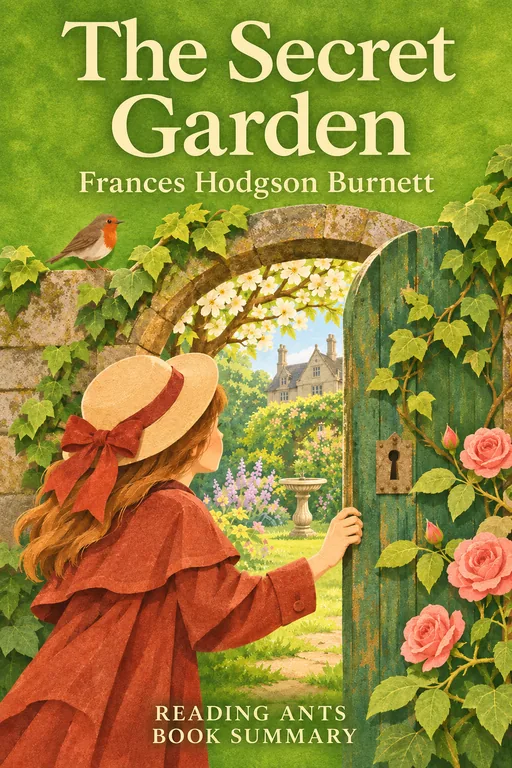
The Secret Garden
A lonely, spoiled orphan sent to live in a gloomy English mansion discovers a locked, forgotten garden, and as she brings it back to life with two new friends, she and her sickly cousin are healed too.
Overview
The Secret Garden begins in India, where Mary Lennox, a sour, sickly and neglected ten-year-old girl, has been raised by servants and ignored by her parents. When a cholera epidemic kills her parents, she is sent to England to live with her uncle, Archibald Craven, in Misselthwaite Manor, a huge, gloomy house on the Yorkshire moors. Her uncle is rarely home, and the house is full of locked rooms and secrets. Mary hears of a garden that has been locked for ten years, and with the help of a friendly robin, she finds the key. Frances Hodgson Burnett’s beloved novel is about friendship, nature and the healing power of fresh air, hope and love.
Main Characters
- Mary Lennox: a lonely, bad-tempered girl who slowly becomes kind and healthy.
- Colin Craven: Mary’s cousin, a spoiled boy who believes he is dying.
- Dickon Sowerby: a cheerful country boy who can charm animals.
- Archibald Craven: Mary’s uncle, a grieving and withdrawn man.
- Martha Sowerby: a warm-hearted young maid, Dickon’s sister.
- Ben Weatherstaff: a grumpy old gardener.
- Mrs. Medlock: the strict housekeeper.
- Susan Sowerby: Dickon’s wise and loving mother.
- The robin: a friendly bird who leads Mary to the garden.
Full Summary
A Lonely Girl
Mary Lennox has grown up in India with parents who never cared for her. Her servants obey her every command, and she has become rude and selfish. When cholera sweeps through the household, both her parents die, and Mary is found alone in the empty house. She is sent to England to live with her uncle, Mr. Craven, a grieving, withdrawn man with a slight curve to his back who has been deeply unhappy since his wife died ten years before.
At Misselthwaite Manor, Mary is left mostly alone. A cheerful young maid, Martha, talks to her in a broad Yorkshire accent and tells her about her large, poor, loving family. She also mentions a garden that Mr. Craven locked and buried the key to after his wife’s death.
The Key and the Robin
Mary explores the grounds and meets Ben Weatherstaff, a gruff old gardener, and a friendly robin who seems to want to talk to her. With fresh air and exercise, Mary begins to grow hungry and stronger. One day, the robin hops onto a patch of freshly dug earth, where Mary finds an old key. Later, a gust of wind blows aside some ivy, revealing a hidden door in the wall. Mary unlocks it and steps into the secret garden. It is overgrown and gray, but some plants are still alive.
Dickon
Mary wants to bring the garden back to life, but she doesn’t know how. Martha’s brother, Dickon, a twelve-year-old boy who knows everything about plants and animals, comes to help. Animals follow him everywhere: a crow, a fox cub and squirrels. Mary trusts him with her secret, and together they begin to weed, plant and prune. As the garden comes to life, Mary becomes happier, kinder and healthier.
The Crying in the Night
At night, Mary hears crying in the house. Searching the dark corridors, she discovers a hidden bedroom where a boy lies in bed: her cousin Colin, Mr. Craven’s son. Colin believes he will grow up with a crooked back and die young, and his father, who can barely stand to look at him because he reminds him of his dead wife, stays away. Colin is spoiled and throws furious tantrums.
Mary visits him secretly, and they become friends. When Colin has a terrible fit of screaming, Mary shouts back at him, telling him that there is nothing wrong with his back. Shocked, Colin calms down. For the first time, someone has told him the truth.
Into the Garden
Mary and Dickon take Colin into the secret garden in his wheelchair, sworn to secrecy. Colin is filled with joy at the sight of the spring flowers. Ben Weatherstaff, peering over the wall, says that Colin is a cripple, and in fury Colin stands up for the first time. He decides he will live.
Over the following months, the three children work and play in the garden. Colin calls the force that is healing them “Magic,” and they chant to it each day. He learns to walk and grows strong, but they keep it a secret from the household, planning to surprise his father. Colin pretends to still be ill, while eating heartily and growing rosy. Dickon’s mother, Susan Sowerby, visits the garden and encourages them warmly.
The Father Returns
Meanwhile, Mr. Craven has been traveling in Europe, trying to escape his grief. One day, sitting by a stream in the mountains, he suddenly feels calm and alive. Later he dreams that his wife is calling him from the garden. He also receives a letter from Susan Sowerby urging him to come home.
Mr. Craven hurries back to Misselthwaite and goes to the garden. He hears laughter, and a boy races out through the door, straight into his arms. It is Colin, healthy and strong. Overjoyed, Mr. Craven walks back to the house with his son at his side, while the servants watch in amazement.
Why It Matters
The Secret Garden, published in 1911, is one of the most beloved children’s books of the twentieth century. It has never gone out of print and has been adapted into several films, television series and a Broadway musical. Burnett, who also wrote A Little Princess and Little Lord Fauntleroy, drew on her own love of gardening.
The book was unusual for its time in having a heroine who begins as rude and unlikable, and who changes believably. It celebrates the healing power of nature, fresh air and friendship, ideas that remain powerful today, as research on the benefits of time outdoors and in gardens continues to grow. Many readers credit it with inspiring a lifelong love of gardening and nature.
Key Takeaways
- Nature heals. Fresh air, sunlight and gardening restore Mary and Colin.
- Friendship changes people. Mary and Colin become kinder through their bond with Dickon.
- Honesty can help. Mary’s blunt truth breaks Colin’s fear.
- Thoughts shape health. Colin’s belief that he will die keeps him ill until he chooses hope.
- Love can be reborn. Grief kept the garden and the family locked; care brings both back to life.
What We Can Learn
The story encourages us to spend time outdoors. Planting seeds, walking in a park or just watching birds can lift our mood and give us energy, just as it does for Mary.
It also shows that people can change. Mary starts out rude and selfish, but with kindness and purpose she becomes generous and happy. Everyone can grow, especially when someone gives them a chance.
Finally, the book teaches that caring for something, whether a garden, a pet or a friend, helps us heal ourselves. Taking responsibility for something we love gives life meaning.
Criticism and Counterpoints
Some modern readers are uncomfortable with the book’s portrayal of India and Indian people, reflecting the attitudes of the British Empire at the time, including Mary’s insulting remarks about Indian servants. The idea that positive thinking alone can cure illness or disability, through Colin’s “Magic,” has also been questioned, especially by readers with disabilities, since Colin’s healing is presented as proof that his condition was mostly in his mind.
Others note that Mary, so central at the start, fades into the background as Colin takes over the story’s final chapters. Despite these criticisms, many readers find its message of hope and renewal deeply moving.
Who Should Read It
This book suits readers from about 8 upward, and it is a lovely read-aloud for families. Children who love nature, animals and secrets will enjoy it most. Some older language and Yorkshire dialect may need explaining for younger readers.
Want the whole book?
A summary is a taste, not the meal. Here is where to find the full book.
You reached the end 🎉
Nicely done. Mark this one as read, and we will suggest what to read next.
Read this next
A Little Princess
Frances Hodgson Burnett
When her wealthy father dies and leaves her penniless, a kind, imaginative girl named Sara Crewe is forced to become a servant at her boarding school, but she holds on to her inner dignity, and her kindness is eventually rewarded.
🧸 Children's Books
Anne of Green Gables
L. M. Montgomery
A talkative, imaginative red-haired orphan is sent by mistake to an elderly brother and sister who wanted a boy, and she wins their hearts and fills their quiet farm with life.
🧸 Children's Books
Heidi
Johanna Spyri
An orphan girl brings joy to her grumpy grandfather in the Swiss Alps, is taken away to a sad city life, and then returns home to the mountains she loves.
🌍 World Literature
Little Women
Louisa May Alcott
Four very different sisters grow up together in a loving but poor family in New England during and after the American Civil War, learning about love, ambition, loss and finding their own paths in life.
📜 Classics
The Wind in the Willows
Kenneth Grahame
A shy Mole, a kindly Water Rat, a gruff Badger and a boastful Toad share riverside adventures in the English countryside, in a story about friendship, home and the madness of Mr. Toad's passion for motorcars.
🧸 Children's Books
Charlotte's Web
E. B. White
A lonely pig named Wilbur learns he is going to be killed, and his clever friend Charlotte, a spider, comes up with an amazing plan to save his life.
🧸 Children's BooksWant something different?
Pick another topic and we will show you three books to start with.