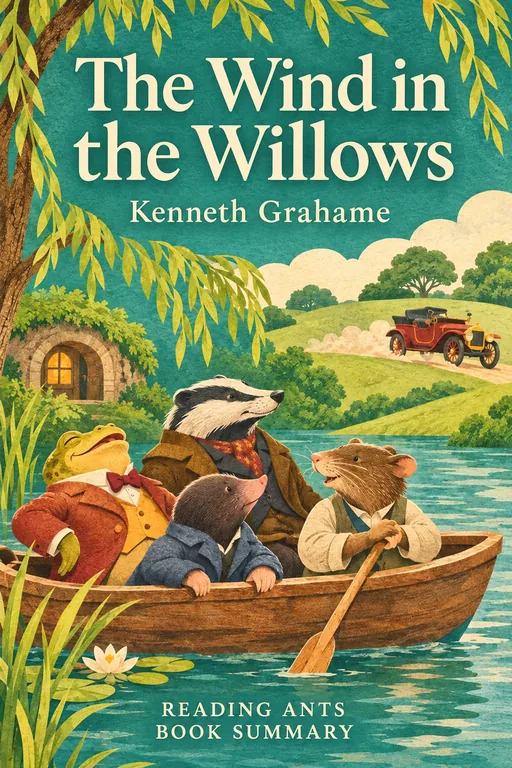
The Wind in the Willows
A shy Mole, a kindly Water Rat, a gruff Badger and a boastful Toad share riverside adventures in the English countryside, in a story about friendship, home and the madness of Mr. Toad's passion for motorcars.
Overview
The Wind in the Willows is set along a river and in the woods of the English countryside, where animals live much like gentle, old-fashioned people. It begins when Mole, tired of spring cleaning, leaves his burrow and meets Ratty, who introduces him to the river and boats. Together they visit their friends, Badger, who lives in the Wild Wood, and Toad, a rich, vain animal who loves new crazes. Kenneth Grahame first told the stories to his young son, and they became one of the best-loved books in English. The book blends comedy, adventure and a deep feeling for nature and home.
Main Characters
- Mole: a shy, kind creature who leaves his underground home for the first time and discovers the river.
- Ratty (Water Rat): a friendly, poetic animal who lives by the river and loves boating.
- Badger: an old, grumpy but wise and loyal animal who lives in the Wild Wood.
- Toad: the wealthy owner of Toad Hall, boastful and impulsive, who goes from craze to craze.
- Otter, the Sea Rat and Portly: other animals Mole and Ratty meet.
- The Wild Wooders: the stoats, weasels and ferrets who live in the Wild Wood and cause trouble.
Full Summary
The River Bank
Mole, tired of spring cleaning, drops his brush and goes up into the sunshine. He wanders until he reaches a river, which he has never seen. There he meets Ratty, who invites him for a ride in his boat. Ratty tells him that nothing is as pleasant as simply spending time in boats. They have a picnic, and Mole is delighted. From then on, he lives with Ratty by the river and learns to swim and row.
Toad and the Motorcar
They visit Toad at his grand home, Toad Hall. Toad has a new craze every few months, such as boating or a horse-drawn caravan. When a speeding motorcar frightens his horse and wrecks his caravan, he becomes obsessed with cars. He buys car after car, crashes them and is injured. His friends try to help him. Badger, a stern and respected friend, joins Ratty and Mole in keeping Toad confined at Toad Hall to cure him, but Toad pretends to be ill, tricks the friend guarding him and escapes.
The Wild Wood and Mole’s Home
Mole, curious, goes alone into the Wild Wood, where he feels fear and is followed by whistling and faces. He gets lost, and Ratty finds him. They shelter in Badger’s cozy house underground, where Badger welcomes them. Later, on a winter walk, Mole smells his old burrow and longs to go home. Ratty takes him there, and they find the little house dusty but dear, and they enjoy a happy time with visiting field mice singing carols.
Toad’s Misadventures
Toad steals a car and is caught and sentenced to twenty years in prison. He languishes in a dungeon, until the jailer’s kind daughter helps him to escape, disguised as a washerwoman. After a series of narrow escapes, in which he is chased by the police, he reaches a train, where he persuades the driver to help him, and later even steals a car again. He is a thoroughly bad-mannered and boastful, yet strangely lovable creature.
The Piper at the Gates of Dawn
In a more serious chapter, set while Toad is in prison, Ratty and Mole go out at night in a boat to search for Otter’s missing son, Portly. At dawn, they come to a mysterious island, where they hear beautiful music and encounter the god Pan, the “Piper,” who protects small animals. They feel awe and gentle sorrow, and then forget the vision, as the god grants them the mercy of forgetting, which Grahame treats as a kindness. They find Portly asleep nearby, safe under the god’s protection.
The Return to Toad Hall
When Toad finally returns home, he learns that the Wild Wooders, the weasels, stoats and ferrets, have taken over Toad Hall. Badger knows a secret underground tunnel into the hall, which he shares with Toad, Mole and Ratty. They plan an attack, enter through the tunnel and surprise the invaders, driving them out. Toad is thankful and promises to behave. He holds a banquet for his friends, and he is humble and genuinely changed. The friends settle again into a peaceful life along the river.
Why It Matters
The Wind in the Willows has been loved for over a century, and has been adapted into plays, films, television shows and animation. It is often listed among the greatest children’s books. Its descriptions of the river and the seasons have influenced writers who wrote about the English countryside, and the characters have become familiar types, especially the loud, impulsive Toad.
The book also shows deep feeling for home, friendship and nature, and has been praised as much for its poetry as for its humor. Many adult readers return to it for its comforting tone and its nostalgia.
Key Takeaways
- Friendship is the greatest comfort. Mole, Rat and Badger look after one another.
- Home matters. Mole’s longing for his burrow shows the pull of home.
- Impulsive pride has costs. Toad’s boastfulness gets him into trouble.
- Patience and loyalty are rewarded. Toad’s friends do not give up on him.
- Nature is full of wonder. The river, the wood and the seasons add beauty.
What We Can Learn
The story shows how true friends help each other even when it is hard. Badger and Ratty, and Mole, stand by Toad despite his foolishness, trying to help him become better.
It also invites us to enjoy simple pleasures, such as a picnic by a river or a visit with friends, and to see them as true wealth.
Finally, it teaches us to consider the effects of our actions. Toad’s thrill-seeking harms him and others, and his friends’ kindness shows how people can be forgiven and still held accountable.
Criticism and Counterpoints
Some modern readers say that the book reflects a comfortable, upper-class English world, with characters who do not do much work, and that the “Wild Wooders” represent the working-class and foreign threats, which seems snobbish. Others point out that there are almost no female characters, apart from a few helpers, and that the animals’ sizes and behavior are inconsistent.
Some also find the pace slow and the language old-fashioned. A few young readers prefer the funny chapters about Toad and find the serious chapter about Pan difficult. Still, many readers love its charm and its lyrical descriptions.
Who Should Read It
This book suits children from about eight, and also adults. It is good for reading aloud, a chapter at a time. Some language is old-fashioned, but the humor and adventure are easy to enjoy.
Want the whole book?
A summary is a taste, not the meal. Here is where to find the full book.
You reached the end 🎉
Nicely done. Mark this one as read, and we will suggest what to read next.
Read this next
Charlotte's Web
E. B. White
A lonely pig named Wilbur learns he is going to be killed, and his clever friend Charlotte, a spider, comes up with an amazing plan to save his life.
🧸 Children's Books
Winnie-the-Pooh
A. A. Milne
A gentle, honey-loving bear and his friends in the Hundred Acre Wood share funny, simple adventures with a boy named Christopher Robin, celebrating friendship, kindness and the joys of childhood.
🧸 Children's Books
Alice's Adventures in Wonderland
Lewis Carroll
A curious girl follows a white rabbit down a hole into a crazy world where she keeps changing size, meets mad and marvelous creatures, and stands up to a furious Queen.
🧸 Children's Books
Black Beauty
Anna Sewell
A gentle black horse tells the story of his life, from a happy childhood to hard years pulling cabs, and shows how kindness or cruelty can change an animal's whole life.
🧸 Children's BooksHarry Potter and the Philosopher's Stone
J. K. Rowling
An unloved orphan boy discovers on his eleventh birthday that he is a famous wizard, and during his first year at a magical school he makes true friends and faces the dark wizard who killed his parents.
🧸 Children's Books
The Hobbit
J. R. R. Tolkien
A comfortable, home-loving hobbit is swept into a dangerous quest with thirteen dwarves to win back their treasure from a dragon, and discovers along the way that he is far braver and cleverer than he ever imagined.
🧸 Children's BooksWant something different?
Pick another topic and we will show you three books to start with.