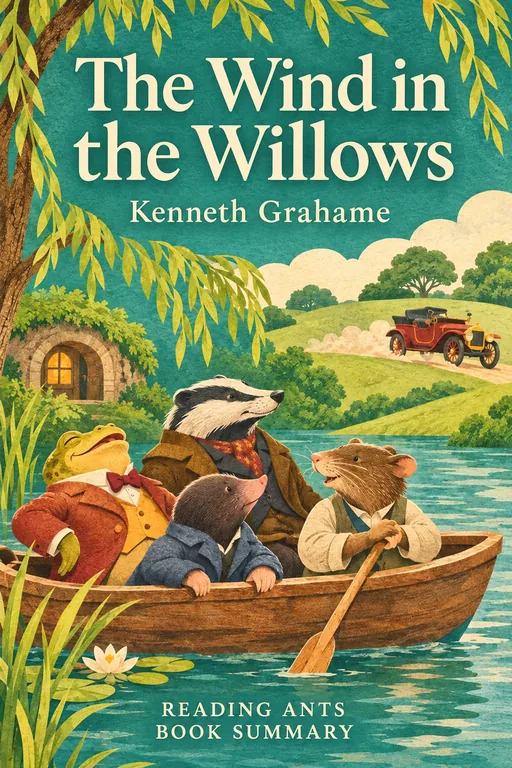
The Wind in the Willows: the longer summary
In One Sentence
A shy Mole, a kindly Water Rat, a gruff Badger and a boastful Toad share riverside adventures in the English countryside, in a story about friendship, home and the madness of Mr. Toad’s passion for motorcars.
Before You Start (No Spoilers)
The Wind in the Willows is set along a river and in the woods of the English countryside, where animals live much like gentle, old-fashioned people. It begins when Mole, tired of spring cleaning, leaves his burrow and meets Ratty, who introduces him to the river and boats. Together they visit their friends, Badger, who lives in the Wild Wood, and Toad, a rich, vain animal who loves new crazes. Mole’s new life introduces both peaceful routines and friends whose habits can disrupt them. The book blends comedy, adventure and a deep feeling for nature and home.
Who’s Who
- Mole: a shy, kind creature who leaves his underground home and discovers the river.
- Ratty (Water Rat): a friendly, poetic animal who lives by the river and loves boating.
- Badger: an old, grumpy but wise and loyal animal who lives in the Wild Wood.
- Toad: the wealthy owner of Toad Hall, boastful and impulsive, who goes from craze to craze.
- Otter, the Sea Rat and Portly: other animals Mole and Ratty meet.
- The Wild Wooders: the stoats, weasels and ferrets who live in the Wild Wood and cause trouble.
Full Summary
The River Bank
Mole, tired of spring cleaning, drops his brush and goes up into the sunshine. He wanders until he reaches a river, which he has never seen. There he meets Ratty, who invites him for a ride in his boat. Ratty shares his enthusiasm for boats and life beside the water. They have a picnic, and Mole is delighted. From then on, he lives with Ratty by the river and learns to swim and row.
A New Craze and an Unfamiliar Wood
They visit Toad at his grand home, Toad Hall. He has abandoned earlier enthusiasms for a horse-drawn caravan and persuades Mole and Rat to travel with him. A speeding motorcar frightens their horse and wrecks the caravan. Instead of remaining angry about the damage, Toad becomes fascinated by the machine responsible and wants cars of his own.
Later, Mole ventures into the Wild Wood to visit Badger. Darkness, strange faces and alarming sounds frighten him. Rat goes looking for him, and the two become caught outside in snowy weather. They find the entrance to Badger’s underground home, where their friend provides warmth, food and a place to sleep. His stern reputation conceals generous hospitality.
A Return to Mole’s Home
On a winter walk, Mole smells his old burrow and longs to return. Rat initially presses ahead without understanding his distress, but turns back when he realizes what is wrong. Mole worries that his modest, dusty home is too poor to entertain a guest. Rat helps make it welcoming. Visiting field mice sing carols and share supper, turning the return into a celebration.
Toad Cannot Keep His Promises
Toad buys and crashes motorcars and spends money recklessly. Badger, Mole and Rat try to cure the obsession by keeping him at Toad Hall under supervision. Toad pretends to be seriously ill, persuades Rat to leave his guard duty and escapes. He later takes a car left outside an inn and drives away. Arrested for his offenses and insulting conduct, he receives a twenty-year prison sentence.
Portly and the Mysterious Island
While Toad is imprisoned, Rat and Mole search by boat for Otter’s missing son, Portly. At dawn they follow extraordinary piping to an island. There they see a horned, divine protector with the little otter asleep between his hooves, a figure recognizable as Pan. They respond with awe and love. The vision vanishes, and the narrator explains that forgetfulness protects the animals from being overwhelmed by its memory. They find Portly safe and take him back toward his father.
Escape and Restlessness
A kind jailer’s daughter helps Toad escape by exchanging his clothes for those of her washerwoman aunt. He reaches a train and receives help from its driver, but a pursuit forces another narrow escape. His freedom does not immediately improve his judgment. During later adventures he quarrels with a barge woman, steals her horse, sells it, and again succumbs to the attraction of driving a motorcar. He eventually reaches Rat’s home after another disastrous escape.
Meanwhile, Rat meets a traveling Sea Rat whose accounts of southern ports awaken an intense wish to leave. Mole notices that his friend is swept up by the stories and helps him regain his balance. The episode reverses their earlier roles: the newcomer now protects the experienced river dweller.
Restoring Toad Hall
Toad learns that stoats and weasels have occupied his house. Badger knows a secret passage into the hall. He, Rat, Mole and Toad plan an attack during the intruders’ celebration, enter by the passage and drive them out. Mole has already helped by misleading some of their guards.
Toad wants to turn the victory banquet into a performance celebrating himself, but his friends insist that he behave modestly. He abandons his planned speeches and songs, thanks those who helped him, and compensates people he wronged. The narrator presents him as reformed. His long history of boasting nevertheless gives readers reason to notice how much effort this new behavior requires.
The Friendships Behind the Adventure
Mole learns how to belong
The river is a discovery before it becomes a home. Mole has lived underground, and the open world seems full of new possibilities. Rat welcomes him without asking him to prove that he is useful or important. A boat ride and a picnic introduce him to a way of living, with habits, pleasures and neighbors that he does not yet understand. Their friendship grows through sharing these ordinary things.
Mole’s eagerness can also make him careless. Wanting to row is not the same as knowing how, and trying too soon creates trouble. Rat’s experience gives him a responsibility toward his guest, but Mole must learn to accept help. The balance between independence and reliance runs through the whole book. Each animal wants freedom, and each depends on other animals when that freedom becomes dangerous.
The setting makes this dependence feel natural. The riverbank contains a whole society of creatures with their own houses, jobs and concerns. Rat knows the social map as well as the physical one. Mole is learning not just where things are, but how to be a friend within that world. Grahame gives this education time, so that the later threats to familiar homes matter.
Toad confuses excitement with a good life
Toad has more money and a grander house than his friends. Neither advantage makes him content. He throws himself into a new interest with such enthusiasm that the previous one seems worthless. When a motorcar wrecks his caravan, the others see danger and damage. Toad sees the thrilling thing he now wants to possess.
This is why advice alone has little effect on him. He can agree that his behavior is foolish while already imagining his next escape. His friends try to protect him from financial ruin, injury and the law, but he treats their concern as an obstacle to pleasure. His cleverness becomes a tool for avoiding responsibility rather than solving a worthwhile problem.
The humor does not make his conduct harmless. A stolen car belongs to somebody else. A crash affects other travelers. The work his friends do to contain him costs them time and patience. Toad’s wealth often shelters him from the immediate consequences, which helps explain why he mistakes a repeated disaster for another amusing episode. His story asks whether affection can survive this kind of selfishness without becoming permission for it.
Fear changes the Wild Wood
Mole enters the Wild Wood believing that curiosity will be enough. As darkness and unfamiliar sounds surround him, that confidence falls apart. He senses faces and movements that may be real or may be enlarged by fear. The episode is frightening because Mole no longer knows how to read the world around him.
Rat’s search is a quieter kind of heroism than Toad’s adventures. He recognizes what has probably happened and goes after his friend. He does not wait until the danger becomes an exciting story. When the pair find Badger’s home, warmth and food restore their sense of proportion. Safety has a physical form: a door that opens, a place to sit, someone willing to listen.
Badger seems stern from a distance, but his hospitality is generous. He also understands the older structures beneath the woodland. His underground rooms suggest a history of human buildings that have disappeared while the animals continue their lives. The house offers a deeper security than Toad’s showy property. Its value comes from shelter and knowledge, not from impressing visitors.
Home is something a friend must notice
On a winter journey, Mole catches the familiar smell of his old home. He wants to stop, but Rat initially fails to understand. Mole follows him and becomes miserable. The problem is small compared with prison or stolen property, yet it tests friendship just as seriously: can Rat recognize a need that is not his own?
Once he does, Rat turns back. Mole is embarrassed by the little house and the lack of good food, but Rat treats it as worth enjoying. Their welcome to the caroling field mice turns a worried return into a celebration. The visit does not require Mole to abandon the river. It allows him to keep an earlier part of himself while living a changed life.
The episode gives the book’s love of home a generous meaning. Rat does not insist that his comfortable riverbank life should satisfy everybody. He learns to value what Mole values. Later, when Rat himself becomes restless, Mole will have to exercise a similar patience. Friendship is not a permanent division between a wise helper and a helpless newcomer; those roles can change.
Rat also feels the pull of escape
The Sea Rat brings stories of journeys, ports and distant countries. For Rat, whose life has seemed complete beside the river, these accounts awaken an almost overwhelming wish to leave. The familiar place suddenly looks too narrow. The traveler seems to carry a larger, more exciting world in his voice.
Mole sees that his friend is not making an ordinary, considered travel plan. Rat is swept along by the feeling the stories have created. Mole helps him remain at home until the spell weakens, then encourages a quieter return to his own interests. This reverses the opening relationship: the newcomer now protects the experienced river dweller.
Rat’s restlessness also gives a thoughtful contrast to Toad’s. Wanting something new is not automatically a fault. The book itself begins when Mole leaves his cleaning. The important question is what happens to judgment and loyalty during that desire. Adventure can enlarge life, but it can also make a person forget everything already sustaining it.
Escape does not immediately improve Toad
In prison, Toad feels sorry for himself, but his misery does not produce lasting humility. The jailer’s daughter helps him because she is kind, and the washerwoman disguise turns his rescue into comedy. It also forces him briefly into a role far below his usual grand position. He needs practical help from people he would normally expect to serve him.
Even after escaping, he boasts, loses his temper and gives in to the attraction of a car. He repeatedly nearly ruins the chances other people provide. Grahame allows the pattern to continue long enough that a promise of reform cannot be accepted merely because Toad announces it. Readers have to ask whether his actions have changed.
Losing Toad Hall finally makes his dependence undeniable. Badger’s plan, Rat’s loyalty and Mole’s courage achieve what Toad cannot manage alone. The restoration is a group action, and the celebration must acknowledge that. Toad has to give up the performance in which he is the only hero. His quieter behavior at the end suggests improvement, though the comedy leaves readers aware of how often he has promised it before.
Why It Still Matters
The novel gives friendship several kinds of work to do. Rat must make room for Mole’s attachment to an old home; Mole must recognize Rat’s distress; and all three responsible friends must decide how to help Toad without approving everything he does. These are different problems, even though each requires attention to another creature’s needs.
The contrast between river life and Toad’s chases also shapes the reading experience. The peaceful scenes establish meals, familiar paths, voices and shelters that make the animals’ world worth protecting. Adventure matters because it threatens or changes those ordinary pleasures. Home is not merely a place to retreat after something exciting happens; it is a source of identities and relationships.
The encounter with Pan adds an experience that the characters cannot keep or fully explain. It places mystery beside comedy without demanding that the two cancel each other. A reader can follow Toad’s noisy exploits and also attend to the quieter story about memory, care and the limits of understanding.
Key Takeaways
- Friendship is the greatest comfort. Mole, Rat and Badger look after one another.
- Home matters. Mole’s longing for his burrow shows the pull of home.
- Impulsive pride has costs. Toad’s boastfulness gets him into trouble.
- Patience and loyalty are rewarded. Toad’s friends do not give up on him.
- Nature is full of wonder. The river, the wood and the seasons add beauty.
What We Can Learn
The story shows how true friends help each other even when it is hard. Badger and Ratty, and Mole, stand by Toad despite his foolishness, trying to help him become better.
It also invites us to enjoy simple pleasures, such as a picnic by a river or a visit with friends, and to see them as true wealth.
Finally, it teaches us to consider the effects of our actions. Toad’s thrill-seeking harms him and others, and his friends’ kindness shows how people can be forgiven and still held accountable.
Criticism and Counterpoints
The animal society assumes that Toad is entitled to his great property and that recovering it restores the proper order. That can make the final conflict feel socially conservative: the intruders’ own experiences receive little attention. This is a possible reading of the contrast, not an established explanation of every woodland creature as a particular human class.
The freedom with which the story changes scale can also be disconcerting. Animals use human furniture and transport without a consistently explained physical system. Accepting that flexibility helps the comedy work, but readers wanting a tightly constructed fantasy world may find it distracting. The differing pace of the river, prison and visionary episodes likewise means that no single kind of adventure governs the whole novel.
Who Should Read It
This book suits children from about eight, and also adults. It is good for reading aloud, a chapter at a time. Some language is old-fashioned, but the humor and adventure are easy to enjoy.
What to Notice While Reading
- Changes in pace. Toad’s chases move quickly, while the river and winter scenes linger over food, light and small sounds. The slower passages establish what the friends want to protect.
- Different homes. Compare Mole’s modest burrow, Rat’s riverside house, Badger’s underground shelter and Toad Hall. Each tells us something about its owner and about the many meanings of comfort.
- Reversed roles. Rat first introduces Mole to the world, but Mole later helps Rat recover his balance. Good friendship allows both creatures to need help.
- Toad’s audience. He enjoys telling others what he has done. Watch for the difference between a useful action and a story designed to make him look important.
- The mysterious island. The encounter with Pan brings awe into a comic book. Its gentleness suggests that the animals’ familiar world contains things they cannot fully explain or keep.
Questions to Think About
- Why does Mole’s old home matter even when he enjoys living with Rat?
- When does helping Toad become difficult for his friends?
- How are Rat’s wish to travel and Toad’s motorcar obsession alike, and how are they different?
- Which character gives the most useful kind of hospitality?
- What behavior would convince you that Toad has truly changed?
Want the whole book?
A summary is a taste, not the meal. Here is where to find the full book.