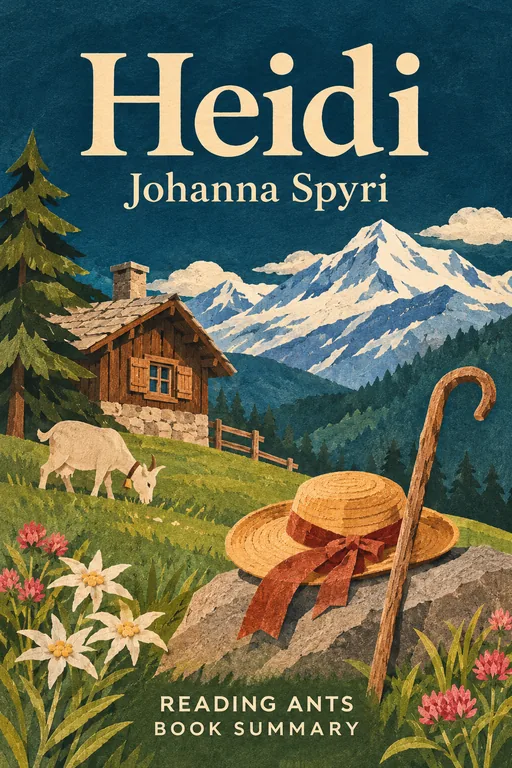
Heidi
An orphan girl brings joy to her grumpy grandfather in the Swiss Alps, is taken away to a sad city life, and then returns home to the mountains she loves.
Overview
Heidi is a children’s novel by the Swiss writer Johanna Spyri, published in two parts, in 1880 and 1881. It is set in the Swiss Alps and in the city of Frankfurt in Germany, in the nineteenth century. It is one of the best-loved children’s books in the world and has been translated into many languages. The story is about a cheerful, warm-hearted girl, and about the healing power of nature, kindness and faith. It is a gentle book, with a strong sense of love for home and the outdoors.
Main Characters
- Heidi: a young orphan, curious, lively and kind to everyone.
- Alm-Uncle (the Grandfather): Heidi’s grandfather, who lives alone in the mountains and is considered a harsh, strange man.
- Peter: the young goatherd, who is Heidi’s friend.
- Clara Sesemann: a rich girl in Frankfurt who cannot walk.
- Fraulein Rottenmeier: the strict housekeeper in the Sesemann house.
- Grandmother: Peter’s blind, elderly grandmother, who lives in the village.
- Aunt Dete: Heidi’s aunt, who takes her to the grandfather and later to Frankfurt.
Full Summary
Up the Mountain
Heidi is a small girl who has lost both of her parents. Her aunt Dete, who has been looking after her, takes her up the mountain to live with her grandfather, since Dete has found a job in a city. The grandfather is known in the village as a hermit and is believed to be unfriendly. He does not welcome the girl, but he lets her stay.
Heidi is delighted by the mountains, the goats, the flowers and the fresh air. She sleeps in a bed of hay in the loft, and she soon wins her grandfather’s heart with her warmth and honesty.
Peter and the Goats
Heidi becomes friends with Peter, a boy who herds goats on the mountain pastures. She goes with him, and learns all the goats’ names. She is happy in the open air.
She also visits Peter’s old, blind grandmother, who lives in a small cottage nearby. Heidi cheers her with her chatter. Heidi persuades her grandfather to repair the cottage, and he does, which shows a softer side of him.
Taken Away
After a few years, Aunt Dete returns and takes Heidi away to Frankfurt, to be a companion to Clara Sesemann, a girl who is in a wheelchair. The grandfather is angry and sad, but he does not stop her.
Clara and Heidi become friends, but the household is run by Fraulein Rottenmeier, who is cold, strict and disapproves of Heidi’s ways. Heidi, who cannot read, struggles to learn, and she is homesick for the mountains.
Homesick
As the months pass, Heidi grows pale and weak. She cannot eat, and she dreams of the mountains. She even begins to walk in her sleep, and the household is frightened because they think that the house is haunted. A doctor realizes that Heidi is homesick, and he advises that she be sent back home.
Clara’s grandmother, who has been kind to Heidi, has encouraged her to learn to read and has told her to trust in God. Heidi is allowed to go home, and she brings a gift of soft white rolls for Peter’s blind grandmother.
Home Again
Back in the mountains, Heidi is overjoyed. She reunites with her grandfather and with Peter. She reads aloud to Peter’s grandmother, and she brings back light to her days.
Later, Clara comes to visit the mountains. At first she is weak and must be carried, but the fresh air, the goat’s milk and Heidi’s company work wonders. Peter, who is jealous, pushes her empty wheelchair down the mountainside, and it is destroyed. This is a cruel act, and the story does not present it as the cure. Clara’s strength has been growing with the mountain air, good food and exercise, and with Heidi’s company.
Clara Walks
Without the wheelchair, Clara has to try to walk, which her growing strength now makes possible. With Heidi’s encouragement, and with the help of her friends, she takes her first steps. Her father and grandmother arrive, and they are overjoyed to see her walking.
The grandfather, who has softened over the years, makes peace with the church and the village, and is now welcomed by the villagers, who once avoided him. Clara’s family promises that they will always take care of Heidi, and the book ends with joy.
Why It Matters
Heidi is one of the best-selling children’s books of all time. It has been adapted many times for the screen and the stage, and it did much to shape the image of Switzerland as a land of mountains, goats and fresh air. The book was written for children, but it carries a serious message about the value of home, nature and compassion. It has inspired generations of young readers, and it is still a popular gift and a favorite in many countries. Spyri herself lived in Switzerland, so her descriptions of village life, goat milk and mountain sunsets come from a real love of the place. The book is also remembered for the way it treats a child’s feelings, such as homesickness, with great respect.
Key Takeaways
- Home is where we belong. Heidi’s love for the mountains shows how much our surroundings matter.
- Kindness can change people. Her warmth softens her grandfather.
- Nature can heal. Clara gets stronger in the mountain air.
- Friendship crosses differences. Heidi connects rich and poor, young and old.
- Faith and hope bring comfort. The book includes a strong religious message.
What We Can Learn
Heidi shows us that gentleness can work in places where force fails. Her grandfather is lonely and bitter, but her love breaks through. If we meet people who seem difficult, we can try kindness and patience.
The story also reminds us how much being outdoors can help our health and our mood. A walk in nature can be a simple way to feel better. Finally, Heidi’s homesickness teaches us to take seriously the feelings of children who are away from home, and to listen when they are sad.
Criticism and Counterpoints
Some modern readers find the book too sweet, and its religious messages too strong. The story’s idea that a child can be cured by fresh air is old-fashioned and not medically accurate. Others point out that the characters are drawn in broad strokes, with the villains, such as Fraulein Rottenmeier, being very one-sided. Yet many people feel that its charm and its love of nature outweigh these weaknesses.
Who Should Read It
This book is for children from about eight years old, and for adults who enjoy gentle, classic stories. It makes a good read-aloud. Those who dislike sentimental or religious stories may find it too sweet, but many readers love its warm, peaceful feeling.
Want the whole book?
A summary is a taste, not the meal. Here is where to find the full book.
You reached the end 🎉
Nicely done. Mark this one as read, and we will suggest what to read next.
Read this next

Anne of Green Gables
L. M. Montgomery
A talkative, imaginative red-haired orphan is sent by mistake to an elderly brother and sister who wanted a boy, and she wins their hearts and fills their quiet farm with life.
🧸 Children's Books
The Secret Garden
Frances Hodgson Burnett
A lonely, spoiled orphan sent to live in a gloomy English mansion discovers a locked, forgotten garden, and as she brings it back to life with two new friends, she and her sickly cousin are healed too.
🧸 Children's Books
A Little Princess
Frances Hodgson Burnett
When her wealthy father dies and leaves her penniless, a kind, imaginative girl named Sara Crewe is forced to become a servant at her boarding school, but she holds on to her inner dignity, and her kindness is eventually rewarded.
🧸 Children's Books
Little Women
Louisa May Alcott
Four very different sisters grow up together in a loving but poor family in New England during and after the American Civil War, learning about love, ambition, loss and finding their own paths in life.
📜 Classics
The Wonderful Wizard of Oz
L. Frank Baum
Swept by a cyclone to the magical Land of Oz, a Kansas girl follows the yellow brick road with three unusual friends to ask a great wizard for help, and learns they already had what they were seeking.
🧸 Children's Books
The Little Prince
Antoine de Saint-Exupery
A pilot stranded in the desert meets a small boy from a tiny planet, who teaches him that the most important things in life, like love and friendship, can only be seen with the heart.
🌍 World LiteratureWant something different?
Pick another topic and we will show you three books to start with.