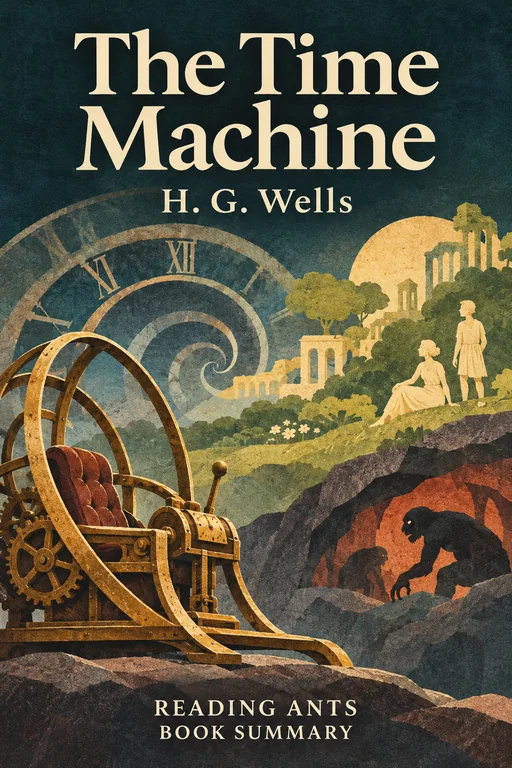
The Time Machine: the longer summary
In One Sentence
A Victorian inventor, known only as the Time Traveller, builds a machine that carries him to the year 802,701, where he encounters the gentle Eloi and predatory Morlocks and proposes a disturbing history of human division, and then to a dying Earth.
Before You Start (No Spoilers)
The Time Machine is a short novel by H. G. Wells, published in 1895, presented as an extraordinary account told to skeptical dinner guests. The story is told by a narrator, who relates what the Time Traveller told his dinner guests one evening. The book is both an adventure and a social parable, shaped by Wells’s concerns about class division in Victorian England and by new ideas of evolution. Its frame keeps the teller’s observations, his explanations and the listeners’ doubts distinct.
Who’s Who
- The Time Traveller: a curious, inventive Victorian scientist, whose name is never given.
- Weena: a gentle Eloi woman whom he saves and befriends.
- The Eloi: small, childlike, beautiful people who live above ground.
- The Morlocks: pale, apelike creatures who live underground and work machines.
- The narrator: one of the guests at the dinner, who tells the story.
- Filby, the Psychologist and the Medical Man: the dinner guests.
Full Summary
The Dinner
On a Thursday evening in London, the Time Traveller explains to a group of friends that time is a fourth dimension, in which travel is possible. He shows them a small model of a time machine, which vanishes. The guests are skeptical. A week later, he arrives late, disheveled and injured, and tells them what happened to him when he tested the full-sized machine.
The Future
The Time Traveller sits in the machine, pulls the lever and is hurled forward. He stops in the year 802,701. He finds himself in a garden-like land, with strange buildings, and meets the Eloi, small and beautiful people who seem to have little practical knowledge or sustained curiosity and do no visible work. They live on fruit and spend their days playing, and fear the dark. He concludes that humanity has reached a state of ease, and has lost its intelligence.
Weena and the Morlocks
Before descending among the Morlocks, he saves an Eloi woman named Weena from drowning. The other Eloi do not help her. She becomes attached to him and repeatedly tries to remain near him.
When the machine disappears, and he cannot find it, he explores. He discovers wells that lead below, where he finds the Morlocks, pale, ape-like beings who live in darkness and run machines. He reasons, in what is only his own changing theory, that the Eloi and Morlocks are the descendants of the upper and working classes, split so thoroughly that they have evolved into two species. He eventually concludes from his observations that the Morlocks feed on the Eloi and maintain them like livestock.
The Museum and the Fire
He explores the ruins of a museum, the Palace of Green Porcelain, where he finds matches and a weapon. He realizes that the Morlocks have taken his machine, and he is determined to recover it. At night, he and Weena are pursued by Morlocks, and he starts a fire in the woods; in the confusion of the fire and the Morlock attack, Weena is lost, and presumed dead.
The Machine
The Time Traveller finds the machine inside the pedestal of a great white statue, where the Morlocks have left it as bait for a trap, and manages to fight his way to the controls and escape. He travels further forward, millions of years, and sees the Earth dying. The sun is red and huge, the shore is inhabited by strange crab-like creatures. He then travels to a time when the Earth is nearly frozen, and the only living thing he sees is a black, ball-like creature on a beach.
The Return
The Time Traveller returns to his own time, and tells his story to his astonished friends. The next day, the narrator finds him preparing to set off again, with a camera, promising to be back shortly, but he does not return. The narrator is left to wonder whether he is lost in time. He keeps in mind the two strange white flowers that the Time Traveller brought back from the future, a sign of gratitude and love, and a faint hope for humanity.
The frame of the story matters, too. Because the whole adventure is told second-hand by a dinner guest, readers are left to decide for themselves how much to believe. The final pages leave open both the Time Traveller’s fate and the question of whether the future he saw can still be avoided.
The Traveller’s Ideas Meet an Unfamiliar World
The dinner table creates a problem of evidence
The opening discussion turns an impossible-sounding journey into something the guests can argue about. The Time Traveller begins with an explanation of dimensions and a small device they can watch. The model’s disappearance supplies an event, but not an agreed interpretation. People can see the same demonstration and still disagree about whether it proves travel through time.
The social setting matters. This is a gathering of comfortable people used to treating difficult questions as conversation. The room offers food, familiar habits and a sense that the world is manageable. When the Traveller later returns dirty, injured and urgently hungry, his body breaks through that calm. Whatever explanation the guests prefer, something has happened that polite argument alone cannot account for.
Wells does not let the reader inspect the future directly through an all-knowing narrator. We hear a guest recount the Traveller telling his story. The distance leaves space for doubt, misremembering and interpretation. It also makes the tale resemble a disturbing report brought home by an explorer: the audience must decide what to do with evidence it cannot independently repeat at once.
Arrival rewards the wrong expectation
The Traveller expects the distant future to be intellectually impressive. Greater knowledge and better machines seem natural extensions of the progress familiar to him. The Eloi’s gentle appearance and pleasant surroundings initially offer another kind of success: perhaps hardship has been overcome so completely that strenuous effort is no longer necessary.
He quickly becomes dissatisfied. Their attention is brief, their conversation limited and their interest in him less serious than he hoped. They do not behave like advanced scientists waiting to explain a transformed civilization. His first account of them turns comfort into the cause of decline: without difficulty, he thinks, strength and intelligence have faded.
This explanation is plausible to him because it fits things he already believes. Yet he has seen only a small part of the world. The novel repeatedly lets him build a theory from incomplete observation and then encounter something it cannot explain. His confidence is part of the action, not a guarantee that readers should accept each conclusion as Wells’s final judgment.
The missing machine turns a visit into captivity
Until the machine disappears, the Traveller can imagine himself as someone who will observe and then leave. Its loss changes his position. He is now dependent on understanding a society whose language and habits he barely knows. The beautiful landscape becomes threatening because he cannot choose when to depart.
The white sphinx provides a focus for that anxiety. The machine appears to have been moved into its pedestal, but the object cannot be opened by ordinary persuasion or force. A statue that looked like scenery becomes a barrier between him and home. The mystery is practical before it is philosophical: he must regain access to the device.
His inability to get useful answers from the Eloi also complicates their apparent innocence. Their lack of explanation may arise from ignorance, fear or inability to understand him. From his position, the distinction is difficult to establish. He has to keep observing rather than treating their silence as reliable evidence that nothing dangerous exists.
Weena makes the future personal
Weena’s rescue begins with a contrast between the Traveller’s response and the behavior of the other Eloi. He sees a person in immediate danger and acts, while they do not provide effective help. The event challenges the idea that a gentle, playful society must also be a deeply caring one.
Her attachment gives him a relationship beyond observation. He still struggles to communicate, and his descriptions of her are often patronizing, but she becomes a particular companion rather than an interchangeable example of a future species. Her fear of darkness supplies information he does not yet know how to interpret.
The flowers she places in his pocket later become the story’s most enduring physical objects. Their importance is not that they explain the machinery of time travel. They connect a vast speculative history with an individual act of affection. Long after theories have become uncertain, the narrator can remember that someone in the future cared about the visitor.
Going below ground overturns the garden
The wells and ventilation structures indicate work hidden beneath the pleasant surface. The Traveller cannot maintain his first theory once he encounters the Morlocks. Their pale bodies, sensitivity to light and mechanical activity suggest a different environment and a different history from that of the Eloi.
He proposes that social divisions have become biological ones. Wealthy people remained above ground while workers were pushed below, until separation changed both groups. This is an inference, not a history supplied by a Morlock witness. It nevertheless gives the imagined future a direct connection with the inequality of his own society.
The discovery of predation changes the meaning of comfort again. The Eloi are not simply leisurely rulers supported by invisible servants. Their dependence has become a terrifying vulnerability. In his developed explanation, the Morlocks maintain the conditions under which the Eloi live and also feed on them. A former hierarchy has not been peacefully repaired; it has developed into another form of exploitation.
The museum preserves objects without their world
The Palace of Green Porcelain is a storehouse of knowledge that has lost the institutions and habits needed to maintain it. Objects remain, but many have decayed or become useless. The Traveller cannot simply recover the full power of past civilization by walking through its remains.
He chooses practical things from the ruins: something to use as a weapon and a means of making fire. The selection reverses his original expectation of learning extraordinary future science. To survive in the distant future, he depends on familiar, comparatively simple tools. Progress has become a question rather than the secure direction of history.
The museum also puts his own period in perspective. What seems permanent to one generation may become a fragile collection to another and dust to a later one. Knowledge requires living communities that can explain, repair and pass it on. Objects alone cannot guarantee that understanding will survive.
Fire reveals the danger of partial understanding
The Traveller knows that the Morlocks fear light and imagines fire as protection. Yet using a force successfully in one way does not mean he can control all its effects. Exhaustion, darkness and the surrounding vegetation turn the escape into a disaster.
Weena disappears during the violence and confusion. The Traveller believes she is lost, but he cannot give a clear, witnessed account of her death. That uncertainty is important. Her absence cannot be repaired by another confident explanation. His exploration has involved a responsibility toward a companion that he has not been able to fulfill.
The burning forest therefore does more than provide a thrilling escape. It tests the idea that superior technical knowledge automatically makes a visitor safe or wise. The Traveller can frighten the Morlocks, but he cannot make the whole environment obey his intentions. His power is real and limited at the same time.
Escaping the trap does not restore faith in progress
When the sphinx opens, the machine offers an obvious temptation. The Morlocks intend the enclosed darkness to favor them. The Traveller escapes by reaching the controls, turning the device from lost property back into a means of movement.
He then goes farther into the future rather than immediately stopping at home. The scale of the story expands beyond the social fate of humanity. The changing sun, strange shore creatures and eventual cold place the struggle between Eloi and Morlocks inside an even larger history of planetary change.
Those scenes are Wells’s imagined far future, shaped by the scientific ideas available to him. They should not be treated as an accurate modern timetable for the Earth or Sun. Their literary function is to remove human civilization from the center of the universe. Even enormous social transformations become brief events beside the timescale he now glimpses.
The final disappearance leaves two different legacies
Back at the dinner table, the ordinary room makes the adventure difficult even for its teller to hold in mind. The guests can examine the machine and flowers, but they still cannot settle every question. The Traveller’s next departure prevents a neat demonstration that would end doubt for everyone.
For the narrator, the future remains unknown. The Traveller’s account may warn against social arrangements that seem permanent in the present, but it does not give an instruction manual for preventing them. The missing man also remains a friend whose fate cannot be established.
The flowers provide a smaller and more intimate conclusion. Whatever has happened to human intelligence, culture or power in the Traveller’s story, tenderness still appears. The narrator keeps that evidence beside the frightening account of decline. Hope survives as a reason to care and act in the present, rather than as certainty that history will improve on its own.
Why It Still Matters
The Traveller’s explanations keep changing. What first seems a victory over hardship becomes evidence of lost capacities; what looks like effortless leisure turns out to depend on hidden activity. The machinery of the story is therefore intellectual as well as physical. Recovering his device requires him to revise what he thinks he knows.
The far-future shore then changes the scale of the problem. Humanity’s divided descendants no longer occupy the whole imaginable future, and even the familiar sun becomes strange. These are literary projections, not a modern scientific schedule for the planet. Against that immensity, the narrator keeps Weena’s flowers. Their significance is modest but durable: tenderness appears inside the frightening history the Traveller tells. The ending supplies neither proof of inevitable progress nor a complete explanation of the missing man. It leaves evidence to interpret and a personal loss to remember.
Key Takeaways
- Social division is the Traveller’s explanation. He interprets the two groups as descendants of separated classes; no independent historian confirms it.
- Comfort can weaken us. The Eloi have lost intelligence.
- Progress is not guaranteed. The future is not necessarily better.
- Curiosity drives discovery. The Time Traveller explores.
- Time is vast. The end of the world puts human life in perspective.
What We Can Learn
The novel suggests that societies that ignore inequality may pay a price, and that a life without challenge may leave people weaker. It encourages us to think about the long-term effects of our choices.
It also reminds us that curiosity is valuable, but that exploring the unknown can be dangerous.
Finally, it invites us to consider our place in a much longer story, and to be humble.
It also encourages a long view: readers can ask how present arrangements might shape later lives. That is a question prompted by the story, rather than a hopeful prediction the Traveller has proved.
Criticism and Counterpoints
The Traveller explains an enormous span of history from limited observations. His theory is powerful as a social warning, but the novel does not supply an independent record confirming every stage. His condescending descriptions of the Eloi and Weena reveal assumptions he brings from home as well as things he discovers.
The physical science is also part of a speculative tale. The model’s disappearance and the later journey are narrated through witnesses who cannot reproduce every observation. A reader can examine the implications without accepting the machinery as experimentally demonstrated. Weena’s lost fate is another limit: the Traveller presumes she dies in the forest disaster, but cannot provide a witnessed account of her final moments.
Who Should Read It
This book suits readers from about ten up to adults. It is short and easy to read, and includes some frightening moments. It is a good choice for those who like classic science fiction.
What to Notice While Reading
- Revised explanations. Keep track of the Traveller’s changing theories. Each revision exposes information he missed and assumptions he brought from home.
- Above and below. The landscape gives social division a physical form. Pleasant surfaces depend on hidden labor and conceal hidden danger.
- Tools in different settings. A machine, matches and a metal bar provide power, but none gives complete control. Notice what each solves and what it cannot solve.
- The limits of the frame narrator. The final account belongs to someone who did not make the journey. This preserves both skepticism and the emotional effect of a friend’s disappearance.
- Weena’s flowers. Their modest size contrasts with the immense future. They preserve an act of care that the broader theories might overlook.
Questions to Think About
- Why does the Traveller initially expect intelligence to increase with time?
- When does a plausible theory become an obstacle to seeing new evidence?
- How does losing the machine change his relationship to the future?
- What responsibility does he have toward Weena, and where does he fail her?
- Why end with flowers rather than with a final explanation of the machine or the future?
Want the whole book?
A summary is a taste, not the meal. Here is where to find the full book.