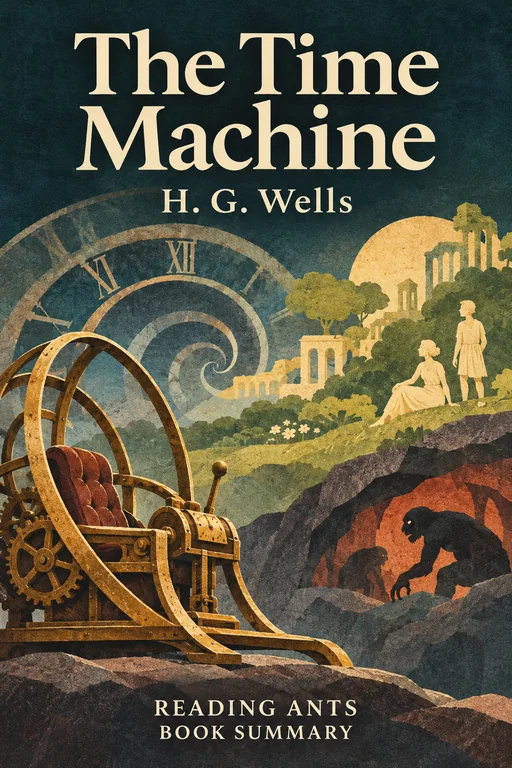
The Time Machine
A Victorian inventor, known only as the Time Traveller, builds a machine that carries him to the year 802,701, where he finds humanity split into two species, the gentle Eloi and the monstrous Morlocks, and then to a dying Earth.
Overview
The Time Machine is a short novel by H. G. Wells, published in 1895, and it was his first major work of science fiction. It popularized the idea of a machine that can travel through time, and the term “time machine.” The story is told by a narrator, who relates what the Time Traveller told his dinner guests one evening. The book is both an adventure and a social parable, shaped by Wells’s concerns about class division in Victorian England and by new ideas of evolution. It has been adapted into films in 1960 and 2002, and has been imitated for over a century.
Main Characters
- The Time Traveller: a curious, inventive Victorian scientist, whose name is never given.
- Weena: a gentle Eloi woman whom he saves and befriends.
- The Eloi: small, childlike, beautiful people who live above ground.
- The Morlocks: pale, apelike creatures who live underground and work machines.
- The narrator: one of the guests at the dinner, who tells the story.
- Filby, the Psychologist and the Medical Man: the dinner guests.
Full Summary
The Dinner
On a Thursday evening in London, the Time Traveller explains to a group of friends that time is a fourth dimension, in which travel is possible. He shows them a small model of a time machine, which vanishes. The guests are skeptical. A week later, he arrives late, disheveled and injured, and tells them what happened to him when he tested the full-sized machine.
The Future
The Time Traveller sits in the machine, pulls the lever and is hurled forward. He stops in the year 802,701. He finds himself in a garden-like land, with strange buildings, and meets the Eloi, small and beautiful people who seem to have no knowledge, curiosity or work. They live on fruit and spend their days playing, and fear the dark. He concludes that humanity has reached a state of ease, and has lost its intelligence.
The Morlocks
When the machine disappears, and he cannot find it, he explores. He discovers wells that lead below, where he finds the Morlocks, pale, ape-like beings who live in darkness and run machines. He reasons, in what is only his own changing theory, that the Eloi and Morlocks are the descendants of the upper and working classes, split so thoroughly that they have evolved into two species. The Morlocks, he learns, feed on the Eloi, who are like cattle.
Weena
The Time Traveller saves a young Eloi woman, Weena, from drowning, and she becomes his companion, and shows him a kind of affection. He explores the ruins of a museum, the Palace of Green Porcelain, where he finds matches and a weapon. He realizes that the Morlocks have taken his machine, and he is determined to recover it. At night, he and Weena are pursued by Morlocks, and he starts a fire in the woods; in the confusion of the fire and the Morlock attack, Weena is lost, and presumed dead.
The Machine
The Time Traveller finds the machine inside the pedestal of a great white statue, where the Morlocks have left it as bait for a trap, and manages to escape, killing some of them. He travels further forward, millions of years, and sees the Earth dying. The sun is red and huge, the sea is lifeless, and there are only strange crab-like creatures. He then travels to a time when the Earth is nearly frozen, and the only living thing he sees is a black, ball-like creature on a beach.
The Return
The Time Traveller returns to his own time, and tells his story to his astonished friends. The next day, the narrator finds him preparing to set off again, with a camera, promising to be back shortly, but he does not return. The narrator is left to wonder whether he is lost in time. He keeps in mind the two strange white flowers that the Time Traveller brought back from the future, a sign of gratitude and love, and a faint hope for humanity.
The frame of the story matters, too. Because the whole adventure is told second-hand by a dinner guest, readers are left to decide for themselves how much to believe. The final pages leave open both the Time Traveller’s fate and the question of whether the future he saw can still be avoided.
Why It Matters
The Time Machine is a founding work of science fiction, and Wells is often called one of its fathers, along with Jules Verne. It introduced concepts that have shaped the genre, including the use of time travel to explore social and philosophical questions. It also reflected the fears of its age, in particular the effects of industrial capitalism, and a pessimism about the future of humanity.
The book’s central images, the Eloi and the Morlocks, have become standard references, and the novel has inspired countless stories about time.
Its last chapters, set on a nearly lifeless beach under a dying sun, remain some of the most memorable images in early science fiction.
Key Takeaways
- Social divisions can have lasting effects. The classes have split into two species.
- Comfort can weaken us. The Eloi have lost intelligence.
- Progress is not guaranteed. The future is not necessarily better.
- Curiosity drives discovery. The Time Traveller explores.
- Time is vast. The end of the world puts human life in perspective.
What We Can Learn
The novel suggests that societies that ignore inequality may pay a price, and that a life without challenge may leave people weaker. It encourages us to think about the long-term effects of our choices.
It also reminds us that curiosity is valuable, but that exploring the unknown can be dangerous.
Finally, it invites us to consider our place in a much longer story, and to be humble.
It also encourages a long view: the Time Traveller’s hope is that the choices people make now, about fairness and about how they treat one another, are what will decide what the future looks like.
Criticism and Counterpoints
Some readers find the plot thin, and the characters, apart from the Time Traveller, undeveloped. Others criticize its picture of class division as simplistic, or find that the Eloi and Morlocks are a crude stereotype of the rich and the poor. The story’s science is not rigorous, and the ending is pessimistic.
A few modern readers find its attitudes to women, represented by Weena, patronizing. Still, it is a classic.
Who Should Read It
This book suits readers from about ten up to adults. It is short and easy to read, and includes some frightening moments. It is a good choice for those who like classic science fiction.
Want the whole book?
A summary is a taste, not the meal. Here is where to find the full book.
You reached the end 🎉
Nicely done. Mark this one as read, and we will suggest what to read next.
Read this next
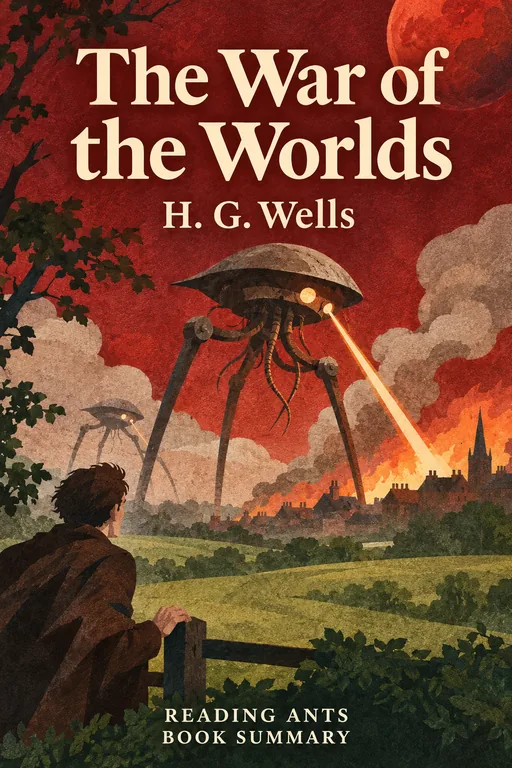
The War of the Worlds
H. G. Wells
Martians land in the English countryside with war machines and heat-rays that overwhelm human armies, until the invaders are brought down by the one thing humans never expected: Earth's smallest germs.
🚀 Sci-Fi & FantasyThe Invisible Man
H. G. Wells
A brilliant scientist who has discovered how to make himself invisible finds that the power isolates him and drives him toward cruelty, until a frightened community hunts him down.
🚀 Sci-Fi & Fantasy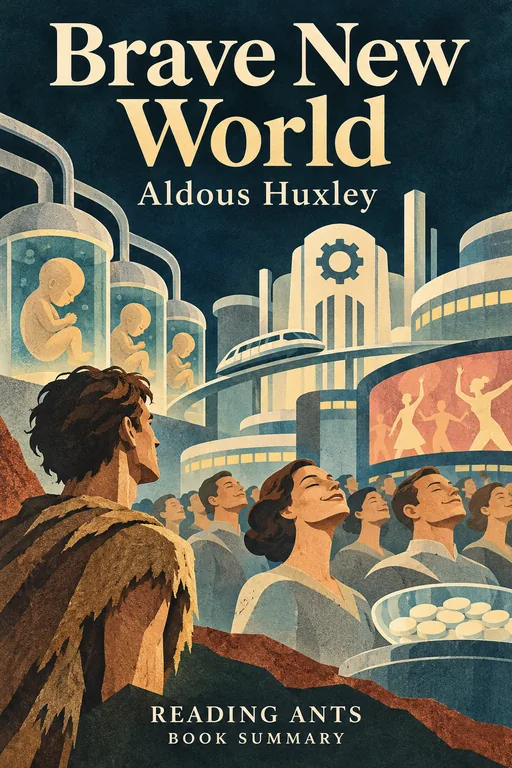
Brave New World
Aldous Huxley
In a future world where people are made in factories, programmed for their roles and kept happy with drugs and entertainment, a man raised outside the system discovers that this perfect comfort comes at the cost of everything that makes us human.
📜 Classics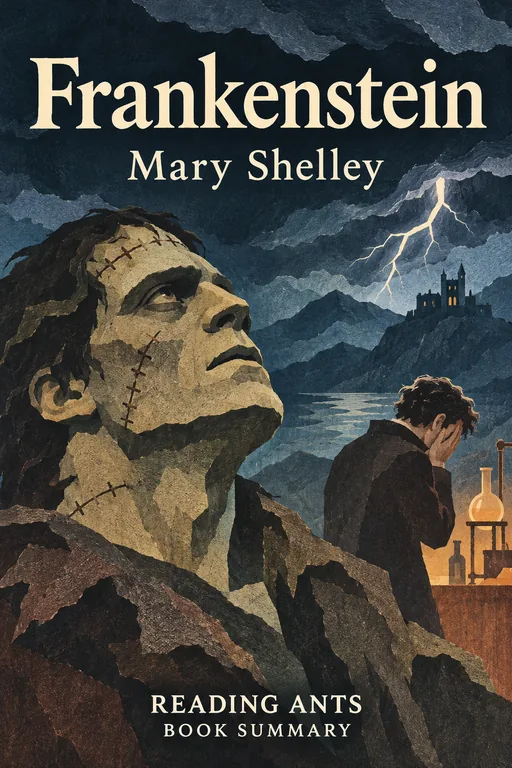
Frankenstein
Mary Shelley
A young scientist creates a living being from dead body parts, then abandons it in horror, and his rejected creation, longing for love, turns to revenge.
🚀 Sci-Fi & Fantasy
Fahrenheit 451
Ray Bradbury
In a future America where books are illegal and firemen start fires instead of putting them out, one fireman begins to read the books he is supposed to burn, and discovers what his society has lost.
🚀 Sci-Fi & Fantasy
The Martian Chronicles
Ray Bradbury
Through a series of linked stories, Ray Bradbury follows human beings as they travel to Mars, destroy the people who live there, build towns that copy the Earth they left behind, and are then pulled back home when a nuclear war breaks out.
🚀 Sci-Fi & FantasyWant something different?
Pick another topic and we will show you three books to start with.