 Reading Ants
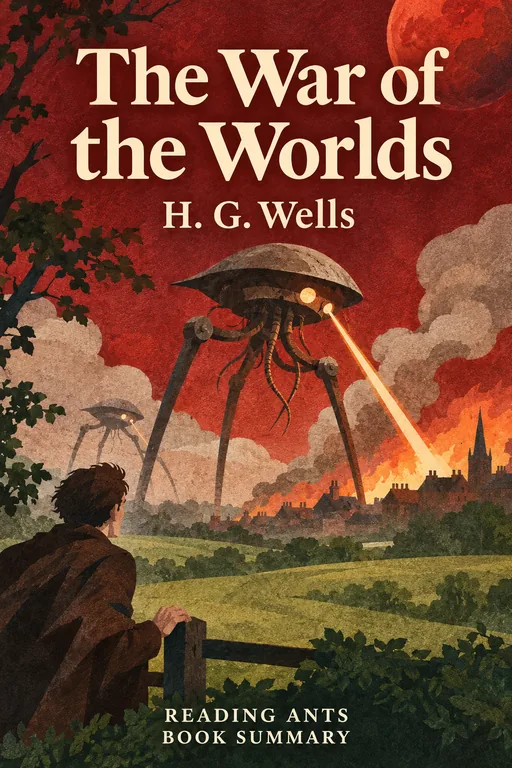
The War of the Worlds: the longer summary
In One Sentence
An English writer struggles to survive and find his wife when Martian invaders overturn ordinary life with machines far beyond the power of human armies.
Before You Start (No Spoilers)
The War of the Worlds is a science fiction novel by H. G. Wells, published in 1898. It imagines an invasion through the experience of people whose familiar surroundings suddenly become unsafe. The narrator, an unnamed man living in Surrey, England, describes how strange cylinders fall from Mars and the invaders build tall, three-legged fighting machines that destroy everything in their path. Wells set the story in familiar English towns, such as Woking, Richmond and London, and wrote it in the realistic style of a news report, which made the shocking events feel real. The book was also a pointed comment on the British Empire, asking readers to imagine how it feels to be conquered by a far stronger power.
Who’s Who
- The narrator: an unnamed writer with an interest in science, who survives the invasion.
- The narrator’s wife: whom he sends to safety and fears he has lost.
- The narrator’s brother: a medical student in London, whose story is told separately.
- The curate: a religious man who loses his mind from fear.
- The artilleryman: a soldier with big, unrealistic plans for survival.
- Ogilvy: an astronomer who first sees the signs of Mars.
- The Martians: tentacled creatures with large heads and enormous intelligence.
Full Summary
The Falling Stars
At the start, astronomers notice strange explosions of gas on Mars. Soon afterward, a ‘falling star’ lands on Horsell Common, near the narrator’s home. It is a huge metal cylinder. A crowd gathers, and the top of the cylinder starts to unscrew. A strange, gray, tentacled creature appears. When a group of men approaches with a white flag, a beam of heat flashes out and burns them to death.
The Heat-Ray
The military arrives but is largely outmatched, though artillery does destroy a machine. More cylinders land across southern England. The Martians climb out of their pits and assemble giant three-legged machines, ‘tripods,’ that tower over trees and buildings. They fire heat-rays that burn everything, and release a poisonous black smoke that kills anyone who breathes it. The narrator escapes with his wife to Leatherhead and leaves her with friends. When he returns, he finds the countryside devastated.
The Curate and the Artilleryman
The narrator spends time trapped in a ruined house with a frightened curate, who is useless and self-pitying, and he observes the Martians obtaining nourishment by transferring blood from captured humans directly into their own bodies. The curate’s noise attracts the Martians, and the narrator knocks him unconscious to keep them from discovering both of them; a Martian’s mechanical tentacle then reaches into the ruined house and removes the curate. Later, the narrator meets an artilleryman, who dreams of building an underground society to survive, with the strongest, cleverest people hunting with machines. The narrator soon recognizes that the man is lazy and deluded.
The Red Weed
During the invasion, the narrator notices a strange red weed spreading across the landscape, a Martian plant that covers ruins and rivers, making familiar places look as though they belong to another world; its spread does not by itself prove a deliberate plan for remaking Earth. From a hiding place, he watches the Martians at work in their pits, building machines and carrying out experiments, and begins to understand how little they care about humans, whom they treat as food and as obstacles. Alone in a flooded and silent countryside, he comes close to despair, and wonders whether humanity’s day is over.
London
Meanwhile, the narrator’s brother is in London, which is gripped by panic as people flee. Steamships take refugees across the sea, and thousands crowd the roads, in scenes of fear and chaos. A brave ship, the Thunder Child, destroys two Martian tripods before being destroyed itself.
The Ruined City
The narrator walks toward London through empty streets and abandoned houses, expecting at any moment to meet a Martian. Instead, he finds a world eerily silent, with only a few stray dogs and an occasional corpse. At last he hears a strange, mournful cry, repeated again and again, and fears the worst.
Death of the Martians
The narrator, wandering among the ruins of London, finds the Martian machines motionless. Approaching them, he sees the Martians lying dead, killed by the bacteria of Earth, to which they have no immunity. The narrator explains their deaths through their lack of resistance to terrestrial microbes. This is the explanation within the novel, not an independently verified account of Martian biology.
Aftermath
The narrator is reunited with his wife, whom he thought dead. Humanity recovers and studies the technology left behind, changing its view of its place in the universe. The narrator ends by wondering whether the Martians, or others, may come again.
How the Invasion Changes Human Life
The observers become the observed
The opening asks readers to abandon a comfortable assumption: that human life is the main event in the universe. People study other planets, classify animals and expand empires while scarcely imagining that another intelligence might study them. Wells turns those familiar habits around. The Martians consider Earth from outside, and human beings become the creatures whose home is being assessed for somebody else’s purposes.
The first cylinder initially looks like an interesting local event. People walk out to see it, discuss it and gather around it. Their curiosity belongs to the world before the invasion, where an unusual object can become a spectacle. The visitors’ intentions are not yet known, but the crowd largely acts as though observation is safe.
The first heat-ray destroys that confidence. A peaceful approach does not create a shared language or a negotiation. Human signals have no power over an enemy that does not recognize an obligation to answer them. The horror comes partly from this lack of a common framework. The people approaching the pit have ideas about how civilized beings should behave, but those ideas do not protect them.
Geography turns into a map of escape
The narrator knows the towns and roads around his home. At first, that knowledge helps him organize a response: send his wife toward safety, return borrowed transport and judge where the danger is spreading. Yet each new landing changes the usefulness of the map. A road that was safe hours earlier may lead toward another machine.
His separation from his wife makes the invasion personal. News is uncertain, movement is difficult and the normal means of finding somebody break down. The question is not simply whether the human species will survive. It is also whether one man can learn what has happened to the person he most wants to protect.
Military resistance briefly creates hope. A machine can be damaged, so the Martians are not physically invulnerable. But the scale of the technological difference defeats organized human defenses. Ordinary courage remains real without becoming sufficient. Wells lets soldiers and civilians act bravely while refusing the comforting idea that bravery alone can overcome any weapon.
The brother’s story widens the disaster
The narrator cannot witness everything, so the account of his brother supplies another perspective. London does not immediately understand the threat. People receive fragments of information, continue familiar routines and then suddenly find themselves among crowds trying to leave. The speed of the change makes social order seem much more fragile than it appeared at the beginning.
On the roads, money and position do not guarantee a clear passage. Vehicles block one another, exhausted people compete for space, and families try to keep together. The brother’s encounters show how quickly fear can produce both selfishness and help. Some people exploit confusion; others take risks for strangers.
The episode with the Thunder Child gives the refugees a brief experience of human power acting on their behalf. The warship fights rather than merely escaping, and its action helps others get away. Its destruction does not make that sacrifice meaningless. It does show that a successful local act of resistance can coexist with a larger military defeat. The novel holds those two scales together.
The ruined house becomes a terrible classroom
The narrator’s confinement with the curate places two frightened people in a space where noise may kill them. The curate cannot make sense of the disaster and repeatedly returns to his own anguish. The narrator becomes impatient and then desperate. Their conflict shows that sharing a hiding place does not automatically create solidarity.
Through an opening in the ruins, the narrator observes the Martians closely. Their bodies are strange, but their machines extend their abilities. Mechanical tools perform functions that their physical forms cannot easily perform on Earth. The distinction between a creature and its technology becomes important: the terrifying giant is partly an engineered extension of a smaller living being.
The treatment of captured humans makes the invaders’ indifference unmistakable. The narrator is no longer looking at a distant scientific curiosity. He sees a system in which people are resources. The comparison with how humans use other animals is disturbing because it makes the Martians’ behavior recognizable without excusing it. Greater intelligence has not produced greater mercy.
Survival can become another fantasy of rule
After the curate is taken, silence and hunger dominate the narrator’s life. He must wait, search for food and judge when it is safe to move. These basic tasks reduce the grand story of a planetary war to the demands of a single body. His survival depends less on a heroic plan than on caution, luck and endurance.
The artilleryman later offers a vision that sounds more active. He imagines a selected human population living underground and eventually learning to use Martian machines. His account supplies order and purpose after chaos. It also divides people into those he considers worth saving and those he would abandon.
The narrator notices the gap between this ambitious speech and the small amount of actual preparation. The artilleryman’s plan allows him to feel important without doing the hard work his dream requires. Wells questions both the practicality and the values of the scheme. A human response to conquest can itself adopt the conqueror’s contempt for vulnerable lives.
The landscape refuses to stay Martian
The red weed makes the invasion look permanent. It spreads across familiar places and changes the appearance of water and land. This is more than battlefield damage. It suggests that the environment itself might be remade, leaving human beings as survivors in somebody else’s world.
Yet the plant is also a living organism entering an unfamiliar biological system. Its decline prepares for the larger reversal. Machines can crush buildings and weapons can kill soldiers, but neither eliminates the countless forms of life that already occupy Earth. The invaders understand many things about technology while failing to account for conditions on which their own bodies depend.
When the narrator finds the Martians dead, the ending overturns the expected shape of a war story. No final human army wins the decisive battle. Ordinary microorganisms do what human weapons cannot. This is not a celebration of disease as harmless; it is a reminder that power exists at scales human pride and military planning can overlook.
Recovery does not erase the experience
The narrator’s reunion with his wife restores a part of the life he thought lost. It does not restore the old certainty that ordinary surroundings are secure. Familiar streets now carry memories of destruction, and future signs in the sky can provoke fear.
The account is therefore both a survival story and a warning against taking human dominance for granted. The Martians are defeated, but their arrival has changed the meaning of Earth’s place in the universe. Human beings can learn from the invasion without possessing a guarantee that it will never happen again. Wells ends with relief and vulnerability existing together.
Why It Still Matters
The novel reverses a familiar claim to mastery. Its opening compares humanity’s treatment of other creatures and peoples with the Martians’ treatment of Earth. Readers are asked to imagine losing the power to decide which lives matter. This comparison gives the invasion an ethical dimension beyond the spectacle of unusual weapons.
Its two witnesses also show why a disaster cannot be understood from one hiding place. The narrator knows some events directly, while his brother’s experiences widen the picture of flight and resistance. Both accounts depend on partial information, changing routes and the collapse of ordinary communication.
The ending challenges the expected military solution. Weapons can destroy machines, yet the decisive change comes from biological conditions the invaders have not mastered. Relief does not restore the narrator’s earlier confidence. His reunion with his wife brings back one essential relationship, while his final fears preserve the memory that apparently secure human arrangements can be overturned.
Key Takeaways
- Humans are not invincible. A technologically advanced enemy can overwhelm us.
- Empire has two sides. Wells invites the British to imagine being the conquered.
- Nature can be a powerful ally. Microbes defeat the Martians.
- Fear brings out the best and worst. Some people flee, some help others.
- Humility is wise. Humans may not be the center of the universe.
What We Can Learn
The novel invites us to think about how it feels to be on the receiving end of overwhelming force. Wells wrote it at the height of the British Empire, and he asked readers to consider what it meant for those the empire conquered.
It also reminds us that nature has its own balance. The tiniest living things, bacteria, which we often fear, have protected humanity.
Finally, it shows how people react in a crisis. Some panic, some become selfish, and some stay calm and help others. Preparing for emergencies, and keeping our heads, can make a difference.
Criticism and Counterpoints
The narrator often explains the invasion from a distance, which can make the people around him seem less developed than the disaster itself. His brother’s account broadens the novel but also interrupts the narrator’s own journey. The sudden discovery of dead Martians can feel abrupt after so much human suffering and resistance.
Several explanations are presented with the confidence of the fictional narrator, including claims about life on Mars and human resistance to microbes. They belong to the novel’s imagined science. The invasion’s comparisons with conquest also deserve scrutiny: the narrator challenges human cruelty while sometimes using the language of hierarchy himself. That tension is more accurate than describing the book as simply endorsing the strongest side.
Who Should Read It
This short novel suits readers from about 10 upward who enjoy science fiction and adventure. Some language and scenes of destruction may be too intense for the very young. Readers interested in how catastrophe changes ordinary places will find much to discuss.
What to Notice While Reading
- Reversed viewpoints. Humans become the objects of study and conquest. The novel repeatedly asks readers to consider power from the side of its victims.
- Ordinary place names. The recognizable towns make catastrophe feel close to daily life. Routes used for work and visits become routes of flight.
- Two witnesses. The brother’s account gives the novel a wider view while acknowledging what the main narrator could not personally observe.
- Promises versus preparation. Compare the artilleryman’s large plan with the work he has actually done. Confidence can imitate competence.
- Living limits on machines. The red weed and the Martians enter an ecosystem. Their technology does not remove their biological dependence.
Questions to Think About
- How does the first crowd misunderstand its position in relation to the Martians?
- Which acts of courage remain valuable even though they do not win the war?
- What does the curate’s story show about fear and cooperation?
- Why is the artilleryman’s proposed society troubling as well as impractical?
- Does the ending make humanity powerful again, or does it teach a different lesson about survival?
Want the whole book?
A summary is a taste, not the meal. Here is where to find the full book.