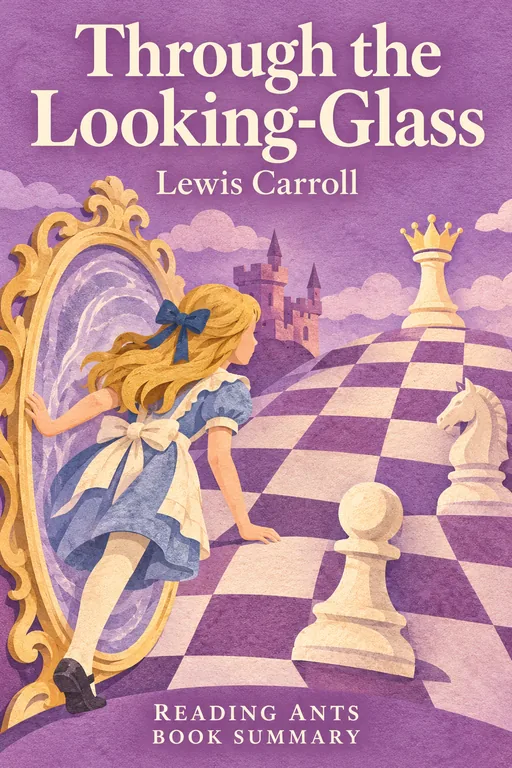
Through the Looking-Glass: the longer summary
In One Sentence
Alice climbs through a mirror into a backwards world laid out like a chessboard, and journeys across it as a pawn, meeting strange creatures along the way, until she reaches the eighth square and is crowned a queen.
Before You Start (No Spoilers)
Through the Looking-Glass, and What Alice Found There is a children’s fantasy by Lewis Carroll, the author of Alice’s earlier adventure, published in 1871 as the sequel to Alice’s Adventures in Wonderland. Where playing cards take a central role near the end of the first book, this one gives Alice a route across a chessboard, and its logic is built on reversal and wordplay. It includes Jabberwocky, a poem whose strange words still suggest a story. The narrative moves between noisy comedy, verbal puzzles and tender partings.
Who’s Who
- Alice: a polite, curious and sensible girl who tries to make sense of nonsense.
- Kitty and Dinah: Alice’s kitten and her mother cat, whom she talks to in the real world.
- The Red Queen: a stern, fast-moving chess queen who corrects Alice’s manners.
- The White Queen: a flustered, forgetful queen who lives backwards in time.
- Tweedledum and Tweedledee: two round, quarrelsome twins who recite a poem.
- Humpty Dumpty: an egg who insists that words mean whatever he chooses.
- The White Knight: a gentle, clumsy inventor who falls off his horse.
Full Summary
Through the glass
On a snowy afternoon, Alice plays with her kitten Kitty and wonders what the room behind the mirror is like. Imagining that the glass has turned soft like mist, she climbs up onto the mantelpiece and passes through into a reversed version of her own sitting room. There she finds chess pieces walking about and a book written backwards, which she can read only by holding it to the mirror. She reads the poem Jabberwocky, which seems to be about something marvelous, though she cannot quite say what.
The garden of live flowers
Alice goes out into the garden, which she wants to see from a hill. Whatever path she takes leads her back to the house. She finds the talking flowers, who gossip and criticize her, and she meets the Red Queen, who leads her up the hill. From the top Alice sees that the whole country is laid out like a giant chessboard, and she wishes to join the game. She is made a pawn, and the Red Queen tells her that she will become a queen if she reaches the eighth square. After an exhausting run with the Red Queen, Alice discovers that the landscape has not moved past them. The Queen describes a world in which changing position requires still greater effort.
Tweedledum and Tweedledee
Taking a train through the countryside, Alice moves on across the chessboard, and meets two identical plump twins, Tweedledum and Tweedledee. They recite The Walrus and the Carpenter, a poem about two figures who lure young oysters out for a walk and eat them. Afterward, they show Alice the sleeping Red King and claim that her existence depends on his dream. The twins then argue over a rattle and prepare to fight, until a huge crow frightens them. After the twins, Alice meets the White Queen, who lives backward and remembers things before they happen.
Humpty Dumpty and the Lion and the Unicorn
Alice meets Humpty Dumpty, sitting on a wall, who explains the strange words in Jabberwocky and claims that his authority as a speaker lets him assign meanings at will. She then meets the White King and his messengers, and watches the Lion and the Unicorn fighting over the crown. Alice is amused when the Unicorn says that he had always thought children were fabulous monsters, and she answers that she had thought the same of unicorns, so they agree to believe in each other. The scene is full of puns and of comic arguments about logic.
The White Knight
A Red Knight comes galloping up and claims Alice as his prisoner, but the White Knight arrives and says that he rescued her, so the two knights fight for her. They tumble off their horses again and again, and the battle ends with the Red Knight riding away. The White Knight then offers to see Alice safely to the end of the wood. He is covered with odd inventions, such as an upside-down box for clothes and sandwiches and a hive that no bees have visited, and he keeps falling off his horse. He sings her a long, sad song, and then points her toward the last brook, which will make her a queen. He asks her to wave her handkerchief as he rides away, and she does, hoping that it encouraged him.
Queen Alice and the awakening
In the eighth square, Alice finds a crown on her head, and she is now a queen. The Red and White Queens test her again, and she is invited to a banquet in her honor, where the food speaks and the dinner turns to chaos. Fed up, Alice seizes the tablecloth and pulls, and everything on the table comes crashing down. She turns on the Red Queen, whom she blames for the mischief, and shakes her until the little queen turns into a kitten. She wakes up in her armchair, with the kitten in her lap, and wonders whether it was she or the Red King who had dreamed it all.
Interpretation: The Strange Rules of Alice’s Second Journey
An ordinary room becomes a puzzle about perspective
Alice begins by talking to the kittens and inventing explanations for their behavior. Her imagination is already active before she crosses the glass. The mirror gives that play a place to go: she wonders what the reflected room contains beyond the part she can see from her side.
Once inside, familiar objects behave differently. The chess pieces have their own concerns, and Alice can interfere with them without necessarily being understood. She sees a world that resembles home but does not share all its rules. That mixture of recognition and surprise makes the new place stranger than a country with nothing familiar in it.
The reversed writing offers a problem she can solve. Holding the book to a mirror lets her read it, but reading the letters does not make every word clear. The nonsense poem gives her a rough sense of action without a full dictionary. Carroll separates several kinds of understanding: seeing marks, recognizing language and imagining what an unfamiliar expression might mean.
The chessboard supplies a destination
Unlike the wandering route of the first Alice book, this journey begins with a visible plan. Alice can cross the board as a pawn and become a queen. Brooks mark divisions between parts of the country, turning the game into a landscape she can walk through.
The plan does not make the trip predictable. The Red Queen can explain the goal while still making ordinary movement absurd. Running hard without getting anywhere challenges Alice’s assumption that effort must produce a change of place. The world supplies a rule that sounds precise but feels impossible from her own experience.
The talking flowers create a similar difficulty in conversation. They treat Alice as a strange specimen and freely criticize her. She is used to considering flowers as things to look at; now they look back and judge. The reversal lets a child experience how uncomfortable it can be to be confidently described by someone who has not tried to understand her.
Losing names briefly removes a barrier
The wood where names are forgotten is one of the book’s gentlest episodes. Alice cannot recall what she or the creatures around her are called. Without those labels, she and a fawn walk together comfortably. Neither initially knows which ordinary relationship their different kinds are supposed to have.
When they leave the wood, the fawn remembers that it is a fawn and that Alice is human. Recognition immediately produces fear, and it runs away. The names restore knowledge, but they also destroy the easy companionship they have shared. A category can help someone navigate the world while also bringing an expectation that prevents contact.
Alice regains her own name as well, which gives her comfort. The episode does not suggest that identity is useless or that everyone should remain confused. It holds two feelings together: the reassurance of knowing who one is and the sadness of discovering that a label can make a friend afraid.
The twins turn stories into arguments
Tweedledum and Tweedledee seem to offer company, but their conversation unsettles Alice. Showing her the sleeping Red King, they suggest that she exists only because he is dreaming. She protests because she experiences her own feelings as real. The argument cannot be settled by ordinary observation inside a dream.
Their poem about the oysters raises another question. Alice first tries to decide which of the two human figures is kinder, but further details make both judgments harder to defend. Tears do not prove that someone has acted compassionately. A person can express sorrow while participating in the harm.
The twins’ own promised battle is equally theatrical. They prepare for conflict over a small grievance, with exaggerated equipment and solemn rules, until a frightening crow disperses them. Their performance resembles an adult quarrel that has grown far beyond its cause. Alice finds herself watching ceremonies of importance whose actual importance remains doubtful.
Backwards time and chosen meanings test ordinary sense
The White Queen remembers things before they happen and reacts to an injury before receiving it. For Alice, cause normally comes before consequence. The Queen’s habits reverse that order and make sympathy difficult to time. A scream no longer tells Alice that a present hurt needs attention.
Humpty Dumpty reverses expectations in another way. He treats himself as the final authority over what words mean. This can seem amusingly powerful, but it also makes conversation unstable. If one speaker can change the meaning whenever convenient, the listener loses any shared ground from which to answer.
His explanations of the poem show that invented language can still be useful when there is some agreement about it. Combining parts of words can suggest a new idea that readers understand. The problem is not invention itself. It is the claim that another person must accept an explanation simply because a confident speaker announces it.
The White Knight makes room for affection
The White Knight’s rescue follows the logic of a game, but his manner changes the emotional tone of the journey. He is awkward, frequently falls from his horse and has inventions that do not solve problems as well as he thinks. Yet his concern for Alice feels kinder than the endless corrections offered by many other characters.
His devices show an imaginative mind that keeps trying. Some are impractical because they answer a difficulty nobody actually has, while others create fresh inconveniences. Alice can notice their absurdity without finding him frightening. The scene allows laughter and sympathy to exist together.
Their farewell matters because it interrupts the rush toward becoming a queen. He helps her reach the next stage, then must remain behind. Alice waves as he asks, giving him a small act of consideration. In a country where conversation often becomes competition, their parting offers a relationship based on a gentler exchange.
Promotion does not produce control
Alice expects the crown to change her position. Reaching the final square has fulfilled the rule given at the start, so she might reasonably expect recognition and freedom. Instead, the queens subject her to new tests. Questions about sums and manners become opportunities to find fault, regardless of how carefully she answers.
The banquet turns that contradiction into a public event. A feast in her honor should give her a secure place among the guests, but the food and company refuse to behave predictably. Introductions and rules of politeness interfere with eating, and the ceremony becomes impossible to manage.
Alice finally stops trying to meet every demand. Pulling at the tablecloth and seizing the Red Queen are physical refusals of a social performance that offers her no fair way to succeed. The change back into a kitten joins dream and sitting room through the object in her hands. Her apparent rise to authority ends when she leaves the world in which the title mattered.
The waking question stays unanswered
Back at home, Alice tries to match her animals with the figures she has met. This makes the dream feel connected to ordinary play, rather than entirely separate from it. A kitten’s appearance and behavior can become the seed of a queen’s character.
Yet the question about the Red King’s dream remains. If he was in Alice’s dream and Alice was supposedly in his, which dream contains the other? The kittens cannot settle the problem, and the narrator invites readers to consider it too. Carroll ends with a question rather than an explanation that closes every possibility.
The final poem looks back toward storytelling, childhood and passing time. That mood differs from the noisy arguments on the chessboard. Adventures may be playful and confusing while also becoming memories that adults value. The book’s affection comes partly from knowing that childhood will move on even when a story can be read again.
Why It Still Matters
The chessboard gives Alice a visible goal without providing stable rules for every conversation along the way. She can know where she hopes to finish and still fail to understand the next speaker. This difference between a plan and an experience gives the journey its distinctive tension. Reaching the last square fulfills the plan but does not make the banquet manageable.
The language puzzles ask related questions about shared meaning. Humpty Dumpty can explain invented words, yet his claim to decide meanings alone threatens the ground on which a reply could be made. The fawn episode shows names doing something different: they restore useful knowledge while also producing fear that interrupts companionship. These scenes can be read as invitations to examine categories rather than simply reject them. The White Knight’s farewell offers a gentler kind of understanding, based on attention and affection instead of winning a verbal contest.
Key Takeaways (Interpretation)
- Language is flexible and playful. Words can be twisted, shaped and enjoyed.
- Logic can be turned upside down. Reversal reveals how arbitrary rules are.
- Growing up means moving across the board. Alice advances from pawn to queen.
- Politeness and common sense help. Alice stays courteous even among absurd characters.
- Reality and dreams blur. The ending asks who is dreaming whom.
What We Can Learn
You can learn to enjoy words, by playing with puns, rhymes and made-up terms, as Carroll did. Alice also shows that curiosity and good manners are useful when you meet people who do not make sense, and that it is fine to challenge confident-sounding rules by asking what they mean. The chessboard journey shows that growing up is a step-by-step process, with confusing places along the way. Try reading Jabberwocky aloud, and invent your own nonsense words, to feel how sound can carry meaning even when the words are strange.
Criticism and Counterpoints
The chess plan can be difficult to follow because not every conversation behaves like a legal chess move. Reading the narrative only as a puzzle to solve may obscure its affection and unease. Some wordplay also depends on sounds and meanings in English, making an explanation necessary before a joke becomes enjoyable. The last question about the dream has no settled answer within the story. Readers who want a clear account of what was real may find that openness frustrating, while others may enjoy the invitation to keep wondering.
Who Should Read It
This book is for children from about seven, for adults who enjoy wordplay and logic, and for fans of the first Alice book, although it can be read separately. Reading aloud works well, especially the poems. Younger children may enjoy it with a parent explaining the jokes.
What to Notice While Reading
- The chess route. Alice has a destination, but the conversations between crossings follow dream logic. Knowing the plan does not explain every event.
- Reversal as a method. Mirrors, flowers that look back, backwards memory and a child treated as an imaginary creature all change the direction of an ordinary assumption.
- Names and categories. The fawn’s behavior changes when it remembers a label. Ask when naming helps and when it creates distance.
- Claims to control language. Humpty Dumpty and the queens use words to win arguments. Shared meaning is different from a command.
- The Knight’s kindness. His awkwardness contrasts with the confidence of ruder characters. Competence and consideration are not always found together.
Questions to Think About
- Why can Alice partly understand a poem containing unfamiliar words?
- What changes between Alice and the fawn when their names return?
- Is Humpty Dumpty right that a speaker can choose any meaning for a word?
- Why is the farewell to the White Knight more tender than most of the encounters?
- Does becoming a queen give Alice the power she expected?
Want the whole book?
A summary is a taste, not the meal. Here is where to find the full book.