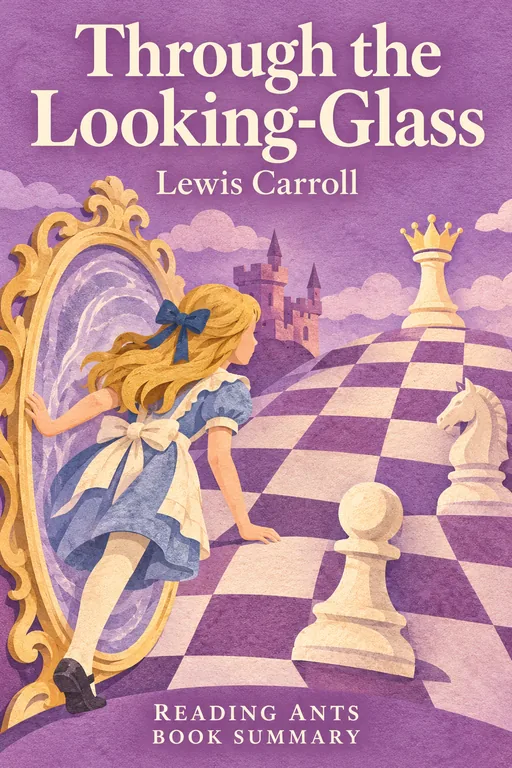
Alice climbs through a mirror into a backwards world laid out like a chessboard, and journeys across it as a pawn, meeting strange creatures along the way, until she reaches the eighth square and is crowned a queen.
Overview
Through the Looking-Glass, and What Alice Found There is a children’s fantasy by Lewis Carroll, the pen name of the mathematician Charles Dodgson, published in 1871 as the sequel to Alice’s Adventures in Wonderland. Where the first book follows playing cards, this one follows a game of chess, and its logic is built on reversal and wordplay. It contains some of the best-known nonsense verse in English, including “Jabberwocky.” The story is gentle and funny, and has been loved by children and adults for over a century.
Main Characters
- Alice: a polite, curious and sensible girl who tries to make sense of nonsense.
- Kitty and Dinah: Alice’s kitten and her mother cat, whom she talks to in the real world.
- The Red Queen: a stern, fast-moving chess queen who corrects Alice’s manners.
- The White Queen: a flustered, forgetful queen who lives backwards in time.
- Tweedledum and Tweedledee: two round, quarrelsome twins who recite a poem.
- Humpty Dumpty: an egg who insists that words mean whatever he chooses.
- The White Knight: a gentle, clumsy inventor who falls off his horse.
Full Summary
Through the glass
On a snowy afternoon, Alice plays with her kitten Kitty and wonders what the room behind the mirror is like. Imagining that the glass has turned soft like mist, she climbs up onto the mantelpiece and passes through into a reversed version of her own sitting room. There she finds chess pieces walking about and a book written backwards, which she can read only by holding it to the mirror. She reads the poem “Jabberwocky,” which seems to be about something marvelous, though she cannot quite say what.
The garden of live flowers
Alice goes out into the garden, which she wants to see from a hill. Whatever path she takes leads her back to the house. She finds the talking flowers, who gossip and criticize her, and she meets the Red Queen, who leads her up the hill. From the top Alice sees that the whole country is laid out like a giant chessboard, and she wishes to join the game. She is made a pawn, and the Red Queen tells her that she will become a queen if she reaches the eighth square. The Red Queen makes Alice run as fast as she can, only to stay in the same place, since in this land you must run twice as fast to get anywhere.
Tweedledum and Tweedledee
Taking a train through the countryside, Alice moves on across the chessboard, and meets two identical plump twins, Tweedledum and Tweedledee. They show Alice the sleeping Red King and tell her that she is only a thing in his dream. They then recite “The Walrus and the Carpenter,” a poem about a walrus and a carpenter who lure young oysters to a walk on the beach and eat them. The twins then argue over a rattle and prepare to fight, until a huge crow frightens them. After the twins, Alice meets the White Queen, who lives backward and remembers things before they happen.
Humpty Dumpty and the Lion and the Unicorn
Alice meets Humpty Dumpty, sitting on a wall, who explains the strange words in “Jabberwocky” and says that when he uses a word it means exactly what he wants it to mean. She then meets the White King and his messengers, and watches the Lion and the Unicorn fighting over the crown. Alice is amused when the Unicorn says that he had always thought children were fabulous monsters, and she answers that she had thought the same of unicorns, so they agree to believe in each other. The scene is full of puns and of comic arguments about logic.
The White Knight
A Red Knight comes galloping up and claims Alice as his prisoner, but the White Knight arrives and says that he rescued her, so the two knights fight for her. They tumble off their horses again and again, and the battle ends with the Red Knight riding away. The White Knight then offers to see Alice safely to the end of the wood. He is covered with odd inventions, such as an upside-down box for clothes and sandwiches and a hive that no bees have visited, and he keeps falling off his horse. He sings her a long, sad song, and then points her toward the last brook, which will make her a queen. He asks her to wave her handkerchief as he rides away, and she does, hoping that it encouraged him.
Queen Alice and the awakening
In the eighth square, Alice finds a crown on her head, and she is now a queen. The Red and White Queens test her again, and she is invited to a banquet in her honor, where the food speaks and the dinner turns to chaos. Fed up, Alice seizes the tablecloth and pulls, and everything on the table comes crashing down. She turns on the Red Queen, whom she blames for the mischief, and shakes her until the little queen turns into a kitten. She wakes up in her armchair, with the kitten in her lap, and wonders whether it was she or the Red King who had dreamed it all.
Why It Matters
Through the Looking-Glass is a landmark in children’s literature and in the history of nonsense. It gave the English language phrases and ideas that people still use, such as the “Jabberwock,” “Tweedledum and Tweedledee” and Humpty Dumpty’s views on words. Its play with logic, language and mirror reversal inspired mathematicians, philosophers, artists and writers, and its mixture of fun and unease has been adapted in countless films, plays and illustrations. The book shows that children’s stories can be clever and philosophical without losing their sense of fun, and it treats a child’s mind with respect.
Key Takeaways
- Language is flexible and playful. Words can be twisted, shaped and enjoyed.
- Logic can be turned upside down. Reversal reveals how arbitrary rules are.
- Growing up means moving across the board. Alice advances from pawn to queen.
- Politeness and common sense help. Alice stays courteous even among absurd characters.
- Reality and dreams blur. The ending asks who is dreaming whom.
What We Can Learn
You can learn to enjoy words, by playing with puns, rhymes and made-up terms, as Carroll did. Alice also shows that curiosity and good manners are useful when you meet people who do not make sense, and that it is fine to challenge confident-sounding rules by asking what they mean. The chessboard journey shows that growing up is a step-by-step process, with confusing places along the way. Try reading “Jabberwocky” aloud, and invent your own nonsense words, to feel how sound can carry meaning even when the words are strange.
Criticism and Counterpoints
Some readers find the book less spontaneous than its predecessor, with a more rigid structure, since the chess plan limits the freedom of the episodes, and the sadness of some scenes, such as the White Knight’s farewell, can feel heavy. Critics also note that the Victorian humor and parodies of old poems can be hard for modern children to follow without notes. Others say that the story’s logic puzzles are too clever for young children, while adults may read hidden meanings into it that the author never intended. Still, the book is widely admired.
Who Should Read It
This book is for children from about seven, for adults who enjoy wordplay and logic, and for fans of the first Alice book, although it can be read separately. Reading aloud works well, especially the poems. Younger children may enjoy it with a parent explaining the jokes.
Want the whole book?
A summary is a taste, not the meal. Here is where to find the full book.
You reached the end 🎉
Nicely done. Mark this one as read, and we will suggest what to read next.
Read this next
Alice's Adventures in Wonderland
Lewis Carroll
A curious girl follows a white rabbit down a hole into a crazy world where she keeps changing size, meets mad and marvelous creatures, and stands up to a furious Queen.
🧸 Children's Books
Peter Pan
J. M. Barrie
A magical boy who refuses to grow up flies three London children to Neverland, where they battle pirates led by the villainous Captain Hook, until Wendy realizes they must go home and grow up.
🧸 Children's Books
The Wonderful Wizard of Oz
L. Frank Baum
Swept by a cyclone to the magical Land of Oz, a Kansas girl follows the yellow brick road with three unusual friends to ask a great wizard for help, and learns they already had what they were seeking.
🧸 Children's BooksThe Adventures of Pinocchio
Carlo Collodi
A troublesome wooden puppet repeatedly ignores good advice, but love, hard work and responsibility gradually help him become a caring human boy.
🌍 World Literature
Coraline
Neil Gaiman
A bored, curious girl named Coraline finds a door to a parallel world where her "other mother" wants to keep her forever, and she must use courage and cleverness to rescue her parents and herself.
🧸 Children's Books
Charlotte's Web
E. B. White
A lonely pig named Wilbur learns he is going to be killed, and his clever friend Charlotte, a spider, comes up with an amazing plan to save his life.
🧸 Children's BooksWant something different?
Pick another topic and we will show you three books to start with.