 Reading Ants
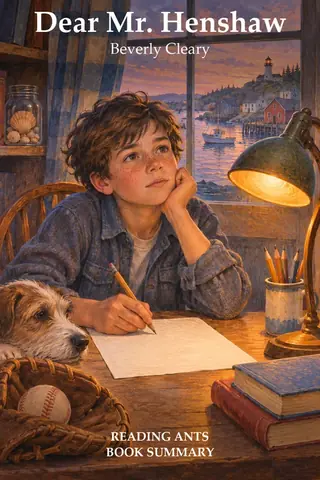
Dear Mr. Henshaw
A lonely boy who writes to his favorite author over several years finds, through letters and a secret diary, how to put his feelings about his parents' divorce into honest words.
Overview
Dear Mr. Henshaw is a 1983 novel by Beverly Cleary, and it won the Newbery Medal in 1984. It is told entirely in letters and diary entries by Leigh Botts. In second grade Leigh writes a fan letter to Boyd Henshaw, the author of a dog book. By sixth grade, he is writing in earnest, because he has moved to a new town with his mother after his parents’ divorce, and he misses his father, a long-distance truck driver, and his dog. The author answers, and his advice leads Leigh to a diary that he addresses to a pretend Mr. Henshaw. It is a short, quiet book about loneliness, growing up and the way writing can help.
Main Characters
- Leigh Botts: the writer of the letters and diary, an observant, shy boy who wants to be an author.
- Mom (Bonnie): Leigh’s mother, who works part time for a caterer and takes classes at a community college to become a nurse.
- Dad (Bill): a long-haul truck driver whose CB radio name is Wild Bill, loving but forgetful.
- Bandit: Leigh’s black dog, who rides with Dad in the truck.
- Boyd Henshaw: the author Leigh writes to, who answers by letter and postcard.
- Mr. Fridley: the school custodian, who notices Leigh.
- Barry: a classmate who becomes Leigh’s first friend at the new school.
- Miss Martinez and Miss Neely: Leigh’s teacher and the school librarian.
- Angela Badger: a visiting author at the writing contest lunch.
Full Summary
Letters to an Author
In second grade, Leigh writes to Boyd Henshaw to say that his teacher read the class a book about a dog. Over the next few years he writes again, for school assignments and out of real interest. He tells Henshaw about his own dog, Bandit, and about a diorama he made of the book. By the fourth grade, he says he wants to be a famous writer with a beard like Henshaw’s. Henshaw suggests that he read other books, and Leigh does.
Ten Questions
In sixth grade Leigh writes to Henshaw again for a class author report, from a new school in a new town. Henshaw sends a joking answer, plus ten questions for Leigh to answer in turn. Leigh is angry and hides the page, but his mother tells him that authors are working people and that he must answer. Over about two weeks Leigh responds. He explains that his parents have divorced, because Dad wanted his own big truck for long hauls across the country and was hardly ever home. He and Mom now live in a tiny cottage by the sea in Pacific Grove, and Dad took Bandit along on his drives.
The Lunch Thief
At school Leigh has few friends, and someone keeps stealing the good treats in his lunch bag, which come from Mom’s boss, a caterer named Katy. Leigh admires the custodian, Mr. Fridley, who talks to him and lets him help raise the flags. Henshaw suggests that Leigh keep a diary, and Leigh begins one, writing to Mr. Pretend Henshaw. He describes missing Dad, who promises to phone and often does not. A trucker brings a Christmas present from Dad, a warm jacket with many pockets.
Dad Calls
One rainy Sunday in February, after Dad has again failed to phone, Leigh calls him. Dad is at home in his trailer, and he admits that he lost Bandit in a snowstorm in the mountains, when the dog did not climb back into the cab. Hearing a boy’s voice in the background asking about pizza, Leigh hangs up in anger. The book never says who the boy is. He tells his mother everything, and she explains that she and Dad married young and that the divorce was not Leigh’s fault. They share a bucket of fried chicken in the car by the ocean and watch the waves, and Leigh begins to feel better.
The Burglar Alarm
Inspired by Mr. Fridley’s joke that he needs a burglar alarm, Leigh reads library books about batteries and builds one into a black lunchbox, using a battery, a switch and a doorbell. The alarm never catches the thief. Leigh sets it off himself when he opens the box at lunch, and the noise makes the whole cafeteria look. Suddenly everyone notices him, and Barry, a boy at his table, becomes his first friend. The thefts stop, and Leigh never learns who the thief was. He decides he is glad not to know. Henshaw’s advice about writing has changed Leigh’s view too. When his story about a melting wax man gets stuck, he learns that a character in a story should solve a problem or change, so he writes a true piece about a day riding in Dad’s truck.
The Writing Contest
Leigh’s piece wins only an honorable mention in the young writers’ yearbook, which means no lunch with the visiting author. Then a prizewinning poem turns out to have been copied from a book, and Leigh is invited in its place. The author, Angela Badger, tells him that he wrote honestly about something he knew, and that writing like himself is the mark of a good writer. The next day Leigh comes home from a walk with Barry and finds Dad’s truck outside. Dad has brought Bandit back, after hearing from another trucker over his CB radio. He is on his way to pick up a load of broccoli, and he asks Mom if there is any chance they might try again. She says no. Leigh tells him to keep Bandit, because Dad needs him more. Leigh is sad, but he also feels much better.
Why It Matters
Dear Mr. Henshaw won the Newbery Medal. Its form, a boy’s letters and diary, makes it short and easy for new readers, and it looks honestly at a child’s life after a divorce, including the anger and the waiting for phone calls.
It is also a gentle guide to writing. Leigh’s progress, from copying other styles to writing honestly about what he knows, shows young readers how real writers work, and it may make some of them want to start a diary of their own. It also shows a boy learning that a writer can say true things on paper that he cannot say out loud, which is a lesson many readers can use.
Key Takeaways
- Write what you know. Leigh’s best piece comes from his own memory of a day on the road with his father.
- Writing can help with feelings. The diary lets Leigh say things he cannot say aloud.
- Divorce is not a child’s fault. Mom tells Leigh clearly that he did not cause it.
- Small kindnesses matter. Mr. Fridley’s attention helps a lonely boy.
- People can love you imperfectly. Dad forgets and disappoints, but in the end he does come to see Leigh.
What We Can Learn
Leigh’s diary shows how helpful it can be to write down our feelings. If something is hard to talk about, writing it out can make it clearer, even if no one ever reads it.
The book also reminds us to notice lonely classmates. Mr. Fridley and the librarian make a difference by simply paying attention. A greeting or a question can be a gift to someone who is new.
Finally, Leigh’s alarm shows that a problem can be solved with patience and a little ingenuity. Instead of accusing the thief, he finds a clever way to protect his lunch.
Criticism and Counterpoints
Some readers find the plot very quiet, since most of the book is a boy’s letters and diary entries, with little action. Because it was written in the early 1980s, the technology, such as CB radios, may feel old to modern children. The ending is bittersweet rather than tidy, since Dad’s problems are not solved and his parents do not get back together, which some readers may find sad. We also hear only Leigh’s side of the letters, so Henshaw remains a bit of a mystery. Many teachers still value its honesty and gentle humor.
Who Should Read It
Dear Mr. Henshaw suits readers from about eight to twelve, especially children who have faced a family split or who like to write. It is a short, easy book for younger readers and a good classroom choice. Readers who want fast adventure may find it slow, but its voice is warm and true.
Want the whole book?
A summary is a taste, not the meal. Here is where to find the full book.
You reached the end 🎉
Nicely done. Mark this one as read, and we will suggest what to read next.
Read this next
Because of Winn-Dixie
Kate DiCamillo
A lonely ten-year-old girl named India Opal Buloni adopts a stray dog in a Florida grocery store and, with his help, makes new friends and learns to cope with the mother who left her.
🧸 Children's Books
Bridge to Terabithia
Katherine Paterson
A shy country boy and an imaginative new girl create a secret magical kingdom in the woods, and when tragedy strikes, he must find the courage to carry their friendship forward.
🧸 Children's Books
The Great Gilly Hopkins
Katherine Paterson
A clever, angry eleven-year-old foster child who lies and fights to keep people away is slowly won over by a huge-hearted foster mother, and then has to leave her.
🧸 Children's Books
Shiloh
Phyllis Reynolds Naylor
An eleven-year-old boy in the West Virginia hills finds a beagle that is mistreated by its owner, and tries to save it, bending the truth along the way.
🧸 Children's Books
Charlotte's Web
E. B. White
A lonely pig named Wilbur learns he is going to be killed, and his clever friend Charlotte, a spider, comes up with an amazing plan to save his life.
🧸 Children's Books
Harry Potter and the Philosopher's Stone
J. K. Rowling
An unloved orphan boy discovers on his eleventh birthday that he is a famous wizard, and during his first year at a magical school he makes true friends and faces the dark wizard who killed his parents.
🧸 Children's BooksWant something different?
Pick another topic and we will show you three books to start with.