 Reading Ants
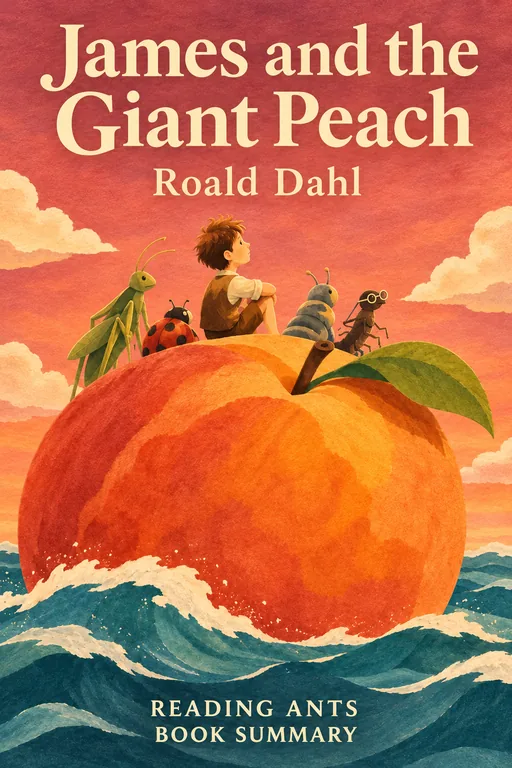
James and the Giant Peach
After losing his parents and living with two cruel aunts, a boy named James climbs into a giant peach and journeys across the Atlantic Ocean with a group of oversized talking insects.
Overview
James and the Giant Peach is a children’s novel by Roald Dahl, first published in 1961. It begins with a sad event: young James Henry Trotter’s parents are eaten by an escaped rhinoceros, and he is sent to live with his cruel aunts, Sponge and Spiker, who treat him badly. A mysterious old man gives him a bag of magic crystals, and a strange peach tree grows. The peach swells to an enormous size and James finds a way inside, where he meets a family of giant, talking creatures. Together, they roll away on a journey across the Atlantic. The book is a mixture of humor, sadness and fantasy.
Main Characters
- James Henry Trotter: a kind, brave seven-year-old orphan.
- Aunt Sponge and Aunt Spiker: James’s selfish, cruel aunts.
- The Old-Green-Grasshopper: a musician who plays the violin with his legs, and a wise friend.
- The Centipede: a boastful but good-hearted creature who claims to have a hundred legs (he has forty-two).
- The Earthworm: a nervous, gloomy and funny worm.
- Miss Spider and the Ladybug: gentle, motherly creatures.
- The Glow-worm and the Silkworm: creatures who give light and thread.
Full Summary
A Sad Start
James lives happily with his parents beside the sea until a rhinoceros escapes from the London zoo and kills them. Left alone, he has to live with his two aunts, who are lazy, greedy and mean. They keep him in a ruined house on top of a hill with a bare garden, make him do chores and call him names. He is not allowed to play with other children, and is very lonely.
The Magic Crystals
One day, an odd little man gives James a bag of tiny green crystals, which he says will do wonderful things. James hurries home, but he trips and spills them at the foot of a dead peach tree. The crystals sink into the ground and, strangely, the tree suddenly grows a single peach that begins to swell, and swell, until it is as big as a house. The aunts realize that they can make money by charging people to see the peach, and they force James to clean up after the visitors.
Inside the Peach
That night, James discovers a hole in the peach, crawls inside and finds a tunnel leading to the pit. There he meets a group of oversized creatures, who have been affected by the crystals: the Old-Green-Grasshopper, the Centipede, the Earthworm, Miss Spider, the Ladybug, the Glow-worm and the Silkworm. They welcome him, and when the Centipede gnaws through the stem, the peach rolls down the hill, flattening the aunts on the way, and gaining speed toward the sea.
Across the Ocean
The peach floats on the Atlantic Ocean, and its occupants make a home inside. They become friends and share stories, though the Centipede brags and the Earthworm worries. Sharks attack the peach, but James has an idea: he and the creatures use thread spun by the Silkworm and Miss Spider to catch hundreds of seagulls, which then lift the peach out of the water and into the sky. The creatures marvel at the view, and during the flight, they pass over clouds.
Among the Clouds
In the sky, James and his friends see a strange scene: the Cloud-Men, who make hail, snow and rainbows. The peach gets tangled in the ropes that hold up one of their rainbows, and the Centipede’s taunts provoke the Cloud-Men, who throw things at the peach. The Cloud-Men are strange and powerful beings, and the encounter shows that the world can contain beauty and danger at once.
The scene is both a comic quarrel and a moment of danger, since the peach and its passengers are far above the ground with nowhere to go. It also shows that the Centipede’s boasting, funny as it is, can have real consequences.
New York
At last, the peach, still carried by the seagulls, nears New York, when a passing plane cuts the threads. The peach falls and lands on the spire of the Empire State Building, scaring everyone. Police, firefighters and a crowd gather, and James tells his story and calms them. The peach is eaten by the children of the city, and James and his friends make a home in the peach pit in Central Park. James lives happily among his new friends, eventually writing his adventures.
Why It Matters
James and the Giant Peach was one of Roald Dahl’s first major children’s books and has remained popular for over sixty years. It showed his style, which blends dark humor, a child hero who faces unkind adults and wild invention. It was adapted into a 1996 film, with stop-motion animation by Henry Selick, and into stage versions.
The book also helped establish a model of children’s fiction that treats young readers as capable of handling sadness and cruelty. The story of an orphan who finds a new family among unlikely friends has comforted many young readers.
Key Takeaways
- Friends can come from unlikely places. James finds a family in odd creatures.
- Cruelty is punished. The aunts get their comeuppance.
- Courage and imagination solve problems. James’s ideas save the group.
- Home is where you are loved. James finds a new home.
- Wonder can follow sorrow. Hard times can lead to adventure.
What We Can Learn
The story shows that we can find friendship and belonging even after loss. James’s kindness and bravery win the loyalty of the creatures, and they become his family.
It also teaches the value of resourcefulness. When facing sharks in the open sea, James thinks of a clever way to use the tools around him, such as silk thread and seagulls, showing that creativity can overcome fear.
Finally, it reminds us to treat others kindly. The aunts’ cruelty ends badly, while James’s generosity to his friends makes him happy.
Criticism and Counterpoints
Some parents and critics object to the dark opening, in which James’s parents die and his aunts are brutal, and some find the aunts’ fate, being flattened by the peach, too violent for a children’s book. Others have criticized Dahl’s later reputation for offensive remarks, which has led to some discussion of his work.
The book was also challenged in some places because of its depiction of frightening situations, and some readers find the later part of the story, including the Cloud-Men, confusing. Still, most children enjoy its humor and fantasy.
Who Should Read It
This book suits children from about six or seven, and can be read aloud to younger ones. It has sad and scary moments but ends happily. It is a good choice for readers who enjoy funny, imaginative stories.
Want the whole book?
A summary is a taste, not the meal. Here is where to find the full book.
You reached the end 🎉
Nicely done. Mark this one as read, and we will suggest what to read next.
Read this next
Charlie and the Chocolate Factory
Roald Dahl
A poor but kind boy wins one of five golden tickets to tour the magical factory of the eccentric chocolate maker Willy Wonka, where the four spoiled children with him meet hilarious fates and Charlie wins the greatest prize of all.
🧸 Children's Books
The BFG
Roald Dahl
A lonely orphan named Sophie is snatched by a giant who turns out to be gentle, and together they hatch a plan with the Queen of England to stop the bigger, man-eating giants.
🧸 Children's Books
Matilda
Roald Dahl
A brilliant little girl with awful parents and a terrifying headmistress discovers she has magical powers, and uses her wits and her magic to help the one adult who truly cares for her.
🧸 Children's Books
The Witches
Roald Dahl
A boy and his cigar-smoking Norwegian grandmother discover that real witches disguise themselves as ordinary women and plan to wipe out children, and they must stop the Grand High Witch even though the boy has been turned into a mouse.
🧸 Children's Books
Fantastic Mr Fox
Roald Dahl
A clever fox who steals food from three greedy farmers to feed his family outwits them when they try to starve him out, by digging tunnels into their storehouses and sharing the feast with all the animals nearby.
🧸 Children's Books
Charlotte's Web
E. B. White
A lonely pig named Wilbur learns he is going to be killed, and his clever friend Charlotte, a spider, comes up with an amazing plan to save his life.
🧸 Children's BooksWant something different?
Pick another topic and we will show you three books to start with.