 Reading Ants
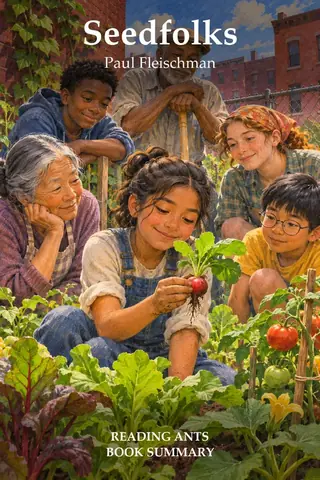
Seedfolks
Thirteen neighbors of different backgrounds tell how a girl planted six lima beans in a trash-filled Cleveland lot and started a community garden.
Overview
Seedfolks is a very short 1997 book by Paul Fleischman, told by thirteen different narrators, one in each chapter, who live around a vacant lot on Gibb Street in Cleveland. The lot is full of trash, and the neighbors, who come from Vietnam, Guatemala, Haiti, Korea, India, Mexico, Romania, Britain and different parts of the United States, mostly keep to themselves. Then a young girl plants some seeds. In turn each narrator describes how the garden affected them. Together, their stories show how a community can be built from small, simple acts.
Main Characters
- Kim: a nine-year-old girl, born in Vietnam, who plants the first seeds.
- Ana: a Romanian woman who watches Kim from her window.
- Wendell: a school janitor who waters Kim’s beans.
- Gonzalo: a Guatemalan teenager whose uncle Juan finds a purpose in the garden.
- Leona: a Black woman who gets the city to clear the trash.
- Sam: an elderly man who notices how the garden is divided into plots.
- Virgil: a Haitian teenager whose father takes over several plots to sell lettuce.
- Sae Young: a Korean woman who has been afraid to leave her home.
- Curtis: a muscular man who grows tomatoes to win back a girlfriend.
- Nora: a British nurse who brings a patient to the garden.
- Maricela: a sixteen-year-old who is pregnant.
- Amir: an Indian businessman who grows vegetables there.
- Florence: the last narrator, a Black woman who watches over the garden and explains the title.
Full Summary
The First Seeds
The vacant lot on Gibb Street in Cleveland is full of trash, and the people who live around it rarely speak to one another. On a cold Sunday in early April, Kim, a nine-year-old girl born in Vietnam, plants lima beans in the lot, digging the holes with a spoon. Her father died when she was a baby, she has no memories of him, and she hopes to prove that she is his daughter by making the beans grow. Ana, a Romanian woman, sees her digging from her window and suspects that the girl is burying drugs or a gun. She digs up the spot and finds only beans. She calls Wendell, a school janitor who grew up on a farm, and asks him to water them. Wendell decides that he cannot change the world, but he can change the lot.
More Gardeners
Gonzalo, a Guatemalan teenager, looks after his uncle Juan, who cannot speak English or find work in Cleveland. When Juan goes missing, Gonzalo finds him at the lot, and soon Juan is planting seeds and studying the soil. Seeing how much his uncle knows, Gonzalo begins to think of him as a man again. Leona, a Black woman, phones officials again and again to ask them to remove the trash. When they ignore her, she brings a smelly bag of garbage to the Public Health Department and opens it in their office, and at last crews come to clean the lot. Sam, an elderly man, watches the crews and later notices that the gardeners have divided the lot into plots by race and nationality, just as the neighborhood is divided.
Trouble and Courage
Virgil, a Haitian teenager, is upset when his father, a taxi driver, takes over five plots to grow baby lettuce for restaurants, because the lettuce soon wilts. Sae Young, a Korean woman, was once attacked in her dry-cleaning shop and has stayed home out of fear. Passing the garden, she feels drawn back toward other people, digs a small plot and grows hot peppers, and later buys funnels to help gardeners collect water. Curtis, a muscular man, grows large tomatoes to win back a former girlfriend, Lateesha. Each person comes to the garden with a different need. For some it is a place for food, for others for company, courage or a reason to get up in the morning.
Growth in Many Forms
Nora, a British nurse, takes Mr. Myles, an elderly patient who has had a stroke and cannot speak, to see the garden, and he comes alive. She sets up a barrel of soil so that he can plant flowers from his wheelchair. Maricela is sixteen and pregnant. She has been assigned a plot through her G.E.D. program and resents the work, but a thunderstorm and a talk with Leona help her to see that she is part of the cycle of nature. Amir, an Indian businessman, grows eggplants, and his unusual vegetables give neighbors a reason to talk to him. The gardeners work together to lift a load of dumped tires and to catch a robber, and Amir sees that his own stereotypes of other people were hollow.
Seedfolk
Florence, the last narrator, cannot garden because of arthritis, but she watches over the lot with pride. She remembers that her great-grandparents traveled from Louisiana to Colorado, and that her father called them “seedfolks” because they were the first in the family to settle in a new place. She realizes that the people who started the garden on Gibb Street are seedfolks too. In winter the garden lies quiet under the snow, and she worries that the community will forget it and that it will not return.
Spring
In spring, Florence sees Kim planting lima beans once more, and she takes it as a sign of renewal. The book ends on a quiet, hopeful note. The vacant lot has become a place where people who were once strangers now know each other. Each narrator has changed a little, and the book suggests that the change is as important as any harvest. The thirteen voices, which began as strangers’ separate stories, now read as one story told by a neighborhood.
Why It Matters
Seedfolks was named an American Library Association Best Book for Young Adults in 1998 and won the Buckeye Children’s Book Award in 1999. It is widely used in classrooms. Its short chapters, each in a different voice, make it a good example of how a story can be told by many people. Paul Fleischman has said that he was inspired by an article about a psychotherapist who used gardening with patients, by his parents who gardened, and by his interest in recent immigrants.
The book’s message about community is also used in schools that run their own gardens. It shows how a shared project can connect neighbors who share little else, and how even a small beginning can change a place.
Key Takeaways
- Small acts can grow. One girl’s beans start a movement.
- Strangers can become neighbors. The garden brings together people from many cultures.
- Everyone has a need. Each gardener finds something in the garden that they are missing.
- Stereotypes fade with contact. Working side by side changes how neighbors see each other.
- Gardens need care. Florence worries about winter and is glad when spring comes.
What We Can Learn
If you want to improve your neighborhood, you can begin by doing one small thing, as Kim does. Others may join you if they see you are serious.
The book also teaches us to listen to different voices. Each narrator sees the garden in a different way, and understanding them all gives the fullest picture.
Finally, it shows that places can be revived. A trash-filled lot can become a garden, and a lonely person can become part of a group.
Criticism and Counterpoints
Some readers may find the book’s picture of a diverse neighborhood a little too neat, with each narrator standing for a group and most stories ending hopefully. The chapters are very short and the characters are drawn quickly, so a few of them can be hard to remember. The garden also has troubles, such as dumping, theft and fights over plots, but the book resolves most of them gently. Some topics, such as a teenage pregnancy, a robbery and a patient who has had a stroke, may need an adult’s help for younger readers. Most teachers value the book for its form and its message.
Who Should Read It
This book suits readers from about ten to fourteen, and it is quick to read, so it is good for reluctant readers. It is a good choice for classrooms that want to talk about community, immigration or gardening. Readers who like one clear plot may find the many voices more like a collection of portraits than a single story.
Want the whole book?
A summary is a taste, not the meal. Here is where to find the full book.
You reached the end 🎉
Nicely done. Mark this one as read, and we will suggest what to read next.
Read this next
Wonder
R. J. Palacio
A ten-year-old boy born with a rare facial difference goes to school for the first time, and through bullying, friendship and courage he helps everyone around him learn to choose kindness.
🧸 Children's Books
Hello, Universe
Erin Entrada Kelly
Over a few days at the start of summer, four very different kids in the same town, a shy boy, a deaf girl, a self-declared psychic and a bully, are tied together by a guinea pig, a well and a series of coincidences.
🧸 Children's Books
Charlotte's Web
E. B. White
A lonely pig named Wilbur learns he is going to be killed, and his clever friend Charlotte, a spider, comes up with an amazing plan to save his life.
🧸 Children's Books
Harry Potter and the Philosopher's Stone
J. K. Rowling
An unloved orphan boy discovers on his eleventh birthday that he is a famous wizard, and during his first year at a magical school he makes true friends and faces the dark wizard who killed his parents.
🧸 Children's Books
The Hobbit
J. R. R. Tolkien
A comfortable, home-loving hobbit is swept into a dangerous quest with thirteen dwarves to win back their treasure from a dragon, and discovers along the way that he is far braver and cleverer than he ever imagined.
🧸 Children's Books
Matilda
Roald Dahl
A brilliant little girl with awful parents and a terrifying headmistress discovers she has magical powers, and uses her wits and her magic to help the one adult who truly cares for her.
🧸 Children's BooksWant something different?
Pick another topic and we will show you three books to start with.