 Reading Ants
The Continuum Concept
An American writer who lived among rainforest peoples of Venezuela argues that human babies expect constant physical contact and a life among working adults, and that modern child-rearing leaves needs unmet that shape unhappy adults.
Overview
The Continuum Concept was written by Jean Liedloff, an American writer who first met the Yequana people of the Venezuelan rainforest on a diamond-hunting expedition. She went back several times, and her official site says she spent more than two and a half years in the jungle. The book first appeared in London in 1975, with an American edition following in 1977. She came to believe that the Yequana treated babies and children in a way that matched what human beings evolved to expect, and that people in industrial societies had lost touch with this inheritance. The book describes her experiences, sets out her theory of the continuum, and argues for a different way of raising babies. It has been very influential among alternative parenting groups and has also been criticized as speculative.
Full Summary
1. Among the Yequana
The idea: Liedloff draws her theory from her time with the Yequana (also spelled Ye’kuana) in the Venezuelan jungle, where she observed a people she found strikingly happy and cooperative. By her account, children rarely fought, were seldom punished and joined in readily with adult life. She became convinced that something in how the Yequana raised their children explained what she saw. These are her own impressions and interpretations, not the findings of a formal study.
In real life: A visitor notices that a group of children play together for hours without quarrels, and asks what is different.
2. The continuum
The idea: Her central idea is the continuum, the set of expectations that human beings, over a long evolutionary history, are born with about the experiences they will have. Babies, she says, arrive expecting certain kinds of care, and when those expectations are met, the child develops in a healthy way. When they are not, the unmet need may be sought in substitutes later in life, which she links to unease and the restless pursuit of happiness.
In real life: A baby who expects to be held and is left alone for long periods may grow into an adult who craves comfort in other ways.
3. The in-arms phase
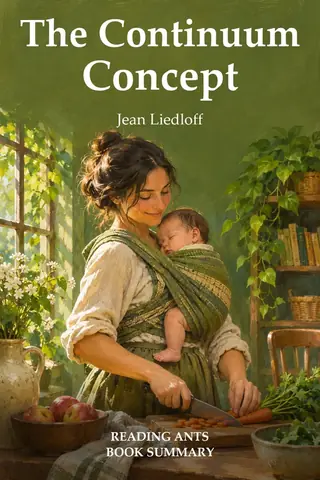
The idea: The most famous part of her theory is the in-arms phase. Yequana babies, she reports, were carried or held in near-constant physical contact while the adults went about their tasks, and they slept close to their mothers and were fed whenever they signaled hunger. This lasted until the babies began to creep and crawl on their own. Liedloff argues that this contact meets a baby’s deepest expectation and gives the child the security to leave when ready, so that independence grows naturally. A baby that watches adults at work, she says, learns what the world is like long before any lesson begins.
In real life: A mother carries her baby on her back while she works, and the baby watches everything and falls asleep there.
4. Children among working adults
The idea: As children grow, Liedloff says, the Yequana let them take part in the life of the community. They imitate adults and take on real tasks willingly and at their own pace. She describes praise as nearly absent, and argues that constant approval can teach children to act for applause instead of from their own sense of what is expected. She also describes the adults as relaxed and attentive without making the child the center of attention, and she treats children as social and cooperative by nature, so that they do not need to be forced into good behavior. She adds that children develop their own sense of safety when adults trust them to.
In real life: A young girl helps with cooking because she wants to, and nobody makes a fuss about it.
5. What civilization loses
The idea: Liedloff applies the idea to modern life and offers practical suggestions for families who do not live in the rainforest. She suggests that problems of industrial societies, such as addiction, compulsive striving and unsatisfying relationships, come from early deprivation of what the continuum requires. She argues for carrying babies, trusting parents’ instincts and letting children take part in daily life, and she says that parents can begin without waiting for society to change.
In real life: A parent who carries a baby in a sling during errands finds the child calm and curious.
Why It Matters
The Continuum Concept has been widely read since 1975 and has been translated into many languages. It gave many parents a vivid picture of an alternative to the isolated, scheduled model of infant care, and it has been discussed in attachment-style and natural parenting circles. A British television series in 2007 featured the continuum concept as one of three well-known approaches to raising babies. Its idea that babies have evolved expectations is often set beside attachment theory and evolutionary thinking about early childhood. It also raised, in a dramatic form, the question of what modern societies might learn from others. Even readers who doubt its generalizations often find the in-arms image a powerful challenge to ordinary habits. It has also fed discussion about how much modern parents are asked to do alone, and about the value of keeping babies close and part of ordinary adult life.
Key Takeaways
- Babies expect closeness. Liedloff argues that infants evolved to expect constant physical contact and prompt responses.
- Unmet needs linger. Missing early experiences may be sought in substitutes later in life, in her view.
- The in-arms phase. Carrying a baby until the baby begins to crawl, by the author’s account, supports secure independence.
- Children join real life. Let children imitate adults and take part in useful work.
- Trust instincts. Parents are urged to follow their own sense of what a child needs.
What We Can Learn
You do not have to adopt the whole theory to use its best insight. Carry your baby more, in a sling or in your arms, and let the baby be present while you do ordinary tasks. Keep the baby near you at night if that works for your family and follows safe-sleep guidance.
As your child grows, let them join in real work, such as cooking, sorting or carrying, instead of keeping them separate from the day. Notice when you praise or fuss more than the moment needs. And treat the book as a challenge to your assumptions, not as an exact manual.
Criticism and Counterpoints
Critics say that Liedloff generalizes from the Yequana and a few other groups, and that one people cannot be a model for all societies, since Indigenous cultures differ widely. Her claim that her observations explain how the Yequana turned out is her own interpretation, and the link between early contact and later happiness is hard to test. A review in Kirkus in 1977 was skeptical, calling the argument speculative and overstated, and noting that it says little about working mothers or the realities of modern life.
The academic Chris Bobel, writing in 2004, argued that the book’s romanticized picture of the Yequana can fuel mother blame and guilt when it is applied to modern mothers who are doing their best. Readers also point out that the book is not an evidence-based modern guide, and parents should follow current safe-sleep and medical advice.
Who Should Read It
This book is for parents, expectant parents and anyone interested in how culture shapes child-rearing. It is vivid and provocative, and it makes a good starting point for questions about closeness and independence. Readers who want research evidence or a practical manual should look elsewhere, and those who follow it should take care with safety advice.
Want the whole book?
A summary is a taste, not the meal. Here is where to find the full book.
You reached the end 🎉
Nicely done. Mark this one as read, and we will suggest what to read next.
Read this next

Hold On to Your Kids
Gordon Neufeld and Gabor Maté
A clinical psychologist and a physician argue that children who bond more with peers than with parents become harder to guide and more fragile, and they show parents how to restore their place as the main attachment.
🎓 Parenting & Education
Simplicity Parenting
Kim John Payne with Lisa M. Ross
A Waldorf-trained family counselor argues that children are overloaded by too much stuff, too many choices, too much information and too much speed, and he shows parents how to reduce that load through toys, rhythm, schedules and a filtered adult world.
🎓 Parenting & Education
Free-Range Kids
Lenore Skenazy
A columnist who let her nine-year-old ride the New York subway alone argues that fear sold by news, experts and product makers has shrunk childhood, and she offers fourteen commandments to help parents give freedom back.
🎓 Parenting & Education
Bringing Up Bebe
Pamela Druckerman
An American journalist raising her children in Paris reports what she learns from French parents, who expect babies to learn to sleep, children to eat real food and wait their turn, and parents to keep a life of their own.
🎓 Parenting & Education
Raising a Secure Child
Kent Hoffman, Glen Cooper and Bert Powell
Three Circle of Security psychotherapists explain that children are secure when they can both explore the world and return for comfort, and they show parents how to read those needs and how their own childhoods affect their responses.
🎓 Parenting & Education
How to Talk So Kids Will Listen and Listen So Kids Will Talk
Adele Faber and Elaine Mazlish
Parents can get better cooperation and closer relationships by acknowledging children's feelings, describing problems instead of blaming, and using simple, respectful communication skills.
🎓 Parenting & EducationWant something different?
Pick another topic and we will show you three books to start with.