 Reading Ants
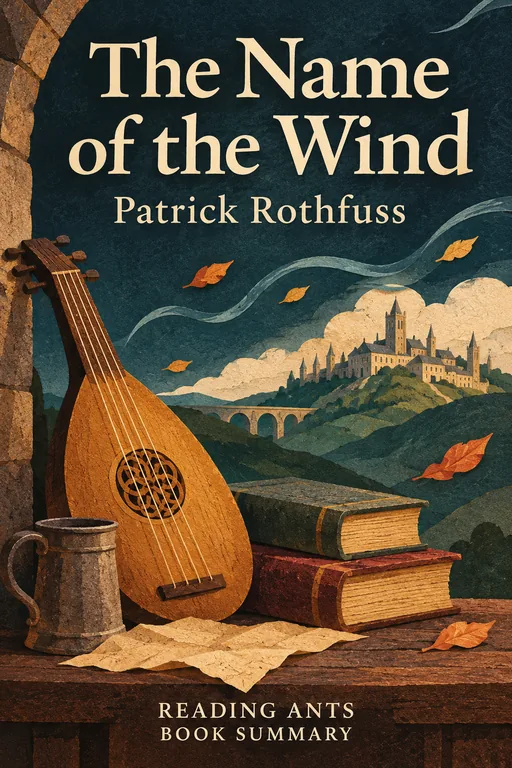
The Name of the Wind
A famous hero who is now hiding as an innkeeper tells the true story of his youth: how a boy from a family of traveling performers became the most notorious wizard of his age.
Overview
The Name of the Wind is a fantasy novel by Patrick Rothfuss, published in 2007, and it is the first book of the Kingkiller Chronicle. The story is told in two layers. In the present, an innkeeper named Kote is visited by a scribe who recognizes him as the legendary Kvothe, and Kote agrees to tell his life story over three days. Most of the book is Kvothe’s own account of his childhood, his time on the streets and his years at a university where magic and many other subjects are taught. The book is long and detailed, with a strong focus on music, learning and the way that stories grow bigger than the truth.
Main Characters
- Kvothe: the narrator, a gifted musician and student of magic with red hair.
- Kote: the quiet innkeeper that Kvothe has become in the present.
- Bast: Kote’s odd, devoted helper.
- Chronicler: a scribe who persuades Kvothe to tell his story.
- Abenthy: a traveling arcanist who teaches Kvothe as a child.
- Denna: a mysterious, beautiful young woman whom Kvothe loves.
- Ambrose: a rich, spiteful student who becomes Kvothe’s enemy.
Full Summary
The Innkeeper
In a village inn, a quiet man named Kote pours drinks and listens to rumors of strange creatures and a war. The scribe known as Chronicler is attacked on the road by a monster, and Kote saves him. Chronicler realizes that the innkeeper is Kvothe, a legendary figure who is said to have killed a king and done other great deeds. Kote refuses at first, but he agrees to tell the truth, in his own words, if the scribe writes it down. The story will take three days.
The Troupe
Kvothe was born into the Edema Ruh, a family of traveling performers, and he grows up on the road with his parents, who are talented, and with a troupe of actors and musicians. He learns songs and plays, and he is clever, with a quick memory. A traveling arcanist named Abenthy joins the troupe and teaches him some elements of science and magic, including the idea of “sympathy,” which links two objects. Kvothe also learns about the legends of an ancient group called the Chandrian.
His happy childhood ends when the troupe is murdered, and the Chandrian themselves, the figures of legend, are at the camp. Kvothe, the only survivor, is left alone.
The Streets
Kvothe, now a young teenager, goes to the city of Tarbean, where he lives on the streets for years as a beggar and thief. He is cold, hungry and numb with grief, and he is beaten up by older boys. He is nudged out of despair when he hears a storyteller tell a tale about the Chandrian and the hero Lanre. After several years, he decides that he will escape, and he plans to attend the University, to learn more about the Chandrian.
The University
Kvothe travels to the University, a vast place of study, where students learn medicine, arithmetic, naming, sympathy and many other arts. He impresses the masters at his entrance exam, and he is admitted at a young age. He makes friends, but he has little money and works hard, and he finds that some teachers treat him well while others try to hold him back.
His great skill with sympathy and his talent for music soon become well known. But he also makes an enemy of Ambrose, a student from a noble family, who uses his money and his influence to cause trouble for Kvothe.
Denna and the Dragon
Kvothe has already met a woman called Denna, and he meets her again in town. She is mysterious and keeps changing her name and story. He falls in love with her, but she is elusive. He also performs in a tavern, which earns him money and a name for his music.
Kvothe goes in search of news of the Chandrian after a rural wedding where there was blue fire and murder, and he finds Denna injured there. A draccus, a kind of dragon, threatens a nearby town, and Kvothe kills it. He learns that the Chandrian had killed the wedding guests.
The Name of the Wind
Throughout his studies, Kvothe seeks the “name of the wind,” which is a secret key to power in the world of magic. He learns that every thing has a true name, and that to know the name of the wind would let him control it. He catches only brief, uncertain glimpses of this power in this first part of his story, and the idea links the book’s themes of learning, knowledge and storytelling. The story breaks off with the first day’s telling done, and with many mysteries still unsolved.
Why It Matters
The Name of the Wind was a bestselling debut, and it became one of the most popular fantasy novels of the twenty-first century. Its focus on a hero’s early years, and its mix of humor, music and mystery, drew many readers who might not usually like epic fantasy. It has also been praised for its careful magic system and for its prose, which is lyrical and detailed. The unfinished series, which has had a long wait for its final volume, has built a devoted community of fans who discuss and debate its clues.
It is also notable for how it treats storytelling. Kvothe is an unreliable narrator, who tells the story of his own legend and knows that others have already exaggerated it, and the book asks how much of a famous person’s story can be believed.
Key Takeaways
- Stories grow beyond the truth. Kvothe’s legend is bigger than his real life.
- Learning takes effort and struggle. Kvothe studies hard and goes hungry to do it.
- Grief can drive a person. Kvothe’s search for the Chandrian shapes his life.
- Talent needs humility. Kvothe’s pride gets him into trouble.
- Names carry power. To know a name is to understand and to control.
What We Can Learn
The book shows how powerful it can be to keep trying when things are hard. Kvothe survives years of poverty and hardship, and he gets to the University because he never stops learning. We can take from this that skill is built over time, and that setbacks need not be the end.
It also warns about pride. Kvothe is brilliant, but he often acts without thinking, and he makes enemies because he cannot resist showing off. Being good at something does not mean that we do not need to be careful with others.
Finally, the story reminds us to look at how stories are told. A famous person’s life is often reshaped by rumor. Asking who is telling a story, and why, helps us read and listen well.
Criticism and Counterpoints
Some readers find the book too long and slow, with many pages on student life and money that do not move the plot. Others criticize the hero as too perfect, a gifted genius who succeeds at nearly everything, and say that the women in the book are mostly seen through his eyes and defined by their relationship to him. The fact that the third volume has still not appeared has frustrated many fans, and some argue that the story’s mysteries may not be resolved.
Still, many readers praise the quality of the writing and the pleasure of its world.
Who Should Read It
This book is for teenagers and adults who love long, immersive fantasy and don’t mind a slow build. It has some violence and a few mature themes. It is a good choice for readers who enjoy music, magic and a story told within a story, and who can live with an unfinished series.
Want the whole book?
A summary is a taste, not the meal. Here is where to find the full book.
You reached the end 🎉
Nicely done. Mark this one as read, and we will suggest what to read next.
Read this next
A Wizard of Earthsea
Ursula K. Le Guin
A proud, gifted boy named Ged becomes a powerful wizard, but his arrogance releases a dark shadow that he can defeat only by facing it.
🚀 Sci-Fi & Fantasy
The Hobbit
J. R. R. Tolkien
A comfortable, home-loving hobbit is swept into a dangerous quest with thirteen dwarves to win back their treasure from a dragon, and discovers along the way that he is far braver and cleverer than he ever imagined.
🧸 Children's Books
Mistborn: The Final Empire
Brandon Sanderson
A street thief named Vin joins a crew planning to overthrow an immortal tyrant, and discovers that she has extraordinary powers.
🚀 Sci-Fi & Fantasy
The Princess Bride
William Goldman
A farm boy and the most beautiful woman in the world are torn apart and reunited through pirates, giants, a prince and a good deal of swordplay, in a story that is both a fairy tale and a joke about fairy tales.
🚀 Sci-Fi & Fantasy
The Lord of the Rings
J. R. R. Tolkien
A small hobbit inherits a ring holding the Dark Lord Sauron's evil power, and a fellowship of nine sets out to destroy it in the volcano where it was made, deciding the fate of Middle-earth.
🚀 Sci-Fi & Fantasy
Frankenstein
Mary Shelley
A young scientist creates a living being from dead body parts, then abandons it in horror, and his rejected creation, longing for love, turns to revenge.
🚀 Sci-Fi & FantasyWant something different?
Pick another topic and we will show you three books to start with.