 Reading Ants
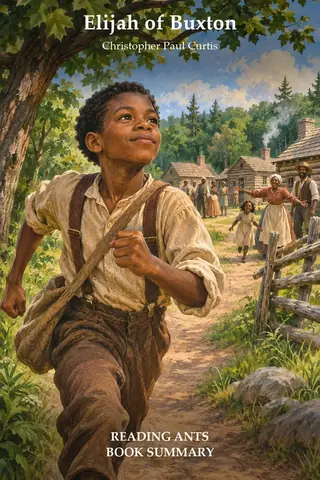
Elijah of Buxton
A funny, tender-hearted boy who is the first child born free in a Canadian settlement of former slaves is forced to learn what freedom cost when he follows a thief across the border into the United States.
Overview
Elijah of Buxton is a 2007 novel by Christopher Paul Curtis. It won the Coretta Scott King Award and was a Newbery Honor book in 2008. The narrator, Elijah Freeman, is eleven and lives in the Elgin Settlement, called Buxton, in Canada West, in the late 1850s. It is a community founded for people who escaped from slavery or were freed. He is the first child born free there, a fact he hears about constantly, along with the story of how, as a baby, he threw up on the famous Frederick Douglass. For most of the book, Elijah’s chatty, dialect-rich voice and the comic adventures of village life are funny. Then a journey across the border shows him, for the first time, what slavery was.
Main Characters
- Elijah Freeman: the eleven-year-old narrator, a boy who can throw stones with either hand and who is known for being easily frightened.
- Ma (Sarah) and Pa (Spencer): his loving parents, who grew up enslaved.
- Cooter: his best friend.
- Mr. Leroy: a woodcutter and carver, branded by a slave owner, who is saving money to buy his wife and children out of slavery.
- The Preacher: a pompous, boastful man who tells tall tales and often takes advantage of Elijah.
- Mrs. Holton: a widow whose husband died after being recaptured.
- Mr. Travis: the school’s teacher.
- Mr. Segee: the owner of the stable where Elijah works.
- Old Flapjack: the mule Elijah loves.
- Emma Collins: the first girl born free in Buxton, who greets newly freed people with her sock doll.
- Chloe and Kamau: captured runaways held in a stable in Michigan, with their baby, Hope.
Full Summary
The First Free Child
Elijah lives with his parents in Buxton and does chores at a stable for a man named Mr. Segee. He has a gift for throwing rocks, which he uses to knock fish out of a hidden lake, and he loves a mule called Old Flapjack. He is also, as his mother says, fragile: he screams at snakes, cries easily and faints at frightening things. When the Preacher tells him and Cooter a made-up story about deadly hoop snakes, Elijah runs home in a panic. Everyone also tells the story of how, as a baby, he was held up before Frederick Douglass at the new schoolhouse and vomited on him. The grown-ups, who were once enslaved, love to exaggerate their tales, and Ma warns Elijah not to believe everything they say.
Life in Buxton
Elijah’s days are full of small adventures. The Preacher tricks him out of four of his ten fish by counting the fish’s ages as a tithe. Elijah also clears trees in the evenings with Mr. Leroy. One night on the road home, Elijah starts to say a hateful word, and Mr. Leroy knocks him down. He shows Elijah the letter T branded on his chest and his missing finger, and explains that the word carries only hate. It is the first hint that Buxton’s cheerful life rests on a harsh past.
The Carnival
The Preacher takes Elijah to a traveling carnival near Chatham, saying that Elijah’s stone throwing can help raise money for the Settlement. He passes Elijah off to the showman as an Indian orphan named “little Ahbo.” After Elijah beats the carnival’s slingshot woman in a contest, he meets MaWee, a boy the showman paid for in Louisiana. The Preacher realizes what the carnival really is and storms off. Later that night, he comes back with guns and carries MaWee off to Buxton, where the boy gets a haircut and new clothes and begins school. The Preacher is a fraud, but this deed shows that he has some good in him.
Runaways and the Bell
One day a family of runaways arrives, and Emma Collins, with her sock doll Birdy, walks the nervous father to Elijah’s pa and the others. Pa gives the welcome that Buxton gives to every newcomer, and Elijah and Cooter ring the settlement’s five-hundred-pound Liberty Bell. Later a letter comes from Virginia for Mrs. Holton, and Elijah reads it aloud. It says that her husband was recaptured and died after a brutal punishment. The women of Buxton bring her food, and Elijah does not cry. Mrs. Holton then gives Mr. Leroy the gold she had saved to buy her husband’s freedom, so that he can buy his own family’s.
The Money
Mr. Leroy wants to go at once, and the Preacher offers to take the gold to a man in Michigan who arranges such purchases. Pa urges caution, and when Mr. Leroy asks Elijah whether the Preacher can be trusted, Elijah says yes. Pa insists that a neighbor, Mr. Highgate, ride along. Days later Mr. Highgate is carried back, wounded. The Preacher shot him, took the money and went off to gamble. Elijah blames himself, and Mr. Leroy hurls his axe into a tree.
Across the River
Mr. Leroy decides to go after the money, and takes Elijah because the boy can read and write. They cross into Michigan. Mr. Leroy collapses and dies, calling Elijah by his own son’s name. Elijah goes looking for the Preacher at a stable, where the Preacher’s body hangs, killed by slave catchers. Nearby are chained captives, including a woman named Chloe, Kamau and their baby, Hope. Chloe tells Elijah that no one can free them and that he should go. Elijah tries to get help but is turned away, and he returns. Chloe lets him take her baby to freedom. He carries Hope home toward Buxton, and when she spits up on him, he finally understands the Douglass story, and laughs.
Why It Matters
Elijah of Buxton won the Coretta Scott King Award and a Newbery Honor, and it also won the Canadian Library Association’s Book of the Year for Children Award and the Scott O’Dell Award for Historical Fiction. It tells a part of history that is less often taught: the Black communities in Canada that welcomed people who had escaped slavery. Buxton was a real place, and the author’s note says that Frederick Douglass really did visit it, though there is no record of an accident like the one in the book.
The book is remarkable for its tone. It begins as a comedy and turns, through one boy’s eyes, into a moving story of what freedom meant. This shift allows readers to love the characters before they feel the weight of what they lived through.
Key Takeaways
- Freedom has a cost. Buxton’s cheerful life rests on the suffering that its people escaped.
- Words carry history. Mr. Leroy’s lesson shows why hateful words should not be used lightly.
- Courage and fear can live in one person. Elijah is scared easily, yet he returns to the stable.
- Stories can hide and reveal truth. The exaggerated tales of Buxton hold real pain.
- Hope can be carried. Elijah takes a baby across the river toward a free life.
What We Can Learn
The book reminds us to respect the people who came before us, and to ask about the stories behind their lives. Behind a joking adult there may be a history of suffering.
It also teaches that being afraid does not stop us from being brave. Elijah is frightened of snakes and of dark stables, yet he does what he must. We can do the same when something matters.
Finally, it shows how a community can care for newcomers. Buxton rings its bell, offers a welcome and shares what it has.
Criticism and Counterpoints
Some readers may find the long comic first half slow before the story turns serious, and the heavy dialect in Elijah’s narration hard to read. The shift in tone is sudden, and the later chapters are very intense for a ten-year-old. The story also leaves the fate of the captives unknown, which some readers may find frustrating. The racist words and the details of slavery need an adult’s help for younger readers. Many readers, however, find the change in tone to be the book’s greatest strength.
Who Should Read It
This book suits readers from about ten to fourteen, and anyone interested in the history of slavery and the Underground Railroad. It is a good choice for classes studying Canada, the Civil War era or Black history. Because of the death of a character, the chained captives and the account of slavery, it is best read with some adult support for sensitive readers.
Want the whole book?
A summary is a taste, not the meal. Here is where to find the full book.
You reached the end 🎉
Nicely done. Mark this one as read, and we will suggest what to read next.
Read this next
The Watsons Go to Birmingham - 1963
Christopher Paul Curtis
A funny family from Flint, Michigan, drives south to Alabama in the summer of 1963 to straighten out their troublemaking oldest son, and finds themselves close to one of the worst crimes of the civil rights era.
🧸 Children's Books
Roll of Thunder, Hear My Cry
Mildred D. Taylor
A Black family in 1930s Mississippi fights to keep their land and their dignity in the face of racism, and a young girl learns what it means to stand up.
🎒 Young Adult
Chains
Laurie Halse Anderson
In New York during the first year of the American Revolution, an enslaved girl is sold, spies for the Patriots and fights to free herself and her little sister.
🧸 Children's Books
Charlotte's Web
E. B. White
A lonely pig named Wilbur learns he is going to be killed, and his clever friend Charlotte, a spider, comes up with an amazing plan to save his life.
🧸 Children's Books
Harry Potter and the Philosopher's Stone
J. K. Rowling
An unloved orphan boy discovers on his eleventh birthday that he is a famous wizard, and during his first year at a magical school he makes true friends and faces the dark wizard who killed his parents.
🧸 Children's Books
The Hobbit
J. R. R. Tolkien
A comfortable, home-loving hobbit is swept into a dangerous quest with thirteen dwarves to win back their treasure from a dragon, and discovers along the way that he is far braver and cleverer than he ever imagined.
🧸 Children's BooksWant something different?
Pick another topic and we will show you three books to start with.