 Reading Ants
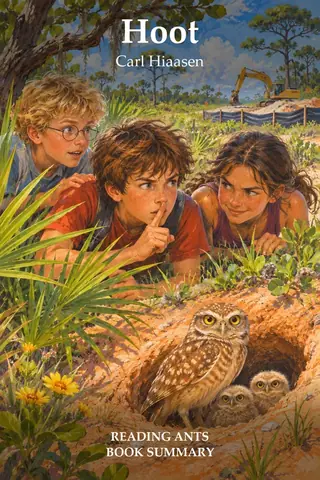
Hoot
A new kid in Florida teams up with a barefoot runaway and a tough classmate to save a nest of tiny burrowing owls from a pancake restaurant being built on top of them.
Overview
Hoot is a 2002 novel by Carl Hiaasen, who had written funny crime stories for adults before this, his first book for young readers. It won a Newbery Honor in 2003. Roy Eberhardt has moved from Montana to the Florida town of Coconut Cove, where he is bullied and has trouble fitting in. A chance sighting of a barefoot boy running past the school bus pulls him into a mystery about strange vandalism at a building site. The story is funny and quick, and it is about caring for wildlife, standing up to bullies and speaking up when adults are not honest.
Main Characters
- Roy Eberhardt: the new boy from Montana, thoughtful and determined.
- Dana Matherson: a bigger student who bullies Roy.
- Mullet Fingers: a barefoot runaway whose real name, Napoleon Bridger Leep, Roy learns at the end. He sabotages the construction site.
- Beatrice Leep: Mullet Fingers’s tough, athletic stepsister and a classmate of Roy’s.
- Officer David Delinko: a young policeman who investigates the vandalism.
- Curly Branitt: the construction foreman.
- Chuck Muckle: a vice president of the pancake company, who wants the restaurant built on schedule.
- Viola Hennepin: the school vice principal.
Full Summary
The New Kid
Roy Eberhardt has just moved from Montana to Coconut Cove, Florida. On the school bus, a bully named Dana Matherson grabs him and chokes him. At the same moment, Roy sees a boy running barefoot beside the bus, and he cannot stop thinking about him. Roy hits Dana and breaks his nose. The vice principal, Miss Hennepin, suspends Roy from the bus for two weeks and makes him apologize, though Dana refuses to accept the apology. When Roy tries to follow the running boy, a golf ball knocks him down. Roy is new in town and has few friends, so he mostly watches and wonders, and the strange boy gives him something to wonder about.
Vandals at the Pancake House
The company Mother Paula’s All-American Pancake House plans to build a new restaurant in town, but someone keeps sabotaging the building site. Survey stakes disappear, and even alligators turn up in the portable toilets. Officer Delinko is supposed to catch the vandal, but he falls asleep on watch, and when he wakes someone has painted his car windows black. He is put on desk duty. Roy tracks down the barefoot boy, who goes by the nickname Mullet Fingers. Beatrice Leep, a tall, tough classmate, turns out to be his stepsister, and she helps Roy. Roy learns that Mullet Fingers is living on his own, hiding from a family that does not want him.
Proving the Owls
Mullet Fingers is the vandal. He is trying to stop the bulldozers because the lot is home to a colony of burrowing owls, small owls that nest in holes in the ground. The foreman, Curly, says there are no owls, and the executive, Muckle, pressures Curly to finish the work. Curly brings in guard dogs, and one of them bites Mullet Fingers. Roy and Beatrice help him. Roy researches the owls and finds that the building permits at City Hall are missing or incomplete. He gives a speech about the owls at school and gets Mullet Fingers to take photographs. Roy also plays a trick on Dana by telling him a lie about cigarettes in the foreman’s trailer. Dana is caught at the site and arrested, and the police blame him for the vandalism. Delinko sees a baby owl in its burrow and understands what the bulldozers would do.
The Groundbreaking
At the ceremony to start building, Roy and his classmates show up to speak for the owls. The photographs are not clear enough to prove anything, so Mullet Fingers buries himself in an owl burrow to stop the work. Muckle loses his temper in front of the cameras. Afterward Roy finds that the file at City Hall is missing an environmental report that the law requires before building, and he gives it to a reporter. The story becomes a scandal, and the company blames former employees. The pancake chain gives up the site, and the land is saved as a home for the owls. Muckle is disgraced, and Dana is sent to a juvenile detention center for his own troubles with the law.
Mullet Fingers
The last chapters follow Mullet Fingers. His mother turns up at the protest and tries to grab the attention of the cameras. Soon afterward he is mistaken for a burglar, and he ends up in a juvenile detention center, from which he escapes. In the final chapter Roy learns the boy’s real name, Napoleon Bridger Leep. Roy has gained a friend and a cause in his new town, and the owls have a safe home, even though Mullet Fingers himself is still on the run.
Why It Matters
Hoot was Carl Hiaasen’s first book for young readers and earned a Newbery Honor. It was made into a film in 2006. Kirkus Reviews said that Hiaasen adapted the style of his adult novels to younger readers remarkably well. It is part of a wider body of children’s fiction that encourages concern for the natural world, but with humor and adventure instead of lectures.
The story also shows how ordinary young people can affect big decisions. Roy and his classmates do not have power or money, but they discover that persistence and the truth can embarrass a powerful company into doing what is right.
Key Takeaways
- Wildlife needs defenders. Small creatures like the owls have no voice unless someone speaks up.
- Young people can make a difference. A few determined students change a company’s plans.
- Bullies can be faced. Roy stands up to Dana, though it costs him.
- Honesty beats trickery. The company’s cover-up falls apart once the missing report comes to light.
- Friendship comes in odd forms. An unlikely group works together.
What We Can Learn
If you care about something, find the facts first. Roy and his friends win because they find proof that the company ignored the rules. A protest backed by evidence is hard to ignore.
The book also shows that you can protest peacefully and cleverly. Speeches, photographs and attention from the press do more than anger. If you want to protect a park, a pond or an animal, think about whom to tell and how to get them to listen.
Finally, it reminds us that bullying should not be accepted. Roy fights back once and is punished for it, and the story suggests that a better plan is to tell an adult and to find friends who will stand with you. Roy’s trick on Dana also gets Dana into trouble, which is worth thinking about: honesty matters even when the other person is unpleasant.
Criticism and Counterpoints
Some reviewers find the plot predictable, and they point out that careful readers will work out the connections early. Kirkus also called Roy’s wholesomeness a little unnatural. The adults, such as the police officer and the company executives, are shown as fools, and the story makes saving nature look easy, since a few facts and a protest defeat a big company. Parents should know that the book includes bullying, a bully who smokes, a few mild swear words and a number of pranks and fights. Even so, readers often praise its humor and its love of the Florida landscape.
Who Should Read It
Hoot suits readers from about ten to fourteen who like funny adventure, animals and mysteries, and teachers who want a book about the environment that students will enjoy. It is also a good pick for reluctant readers, because the chapters are short and the plot moves quickly.
Want the whole book?
A summary is a taste, not the meal. Here is where to find the full book.
You reached the end 🎉
Nicely done. Mark this one as read, and we will suggest what to read next.
Read this next
Holes
Louis Sachar
A boy with a family curse is wrongly sent to a desert detention camp where boys must dig holes all day, and he uncovers a buried secret that connects his family's past to the camp's cruel warden.
🧸 Children's Books
Hatchet
Gary Paulsen
After a plane crash leaves him alone in the Canadian wilderness with only a hatchet, a thirteen-year-old boy must learn to survive, and grows from a frightened city kid into a patient, resourceful young man.
🧸 Children's Books
The One and Only Ivan
Katherine Applegate
A gorilla named Ivan, who lives in a small cage in a shopping mall, promises to rescue a baby elephant named Ruby and finds his voice through painting.
🧸 Children's Books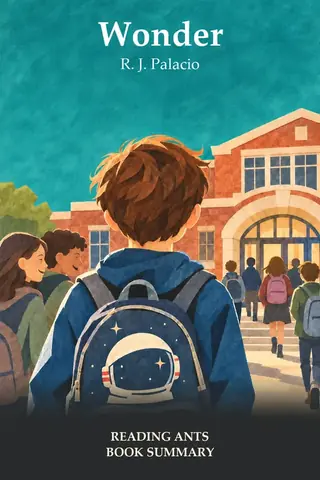
Wonder
R. J. Palacio
A ten-year-old boy born with a rare facial difference goes to school for the first time, and through bullying, friendship and courage he helps everyone around him learn to choose kindness.
🧸 Children's Books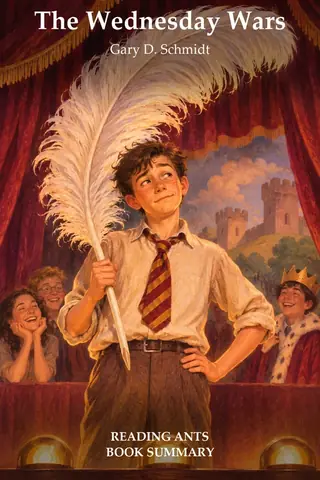
The Wednesday Wars
Gary D. Schmidt
A seventh grader in 1967 who is stuck alone with his teacher every Wednesday afternoon finds, through Shakespeare, a way to grow up in a year of war and family trouble.
🧸 Children's Books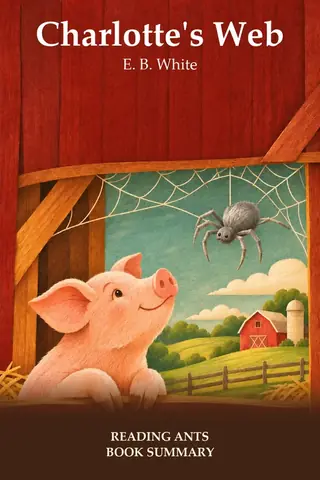
Charlotte's Web
E. B. White
A lonely pig named Wilbur learns he is going to be killed, and his clever friend Charlotte, a spider, comes up with an amazing plan to save his life.
🧸 Children's BooksWant something different?
Pick another topic and we will show you three books to start with.