 Reading Ants
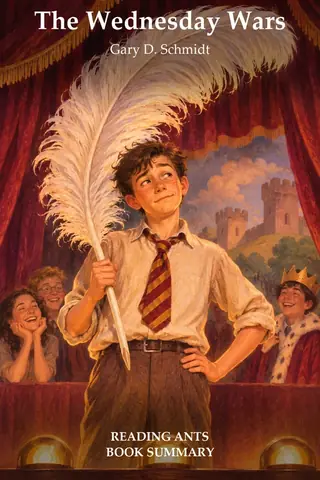
The Wednesday Wars
A seventh grader in 1967 who is stuck alone with his teacher every Wednesday afternoon finds, through Shakespeare, a way to grow up in a year of war and family trouble.
Overview
The Wednesday Wars is a 2007 novel by Gary D. Schmidt, a Newbery Honor book in 2008. It is set at a junior high school on Long Island, New York, during the 1967–68 school year, when the Vietnam War is in the news and the country is changing fast. The narrator is Holling Hoodhood, a seventh grader who is the only Presbyterian in his class. On Wednesday afternoons the Catholic and Jewish students leave for religious classes, so Holling is left behind with his teacher, Mrs. Baker, who he is sure dislikes him. What follows is a funny, moving story about a boy discovering that he has a mind and a voice.
Main Characters
- Holling Hoodhood: a seventh grader, the narrator, nervous but increasingly brave.
- Mrs. Baker: his strict teacher, whose husband, Lieutenant Baker, is a soldier in Vietnam.
- Holling’s father: an architect who cares about money and appearances more than about his children.
- Heather: Holling’s older sister, who argues with their father and runs away from home, heading for California.
- Meryl Lee: a sharp, loyal classmate whom Holling takes to see Romeo and Juliet on Valentine’s Day.
- Danny Hupfer: Holling’s baseball-crazy best friend, whose bar mitzvah Holling attends.
- Mai Thi: a classmate who came from Vietnam only the summer before and is treated badly by some people at school.
- Doug Swieteck: a classmate whose scary older brother becomes Holling’s enemy.
- Mrs. Bigio: a school cafeteria worker whose husband is killed in Vietnam.
- Sycorax and Caliban: the classroom rats.
Full Summary
Alone on Wednesdays
At Camillo Junior High, Holling Hoodhood is the only Presbyterian in his seventh-grade class. Every Wednesday afternoon half his classmates leave for Hebrew school and the other half for Catechism, and he is left behind with his teacher, Mrs. Baker. He is sure she hates him. At first she gives him chores, such as washing the chalkboards and pounding chalk dust out of the erasers. Then she announces that on Wednesdays they will read Shakespeare together, starting with The Merchant of Venice. Her last chore for him is to clean the cage of the class rats, Sycorax and Caliban. During the cleaning the rats escape and vanish into the ceiling, where they stay hidden for months while school staff try to catch them. Holling expects Shakespeare to bore him to death, but he finds to his surprise that he enjoys the plays, and over the year the two move slowly from hostility toward friendship.
Yellow Tights and a Fallen Hero
Holling’s father is an architect who cares a great deal about his image. He keeps asking whether everything is all right with Mrs. Baker, because her family’s Baker Sporting Emporium is choosing an architect and his firm hopes to be picked. Meanwhile Holling gets a part in the Long Island Shakespeare Company’s Holiday Extravaganza almost by accident, after the baker Mr. Goldman hears him recite lines from The Tempest. He is cast as Ariel, and his costume is bright yellow tights with white feathers on the seat. He is mortified, though the show goes well. Afterward, with no ride and no money, he rides a bus in costume to the Emporium, where Mickey Mantle is signing baseballs. Mantle laughs at the tights, refuses to sign, and tosses the ball aside. Danny, who has just had his own ball signed, puts it back down in disgust. Holling’s hero has fallen. Before the holiday break, Mrs. Baker and her brother-in-law arrange for two other Yankees, Joe Pepitone and Horace Clarke, to visit the school gym. They play catch with Holling, Danny and Doug, sign their baseballs, and give each boy two tickets for Opening Day. Pepitone gives Holling his jacket.
War at Home and at School
At home, Holling’s father puts his work before his children. He fights with Holling’s older sister Heather, who has turned against the Vietnam War. At school the war is close too. In November, Mrs. Bigio, the cafeteria cook, learns that her husband, a Marine, has been killed in Vietnam, and soon afterward vandals scrawl a hateful message on the home where Mai Thi lives. In her grief, Mrs. Bigio becomes cold toward Mai Thi and tells her that she has no business sitting safe in a refugee home while American soldiers are in the swamps. Mrs. Baker quietly gives Mai Thi her own cup of hot chocolate. Months later, after older students taunt Mai Thi and Danny punches one of them, Mrs. Bigio brings the class fried bananas, a Vietnamese recipe, and tells Mai Thi she is sorry. Holling also learns that Mrs. Baker’s husband is serving in Vietnam. In February a telegram reports that his helicopter was downed and that he is missing in action, and Holling begins to see his strict teacher differently.
Snow, a Bus and a Valentine
In January, during an ice and snow storm, Holling rushes into the street and shoves Heather out of the way of a sliding school bus. The bus hits him, he lands in a snowbank with only a bruise, and the newspaper calls him a local hero. In February, after reading Romeo and Juliet, he asks Meryl Lee to go somewhere with him for Valentine’s Day. Mrs. Bigio, hearing of his money troubles, hands him two season tickets, and the two of them see the play, with Mr. Goldman as Friar Laurence, and then share Cokes at Woolworth’s. There Holling sketches his father’s design for a new junior high school. Meryl Lee passes the idea to her own father, a rival architect, and Holling feels betrayed. He makes peace by bringing her a rose and two Cokes. Mr. Kowalski presents a redesign based on the idea, but he then withdraws his bid, and Holling’s father wins the school contract.
Rats, a Race and Opening Day
Mrs. Baker coaches Holling’s running before the cross-country tryouts, and he learns that she once ran in the 1956 Olympic relay. On the ides of March, school board members visit the class. When Holling acts out the stabbing of Julius Caesar, a ceiling tile gives way and Sycorax and Caliban drop into the lap of Mrs. Sidman, a board member. She grabs them by the scruff of the neck and carries them off, and she soon becomes the new principal. That afternoon, at the tryouts, the exterminator drops the rats’ cage and they chase Holling around the school yard. He sets a record time, and the rats are run over by a school bus.
In April, Holling’s father promises to pick him up at noon for Opening Day at Yankee Stadium. He never comes, and his secretary says he has a business meeting that he would not miss. Mrs. Baker, who has never been to a baseball game, drives Holling to the Bronx herself, at a very careful speed. They reach the game in the third inning and sit with Danny, Doug and their fathers. After the game, Pepitone and Clarke recognize Mrs. Baker as the Olympic runner, and the whole team shows them around the stadium.
A Sister Comes Home
In May, Heather and her father fight over whether she can go to college, and she leaves a note and drives west with a friend named Chit. One night she phones Holling from a bus station in Minneapolis, nearly out of money and afraid to call her parents. Holling cashes in the savings bond he won in a cross-country race and wires her the money. When he tells his parents that she is coming home by bus, their father refuses to fetch her, so Holling goes to the city himself and meets her at the Port Authority. They spend the day in Central Park. Soon afterward, Mrs. Baker receives a telegram that her husband has been found alive in the jungle.
Strawberries and a Sunrise
The year ends with a class camping trip in the Catskills. It rains, the mosquitoes attack, and Holling loses the utensils from his pack, but Mrs. Baker is smiling all the while. Mrs. Bigio hikes in with food, cooks a Vietnamese stew with Mai Thi, and offers her a home. At dawn Holling sees the sun light up the river and feels that there is more light to come. A week later he attends Danny’s bar mitzvah, and he tells his father that he does not yet know who he will be, standing up to him as never before. Eleven days after that, Lieutenant Baker comes home alive, and the whole class greets him with boxes of strawberries.
Why It Matters
The Wednesday Wars received a Newbery Honor in 2008. It captures a turbulent moment in American history, with the Vietnam War and the killings of Martin Luther King Jr. and Robert F. Kennedy in the background, through a boy who is more worried about his own embarrassments than about politics, and who slowly sees how larger events affect the people he knows.
It is also a lively argument for reading classic literature. Holling expects Shakespeare to be a punishment, but he finds it thrilling, and the plays help him make sense of his own life. Kirkus Reviews praised the book’s comedy and Holling’s wry wit.
Key Takeaways
- A good teacher can change a life. Mrs. Baker’s patience helps Holling find his strengths.
- Old books speak to young people. Shakespeare’s words give Holling ways to understand his own feelings.
- War touches ordinary people. Mrs. Baker, Mrs. Bigio and Mai Thi show how far the effects of a war reach.
- Families can fail us, and others can step in. Holling finds support outside his home.
- Growing up means taking responsibility. Holling learns to care about others and to find his own way, even when his father disagrees.
What We Can Learn
If a teacher or adult seems to be hard on you, give them time. Mrs. Baker is demanding, but she is also looking out for Holling. A good mentor often asks more of us than we expect.
The book also encourages trying things that scare us, such as a play, a race or a new book. Holling tries a play, a race and a new kind of book, and he grows from each.
Finally, it reminds us to think about what others are going through. A classmate or a school cook may be angry because of a loss we cannot see, and a small kindness can help.
Criticism and Counterpoints
The novel follows Holling through a year of school, month by month, so some readers feel it moves from one episode to the next. Common Sense Media notes that kid reviewers have mixed opinions: some find the book rewarding, while others call it boring or its plot weak. It is probably best for older kids who can handle the writing style and the historical references to the 1960s. Even so, reviewers praise its humor and warmth.
Who Should Read It
This book suits readers from about ten to fourteen, especially those who like funny, thoughtful stories about school and family. It is also a good fit for teachers and parents who want to introduce Shakespeare in a friendly way. Readers who prefer a single strong plot may find the episodes loosely connected, but the characters are memorable.
Want the whole book?
A summary is a taste, not the meal. Here is where to find the full book.
You reached the end 🎉
Nicely done. Mark this one as read, and we will suggest what to read next.
Read this next
Okay for Now
Gary D. Schmidt
An eighth-grade boy with a harsh family and a bad reputation moves to a new town, where a library book of bird paintings and a few kind adults help him learn to draw, read and hope.
🧸 Children's Books
Wonder
R. J. Palacio
A ten-year-old boy born with a rare facial difference goes to school for the first time, and through bullying, friendship and courage he helps everyone around him learn to choose kindness.
🧸 Children's Books
Holes
Louis Sachar
A boy with a family curse is wrongly sent to a desert detention camp where boys must dig holes all day, and he uncovers a buried secret that connects his family's past to the camp's cruel warden.
🧸 Children's Books
The Watsons Go to Birmingham - 1963
Christopher Paul Curtis
A funny family from Flint, Michigan, drives south to Alabama in the summer of 1963 to straighten out their troublemaking oldest son, and finds themselves close to one of the worst crimes of the civil rights era.
🧸 Children's Books
Roll of Thunder, Hear My Cry
Mildred D. Taylor
A Black family in 1930s Mississippi fights to keep their land and their dignity in the face of racism, and a young girl learns what it means to stand up.
🎒 Young Adult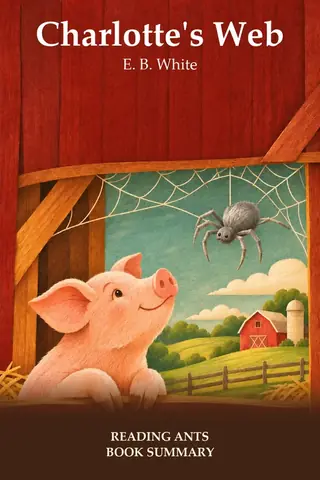
Charlotte's Web
E. B. White
A lonely pig named Wilbur learns he is going to be killed, and his clever friend Charlotte, a spider, comes up with an amazing plan to save his life.
🧸 Children's BooksWant something different?
Pick another topic and we will show you three books to start with.