 Reading Ants
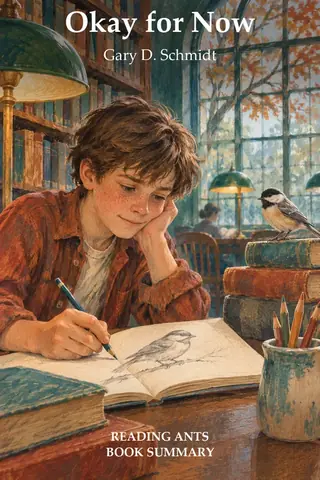
Okay for Now
An eighth-grade boy with a harsh family and a bad reputation moves to a new town, where a library book of bird paintings and a few kind adults help him learn to draw, read and hope.
Overview
Okay for Now is a 2011 novel by Gary D. Schmidt, a companion to The Wednesday Wars, with a character from that book as its hero. Doug Swieteck is an eighth grader whose father has just been fired and has moved the family from Long Island to a small town called Marysville, in upstate New York. It is 1968 and 1969, the years of the Vietnam War and the Apollo moon missions. Doug’s father hits his sons, his brother Christopher is a bully, and his oldest brother Lucas is in the war. In the town library, Doug finds a huge book of bird paintings by John James Audubon, and it begins to change his life. Doug tells the story himself, in a funny, boastful voice. The book was a finalist for the National Book Award.
Main Characters
- Doug Swieteck: the narrator, an eighth grader who boasts and talks back, but has a talent for drawing.
- Mr. Swieteck: Doug’s father, a bitter, violent man who works at a paper mill.
- Mrs. Swieteck: Doug’s loving, plant-growing mother.
- Lucas: Doug’s oldest brother, who comes home from Vietnam badly wounded.
- Christopher: Doug’s older brother, who bullies him but turns out to be protective.
- Lil Spicer: a sharp-tongued girl Doug meets, the daughter of the town’s deli owner.
- Mr. Powell: the elderly head librarian, who teaches Doug to draw.
- Mrs. Windermere: an eccentric playwright who gets her groceries from the deli.
- Mr. Ferris and Miss Cowper: Doug’s physical science and English teachers.
- Coach Reed: the gym teacher, a harsh man who is a Vietnam veteran.
- Mr. Ballard: the owner of the paper mill.
- Principal Peattie: the school principal, who has an Audubon print hanging in his office.
- Mr. Gregory: a New York theater producer.
Full Summary
A New Town
Doug’s father is fired from his job at Culross Lumber after a fight with his boss, Mr. Culross, and he moves the family to Marysville for a job at a paper mill. The pay turns out to be only about half of what a friend promised. They live in a small, rundown house that Doug calls The Dump. Doug, who has always been blamed for things his brother Christopher did, expects the same here. Before he leaves, his old friend Holling Hoodhood gives him a New York Yankees jacket that once belonged to the ballplayer Joe Pepitone, and Doug treasures it. In Marysville he meets Lil Spicer outside the public library. Inside, upstairs, he finds a huge book of Audubon’s bird paintings under glass, open to a picture of an Arctic tern falling toward the sea.
The Bird Under Glass
Doug keeps coming back to the library steps, even when the doors are locked. Lil offers him a Saturday job delivering groceries for her father’s deli. The librarian, Mr. Powell, lets him in early one day, and soon he finds paper and colored pencils waiting by the glass case. Doug insists that he does not draw, but he starts anyway, and Mr. Powell teaches him about composition, white space and balance, using a different Audubon print each week. One of Doug’s customers is Mrs. Windermere, a playwright in a huge house who lets him fix her typewriter. She tells him that the mother bird in a picture of red-throated divers is watching for the next wonderful thing in her child’s life.
School and Secrets
At school the teachers assume that Doug is a troublemaker, because of Christopher’s record. When the deli is robbed, the whole town suspects the Swietecks. One afternoon, when Doug is serving detention in the science room, his science teacher, Mr. Ferris, discovers that Doug can hardly read. Mr. Ferris apparently tells his English teacher, Miss Cowper, who quietly teaches him through what she calls a literacy unit. Doug begins sounding out Jane Eyre word by word on his delivery route. Meanwhile the gym coach, Reed, clashes with him in class. When Reed grabs at Doug’s gym shirt and tears it, everyone sees the tattoo that Doug has always hidden. Doug runs out and hits Mr. Ferris in the stomach, and then he tells him that his father forced him to get the tattoo on his twelfth birthday.
Lucas Comes Home
In December, Doug and his parents drive to New York City to meet Lucas’s bus. He has lost both legs above the knee, and burns have forced bandages over his eyes. Crowds of war protesters shout cruel things at Lucas, and Doug’s father steps in front of him. At home Lucas is quiet and in pain, and he has nightmares. By accident Doug sees Coach Reed’s drawing pad and finds sketches of the war, including a massacre. He begins to understand why Reed is so hard on boys, and he offers to help with Reed’s fitness charts. Reed slowly softens, and Doug hopes that someone who knows the war might help his brother.
Saving the Birds
The town council has been cutting plates out of the library’s Audubon book and selling them to raise money. Doug becomes determined to get them back. His classmate James Russell’s father bought the puffins, and Doug trades him a rare book of Aaron Copland’s that Mrs. Windermere gives him. When Mr. Ballard, the mill owner, shows Doug the Yellow Shank he bought, Doug says it belongs back in the book, and Mr. Ballard returns it. Principal Peattie, who has the pelican, agrees to give it up only if the police find the real thief and clear Christopher, who is arrested in the spring for a robbery he did not commit. Doug’s Yankee jacket also disappears, and he sees Ernie Eco, his father’s friend, wearing it.
The Play
Mrs. Windermere is writing a Broadway version of Jane Eyre. Her producer, Mr. Gregory, needs a Helen Burns, and Doug persuades Lil to take the part by promising that they will both receive the Snowy Heron print. Doug is cast as the offstage shriek of the madwoman Bertha Mason. On opening night Lil falls ill and is taken to the hospital, and Doug must play Helen Burns himself. He demands another print in exchange, and he moves the audience. Afterward Joe Pepitone, who was in the audience, comes backstage to meet him. Lil is seriously ill. Soon after, Lucas becomes assistant gym coach, a thief confesses after an anonymous tip, and Christopher is cleared. Doug’s father returns the jacket and makes peace with his wife, and the principal gives back the pelican. Doug paints his own tern to fill the missing plate. The book ends with Doug and Lil watching the Apollo 11 launch from her hospital bed, where he is sure she will be fine.
Why It Matters
Okay for Now was a finalist for the National Book Award for Young People’s Literature, and it was praised for its voice, which is funny, fast and increasingly moving. It is the rare companion novel that gives a secondary character from an earlier book his own full story, and it can be read on its own.
It also treats art, reading and the effects of war with honesty. The Audubon paintings, which are connected to Doug’s moods and fortunes, give the book a strong structure, and each chapter is named for one of the plates.
Key Takeaways
- One caring adult can change a life. Mr. Powell, Mr. Ferris and Miss Cowper each help Doug find his gifts.
- Art can heal. Drawing gives Doug a way to express what he cannot say.
- Reputation is not destiny. The town expects the worst of Doug, but he proves them wrong.
- War leaves wounds. Lucas and Coach Reed show the costs of Vietnam long after it is over.
- Broken things can be restored. The sold prints and Doug’s family both find ways to be made whole.
What We Can Learn
If a label has been attached to you, such as troublemaker, slow or weak, remember that it may say more about others than about you. Doug is judged by his family, yet he finds that kind people will give him a chance.
The book also reminds us how important it is to notice others’ struggles. Mr. Ferris sees that Doug cannot read, and he and Miss Cowper help without shaming him. Paying attention to a classmate who hides a problem can make a difference.
Finally, Doug shows that learning a skill, whether drawing, reading or acting, takes patience and practice, and that every small step counts.
Criticism and Counterpoints
Some readers find Doug’s repetitive, boastful voice tiresome at first, and the book is long for a middle-grade novel. Others say that the happy turns, such as the kindness of the mill owner, the school staff and the librarian, are too neat, and that Doug’s father seems to change quickly. The topics, including family violence, a forced tattoo, a wounded veteran and a young girl’s serious illness, can be heavy. The ending leaves Lil’s fate uncertain, which some readers find unsatisfying. Others consider it fitting.
Who Should Read It
This book suits readers from about ten to fourteen, and adults who like warm, character-driven stories. It is a good choice for anyone interested in art, birds or the 1960s. Because of family violence, war injuries and a girl’s illness, sensitive readers may want to read it with an adult, and those who have read The Wednesday Wars will enjoy seeing Doug again.
Want the whole book?
A summary is a taste, not the meal. Here is where to find the full book.
You reached the end 🎉
Nicely done. Mark this one as read, and we will suggest what to read next.
Read this next
The Wednesday Wars
Gary D. Schmidt
A seventh grader in 1967 who is stuck alone with his teacher every Wednesday afternoon finds, through Shakespeare, a way to grow up in a year of war and family trouble.
🧸 Children's Books
Wonder
R. J. Palacio
A ten-year-old boy born with a rare facial difference goes to school for the first time, and through bullying, friendship and courage he helps everyone around him learn to choose kindness.
🧸 Children's Books
Holes
Louis Sachar
A boy with a family curse is wrongly sent to a desert detention camp where boys must dig holes all day, and he uncovers a buried secret that connects his family's past to the camp's cruel warden.
🧸 Children's Books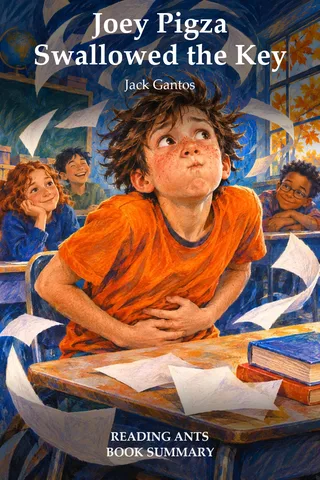
Joey Pigza Swallowed the Key
Jack Gantos
A boy whose body and mind race out of control, and whose medicine does not work well, gets suspended from school and finally finds the right treatment and a bit of stability.
🧸 Children's Books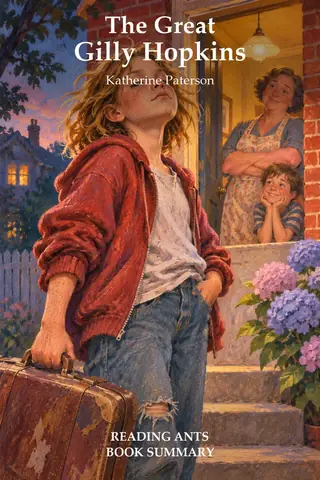
The Great Gilly Hopkins
Katherine Paterson
A clever, angry eleven-year-old foster child who lies and fights to keep people away is slowly won over by a huge-hearted foster mother, and then has to leave her.
🧸 Children's Books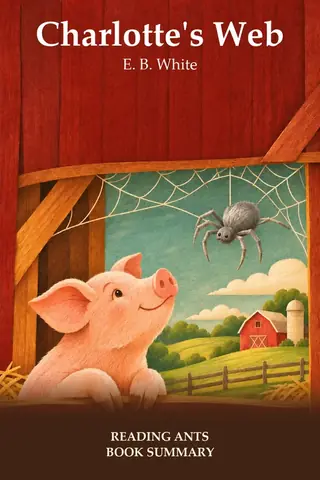
Charlotte's Web
E. B. White
A lonely pig named Wilbur learns he is going to be killed, and his clever friend Charlotte, a spider, comes up with an amazing plan to save his life.
🧸 Children's BooksWant something different?
Pick another topic and we will show you three books to start with.