 Reading Ants
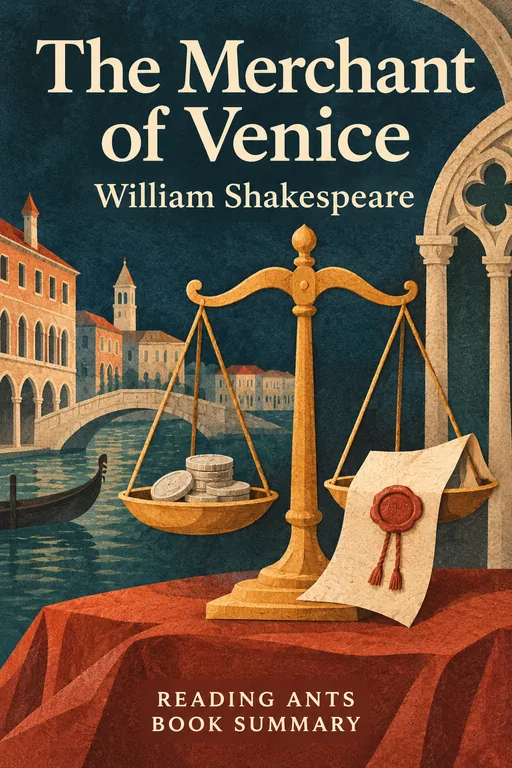
The Merchant of Venice
To help his friend win a rich heiress, the Venetian merchant Antonio borrows money from the Jewish moneylender Shylock, signs a bond promising a pound of his own flesh, and ends up in court fighting for his life.
Overview
The Merchant of Venice is a play by William Shakespeare, written around 1596 to 1598. It is classed as a comedy, because it ends with marriages, but it contains dark themes and has been one of Shakespeare’s most debated plays. It combines two stories: the romance of Bassanio and Portia in the estate of Belmont, and the conflict between Antonio and Shylock in Venice. Shylock is one of the most complex and controversial characters in drama, a figure who is both villainous and sympathetic, and whose treatment raises questions about prejudice, revenge and mercy.
Main Characters
- Antonio: a wealthy, melancholy merchant of Venice who is generous to his friends.
- Bassanio: Antonio’s charming but spendthrift friend, who wishes to marry Portia.
- Portia: a rich, intelligent heiress of Belmont, bound by her father’s will.
- Shylock: a Jewish moneylender who has been mistreated by Christians and wants revenge.
- Jessica: Shylock’s daughter, who runs away with a Christian, Lorenzo.
- Gratiano and Nerissa: Bassanio’s friend and Portia’s maid, who also fall in love.
- The Prince of Morocco and the Prince of Arragon: unsuccessful suitors of Portia.
Full Summary
The Loan
Bassanio asks his friend Antonio for money, so that he can court Portia, who lives in Belmont. Antonio’s wealth is tied up in ships at sea, so he cannot lend the money himself, but offers to guarantee a loan. Bassanio goes to Shylock, a Jewish moneylender. Shylock hates Antonio, who has insulted him in public, and lent money without charging interest, which undercuts his business. Pretending to be friendly, Shylock offers a loan with no interest, but with a strange condition: if the money is not repaid on time, he may take a pound of Antonio’s flesh. Antonio, confident that his ships will return, agrees.
Belmont and the Caskets
In Belmont, Portia’s father’s will states that her husband must be chosen by a test with three caskets: gold, silver and lead. A suitor who chooses the right one will win her. The Prince of Morocco chooses gold, and the Prince of Arragon silver, and both fail. Bassanio, who sees that appearance can deceive, chooses lead, and wins. Portia gives him a ring, and makes him promise never to part with it. At the same moment, his friend Gratiano marries Nerissa.
Jessica’s Flight
Meanwhile, in Venice, Shylock’s daughter Jessica elopes with Lorenzo, a Christian, taking jewels and money from her father. Shylock is devastated, and mourns the loss of both. His grief and anger deepen when he learns that Antonio’s ships have been reported lost. His bitterness against Christians is expressed in a famous speech that asks whether a Jew does not have eyes, hands and feelings like anyone else, and whether, if wronged, he should not seek revenge.
The Trial
When Antonio cannot repay the debt, Shylock demands his pound of flesh. At the trial, the Duke urges mercy, but Shylock refuses and insists on the bond. Portia and Nerissa, disguised as a young male lawyer and his clerk, arrive in court. Portia first makes a famous plea that mercy is a quality that blesses both giver and receiver, but when Shylock still refuses, she points out that the bond allows only flesh, not blood, and that if he spills a drop of Christian blood, his goods will be forfeit.
Shylock’s Fall
Shylock, seeing that he is defeated, asks for the money instead, but Portia says that he has refused it in open court, and that, under Venetian law, an alien who plots against the life of a citizen forfeits half his property to the victim and half to the state. The Duke spares his life and remits the state’s half. Antonio, showing mercy of a kind, asks to hold the other half in trust, on condition that Shylock become a Christian and leave his estate to Jessica and Lorenzo. Shylock, broken, leaves the court.
The Rings
At the end, Portia and Nerissa, still in disguise, ask Bassanio and Gratiano for the rings that their wives had given them, as payment, and the men, with some reluctance, give them away. Back in Belmont, the women pretend to be angry that the rings are gone, then reveal that they were the lawyers. News arrives that Antonio’s ships have come safely home. The play ends with reconciliation and the sense of a happy ending, though the fate of Shylock casts a shadow.
Why It Matters
The Merchant of Venice has long been performed, though its treatment of Jews has made it increasingly controversial, particularly after the Holocaust. Productions often seek to make Shylock more human, and the “Hath not a Jew eyes?” speech is one of the most famous in Shakespeare. Portia’s speech on the quality of mercy is also widely known.
The play remains a central text for discussing prejudice, justice and law, and has been adapted for film, including the 2004 version starring Al Pacino as Shylock.
Directors have staged Shylock as a villain, a victim and a figure of tragic dignity, and each choice changes the play. The famous speech on mercy is often quoted in discussions of law and ethics, and the problem of how to perform the play today is a living question for theaters.
Key Takeaways
- Prejudice breeds cruelty on both sides. Antonio’s scorn and Shylock’s hate feed one another.
- Mercy and strict law can clash. Portia calls for compassion, though the play leaves open whether the Christians’ own mercy is real.
- Appearances can deceive. The caskets test the ability to see beyond glitter.
- Bonds have consequences. The pound of flesh turns a deal into a threat.
- Justice can be harsh. Shylock’s punishment is severe.
What We Can Learn
The play invites us to look at how prejudice shapes behavior. Shylock is mocked and spat upon, and he comes to want revenge, which shows how mistreatment can twist a person.
It also teaches that mercy and legal justice are different, and that people must choose when to forgive. Portia’s argument shows that rules without compassion can lead to cruelty.
Finally, it suggests that we should be cautious about the promises we sign, and think about the worst case before agreeing.
Criticism and Counterpoints
Many critics regard the play as antisemitic, since Shylock is a stereotype of the greedy Jew, and the Christians’ treatment of him, including forced conversion, is hard for modern audiences to accept. Others argue that Shakespeare gives Shylock a humanity that exposes Christian hypocrisy, and that the play is about prejudice rather than endorsing it.
Some critics find Portia’s legal trick unconvincing, and the ending, in which the Christians celebrate while Shylock is ruined, uncomfortable. The play is hard to stage for this reason, and has been banned or protested in some places.
Who Should Read It
This play suits teenagers and adults. It contains antisemitic language and attitudes, and should be read with discussion of the historical context. A modern edition with notes, or a performance, helps.
Want the whole book?
A summary is a taste, not the meal. Here is where to find the full book.
You reached the end 🎉
Nicely done. Mark this one as read, and we will suggest what to read next.
Read this next
Othello
William Shakespeare
A noble Black general in the Venetian army is manipulated by his trusted officer Iago into believing that his loving wife is unfaithful, and his jealousy leads him to destroy her and himself.
🎭 Epics, Drama & Poetry
Twelfth Night
William Shakespeare
After a shipwreck, a young woman named Viola disguises herself as a man and serves a duke, falls in love with him, and becomes tangled in a love triangle that is only resolved by the return of her twin brother.
🎭 Epics, Drama & Poetry
Much Ado About Nothing
William Shakespeare
Two pairs of lovers in Messina, the witty rivals Beatrice and Benedick and the young couple Hero and Claudio, are tricked by their friends and enemies, in a comedy of wit, deception and reconciliation.
🎭 Epics, Drama & Poetry
The Tempest
William Shakespeare
A wronged duke named Prospero, living on a magical island, raises a storm to bring his enemies to him, and in the end chooses forgiveness over revenge.
🎭 Epics, Drama & Poetry
Oliver Twist
Charles Dickens
An orphan boy born in a workhouse escapes to London, where he falls into a gang of child thieves, and despite cruelty and crime around him, his goodness survives until he finds a loving home and learns the secret of his birth.
📜 Classics
The Odyssey
Homer
After the Trojan War, the clever hero Odysseus struggles for ten years against monsters, gods and temptations to return home to his faithful wife and son, then must win back his house from the men trying to steal it.
🎭 Epics, Drama & PoetryWant something different?
Pick another topic and we will show you three books to start with.