 Reading Ants
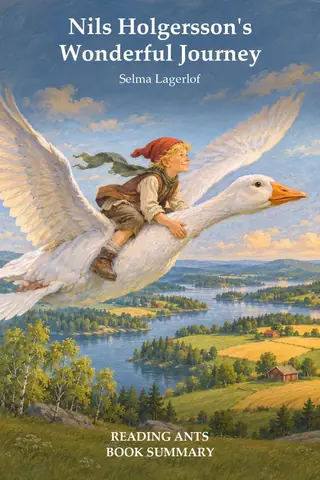
Nils Holgersson's Wonderful Journey
Original title: Nils Holgerssons underbara resa genom Sverige
A lazy, unkind Swedish farm boy is shrunk to the size of a thumb and flies across all of Sweden on the back of a goose, and he learns to be good along the way.
Overview
Nils Holgersson’s Wonderful Journey, also published in English as The Wonderful Adventures of Nils, is a children’s classic by the Swedish writer Selma Lagerlof, who was the first woman to win the Nobel Prize in Literature. It first appeared in two parts, in 1906 and 1907. It began as a commission from a teachers’ association in 1902 to write a geography reader for Swedish schools, and Lagerlof spent years studying nature, birds and local folk tales for it. The result is a fantasy adventure that takes the reader over the whole country, province by province, and also the story of a boy who changes. It is long, but it is divided into short chapters.
Main Characters
- Nils Holgersson: a boy of about fourteen on a farm in southern Sweden, at first lazy and unkind.
- The tomte: a small elf who casts a spell on Nils.
- Morten: the farm’s white gander, who flies off with the wild geese.
- Akka from Kebnekaise: the old, wise leader of the wild geese.
- Smirre Fox: a cunning fox who hunts the geese.
- Gorgo: a young eagle who befriends Nils.
- Osa and Mats: two poor children traveling across the country.
Full Summary
The Boy and the Elf
Nils Holgersson, the son of poor farmers in the province of Skane in southern Sweden, is a boy who likes best to eat, sleep and make mischief. He takes pleasure in hurting the animals on the farm. One Sunday, his parents go to church and leave him at home to learn a part of the Bible. Instead, he catches a tomte, a small elf, in a net. The tomte offers a gold coin to be let go, but Nils refuses, and the tomte punishes him with a spell that shrinks him to the size of a thumb. Nils can now understand the speech of animals, and the farm animals, who have suffered from him, are glad to see him small.
Flying with the Geese
A flock of wild geese flies over the farm on its migration north. Morten, the farm’s white gander, wants to join them, and Nils, trying to hold him back, grabs his neck and is carried up into the sky. The wild geese are not pleased to have a boy and a tame goose with them. Their leader, Akka from Kebnekaise, is suspicious. They test the gander and the boy, and they let both stay after Nils proves useful. In the first days of the journey he sees the fields of Skane from above, like a big checked cloth.
Foxes, Rats and Dangers
The journey is full of dangers and adventures. Smirre Fox follows the geese and tries to catch them, and Nils helps to outwit him. At the old castle of Glimminge, Nils helps the black rats, who are being driven out by gray rats, and he plays a pipe to lead the invaders away. He meets crows, storms and a lonely woman in a cottage, and he thinks about his own parents and how he has hurt them. As he sees more of the country, he starts to care for others, and he finds that one friend is ready to risk everything for him.
Across Sweden
The geese fly through the provinces of Sweden, and the book tells about the land, its animals, farms, mines and cities, and its legends. Nils meets many people and animals, and their stories are woven into the tale. There is a long episode about a hunting dog and an elk, and there are the two poor children Osa and Mats, who walk across the country.
In Stockholm, in a story told in the book, a lonely old fiddler named Clement Larsson, who has come from the countryside to play folk music and guard a peasant cottage at the open-air park Skansen, is homesick. A kind older gentleman sits beside him and talks to him for an hour about the city and why it matters to every Swede. The next day a royal servant brings Clement a book and a letter saying that it comes from the King, and Clement realizes that the gentleman was the King of Sweden, who had spoken to him without making himself known.
The Eagle and the North
Nils meets Gorgo, a young eagle who was raised among the geese in Lapland and has been caught and held at Skansen. Nils frees him, and Gorgo carries Nils north. He sees forests, a mountain fire and the work of the people of the north. The eagle takes him to Lapland, where the wild geese spend the summer. Nils is reunited with Akka and Morten, and he sees Osa find her father there.
The Journey Home
In the autumn the geese fly south, led by Akka. Morten now has a mate, Dunfin, and six goslings. Nils has learned that the elf will give him back his human shape if he watches over the gander so that he gets home safe and sound. At last the flock returns to Skane, and Morten leads Dunfin and the goslings into the old goose pen, where the boy’s mother shuts them in.
The parents, who are poor and about to move, plan to kill the geese for Morten Gooseday. Nils is ashamed to be seen by them at first, but when he hears Morten cry for help he overcomes himself, runs in and tells his mother not to touch the gander. His parents are overjoyed to see their grown and changed son, and Nils is a human boy again. At dawn he goes down to the coast to say goodbye to Akka and the geese as they fly away, and Morten stays on the farm.
Why It Matters
The book is so well known in Sweden that a picture of Nils flying on the back of a goose was printed for many years on the back of the Swedish 20-krona banknote, which carried the author’s portrait on the front. It has been adapted in many countries, including a Japanese animated series from 1980 with fifty-two episodes, which is still loved by many people who grew up with it. The author, who won the Nobel Prize in Literature in 1909, used the story to teach children about geography, nature and folk tales. It is also a story of moral change: a boy who is cruel to animals becomes their friend and protector.
Key Takeaways
- People can change. Nils begins as a cruel boy, and travel and friendship make him kind.
- Seeing the world widely teaches us. Flying over Sweden shows Nils a country bigger and more beautiful than his farm.
- Animals deserve kindness. The story shows creatures as thinking and feeling beings, with homes that need protection.
- Home is worth coming back to. Nils’s journey ends where it began, but he is not the same.
- Courage grows from caring. Nils acts bravely first for others, not for himself.
What We Can Learn
The book is a reminder that a person’s character is not fixed. A young reader who has done something unkind can see in Nils that it is possible to change, and that change comes from actions as well as promises.
It also encourages curiosity about one’s own country and nature. Readers might look at a map and trace Nils’s route, or learn about the birds that migrate through their area.
Finally, it shows that small creatures matter. Nils’s size brings him closer to the animals, and he learns to see the world from their point of view.
Criticism and Counterpoints
The book is long and, as it was meant to teach geography, some chapters read more like a travelogue than a story. Its early sections about the cruelty of the boy, and the hunting of animals, may upset younger readers. The English translation by Velma Swanston Howard cut some chapters and shortened others, so the version most readers know leaves out some parts of the original, including the province of Dalarna. Critics also noted that the geese and the boy only fly over the province of Halland and never stop there. Some modern readers may find its patriotic tone and old-fashioned style slow.
Who Should Read It
This is for children from about eight and for families who like classic adventure stories with animals, flying and magic. It will interest readers who love geography and nature, or who know the animated series. Because it is long, it works well as a read-aloud, a chapter at a time.
Want the whole book?
A summary is a taste, not the meal. Here is where to find the full book.
You reached the end 🎉
Nicely done. Mark this one as read, and we will suggest what to read next.
Read this next
The Wonderful Wizard of Oz
L. Frank Baum
Swept by a cyclone to the magical Land of Oz, a Kansas girl follows the yellow brick road with three unusual friends to ask a great wizard for help, and learns they already had what they were seeking.
🧸 Children's Books
The Jungle Book
Rudyard Kipling
A human boy raised by wolves in the Indian jungle learns the Law of the Jungle from a wise bear and a panther, and must outwit a man-eating tiger, in a collection of classic animal stories.
🧸 Children's Books
Peter Pan
J. M. Barrie
A magical boy who refuses to grow up flies three London children to Neverland, where they battle pirates led by the villainous Captain Hook, until Wendy realizes they must go home and grow up.
🧸 Children's Books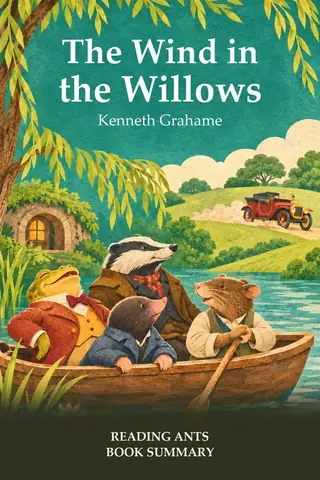
The Wind in the Willows
Kenneth Grahame
A shy Mole, a kindly Water Rat, a gruff Badger and a boastful Toad share riverside adventures in the English countryside, in a story about friendship, home and the madness of Mr. Toad's passion for motorcars.
🧸 Children's Books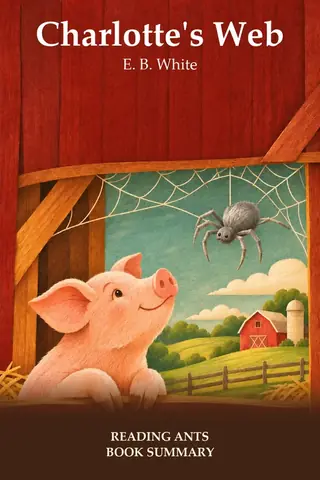
Charlotte's Web
E. B. White
A lonely pig named Wilbur learns he is going to be killed, and his clever friend Charlotte, a spider, comes up with an amazing plan to save his life.
🧸 Children's Books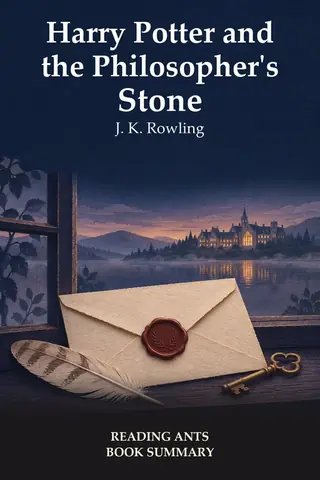
Harry Potter and the Philosopher's Stone
J. K. Rowling
An unloved orphan boy discovers on his eleventh birthday that he is a famous wizard, and during his first year at a magical school he makes true friends and faces the dark wizard who killed his parents.
🧸 Children's BooksWant something different?
Pick another topic and we will show you three books to start with.