 Reading Ants
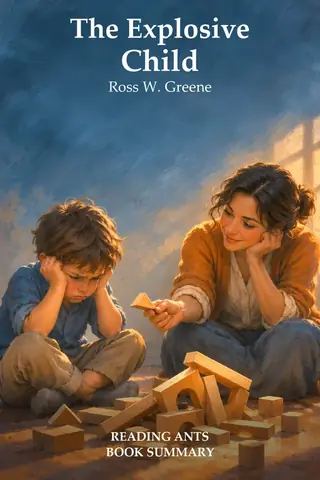
The Explosive Child
A child psychologist argues that children with explosive or concerning behavior lack skills such as flexibility and frustration tolerance, not will or good parenting, and he teaches adults to solve problems together with the child.
Overview
The Explosive Child was first published in 1998 by Ross W. Greene, a clinical psychologist, and the edition read here is the sixth, from 2021. In a new preface he says he never liked the title, which suggests sudden outbursts, because the behaviors matter less than what they tell us, and the book now speaks of concerning behaviors. His model, once called Collaborative Problem Solving, is now called Collaborative & Proactive Solutions. The book explains how to see a child differently, find the problems behind the outbursts and then solve them together with the child.
Full Summary
Skills, not will
The idea: Greene begins by asking readers to drop the usual labels for these children, such as manipulative, attention-seeking or unmotivated. His core belief is that kids do well if they can, not if they want to. When a child melts down, he says, an expectation has arrived that the child does not yet have the skills to meet, such as flexibility, frustration tolerance, adaptability and problem solving. A diagnosis describes behavior but not which skills are missing, so he offers a checklist for finding them. Some children are lucky and cry or withdraw, he says, while others communicate in unlucky ways such as screaming or hitting. He is firm that these lagging skills explain behavior without excusing it, and that adults who believe the child could behave if he chose will keep reaching for the wrong tools.
In real life: A child who was counting on a trip to the park is told that rain has canceled it, and melts down because she cannot shift her plan.
Finding the real problems
The idea: The key to fewer outbursts, in Greene’s view, is to solve the specific problems that set them off. He calls these unsolved problems: particular expectations a child has trouble meeting, at predictable times, such as getting up for school, ending a video game for dinner or putting away laundry. They are not out of the blue, which means they can be listed and planned for. He advises writing each one as a short, neutral statement that leaves out the behavior and any adult theory, then sorting the list by priority. Safety comes first, a few high-priority problems come next, and the rest wait on the back burner. Trying to fix everything at once, he warns, is a recipe for failure.
In real life: A family writes down that getting to dinner and getting to bed cause the most trouble, and sets the other problems aside for now.
Why rewards and punishments fall short
The idea: Greene argues that the usual tools, including sticker charts, time-outs, lost privileges and clearer commands, do not work well for these children. Most of them already know what is expected, and the trouble is that they lack the skill to do it, so reward and punishment cannot teach what is missing. He adds that natural consequences are not very different from consequences imposed by adults, because both leave the problem unsolved. Directives such as telling a child it is time to stop tend to start the conflict they were meant to prevent. His alternative is to stop trying to modify behavior and to work on the problem that sits behind it.
In real life: A parent takes away a privilege after each outburst and finds that the outbursts keep coming.
Three ways to respond
The idea: At the center of the book is a simple choice about each unsolved problem. Plan A is to solve it unilaterally, with an adult deciding and imposing a solution. Plan B is to solve it collaboratively. Plan C is to set it aside, at least for now. Greene says Plans B and C are your future, and Plan A should be kept for real emergencies of safety. In Plan B the adult first gathers information to understand what makes the expectation hard for the child, then explains why it matters to others, and then invites the child to brainstorm a realistic solution that works for both. It works best when done proactively, in a calm moment, not in the middle of a meltdown, and solutions may need revisiting. Plan C is not giving up on all expectations.
In real life: A parent decides to set the dinner problem aside for now and work first on the problem of turning off the television.
Making it work
The idea: The later part of the book is about practice. Greene covers what to do when a child says nothing or says “I don’t know” and the common mistakes adults make when they try to find out. He answers questions about medication, other remedies and children who have trouble communicating. He explains how to include siblings and how to avoid put-downs and perfectionism at home. He urges schools to assess lagging skills, to practice collaborative problem solving and to stop interventions that are not working. The book ends on progress, with the observation that families see improvement for many possible reasons, and that the approach is a way of thinking as much as a method.
In real life: A teacher whose student erupts in class holds a calm conversation with him about the project, and they plan together what will help.
Why It Matters
The Explosive Child changed how many parents, teachers and clinicians talk about difficult children. By treating behavior as a sign of missing skills, it takes blame off the child and parent and gives a concrete way to work on the real problem. Its idea of collaboration was influential in schools, residential settings and therapy, and it offers an alternative to reward-and-punishment systems.
The sixth edition says the model has been used by hundreds of thousands of families and thousands of schools and units, though that claim comes from the author. The book also reaches beyond the home: teachers and counselors use its language of unsolved problems to plan with a student instead of for them.
Key Takeaways
- Skills, not will. Explosions usually point to lagging skills like flexibility and frustration tolerance.
- Name the unsolved problem. Be specific about which expectation is causing trouble and when.
- Plan B beats Plan A. Listening first, then stating your concern, and brainstorming together builds skills and trust.
- Set some things aside. Use Plan C for lower-priority problems while you work on a few.
- Work when calm. Proactive Plan B belongs to quiet moments, not to the middle of a meltdown.
What We Can Learn
Choose one expectation that causes frequent trouble and write it as a specific, solvable problem, for instance “difficulty turning off the tablet at seven.” Pick a calm moment, ask what makes it hard, listen without arguing and then share your own concern in a sentence. Invite your child to think of ideas, and pick one you both can live with.
Expect the first tries to be clumsy. If a solution does not work, return to the conversation without blame. In the meantime, set aside one or two lower-priority demands with Plan C so the household has room to breathe.
Criticism and Counterpoints
Some parents find that Plan B takes a lot of time and patience, and that it can feel hard to keep up with several children or in a tense household. Critics point out that the book’s claims for the method come mainly from its author, and that readers should look at independent research for themselves. Some children need medical or therapeutic help in addition to a new approach, and the book itself discusses medication in a question-and-answer section.
Others worry that setting aside demands, or putting a child’s concerns first, can look like permissiveness, though Greene says it is not about dropping every expectation. The book is also long on explanation and uses a good deal of dialogue and repeated case stories.
Who Should Read It
This book is for parents, teachers and counselors who deal with a child who frequently melts down, and who are tired of punishment that does not work. It is practical, with many examples and a worked-through story. Readers looking for quick tricks will need patience, and families facing safety risks or severe symptoms should combine it with professional help.
Want the whole book?
A summary is a taste, not the meal. Here is where to find the full book.
You reached the end 🎉
Nicely done. Mark this one as read, and we will suggest what to read next.
Read this next
The Whole-Brain Child
Daniel J. Siegel and Tina Payne Bryson
Understanding how a child's brain develops helps parents respond to tantrums, fears and conflicts in ways that connect, calm and teach, so that different parts of the brain work together.
🎓 Parenting & Education
No-Drama Discipline
Daniel J. Siegel and Tina Payne Bryson
Two brain-science authors argue that discipline means teaching rather than punishing, and that a parent who first calms and connects with an upset child can then guide the child toward better choices without screaming, threats or drama.
🎓 Parenting & Education
Good Inside
Becky Kennedy
A clinical psychologist argues that every child and every parent is good inside even when behavior is hard, and she teaches parents sturdy leadership, connection and repair instead of rewards, punishment and shame.
🎓 Parenting & Education
The Self-Driven Child
William Stixrud and Ned Johnson
A neuropsychologist and a test-prep tutor argue that children become calmer and more motivated when parents give them a real sense of control over their own lives, while staying close as a steady, supportive consultant.
🎓 Parenting & Education
Parenting with Love and Logic
Foster Cline and Jim Fay
A child psychiatrist and a former school principal argue that parents raise responsible children by setting firm limits with warmth, offering choices, and letting kids live with the results of their decisions while the stakes are still small.
🎓 Parenting & Education
How to Talk So Kids Will Listen and Listen So Kids Will Talk
Adele Faber and Elaine Mazlish
Parents can get better cooperation and closer relationships by acknowledging children's feelings, describing problems instead of blaming, and using simple, respectful communication skills.
🎓 Parenting & EducationWant something different?
Pick another topic and we will show you three books to start with.