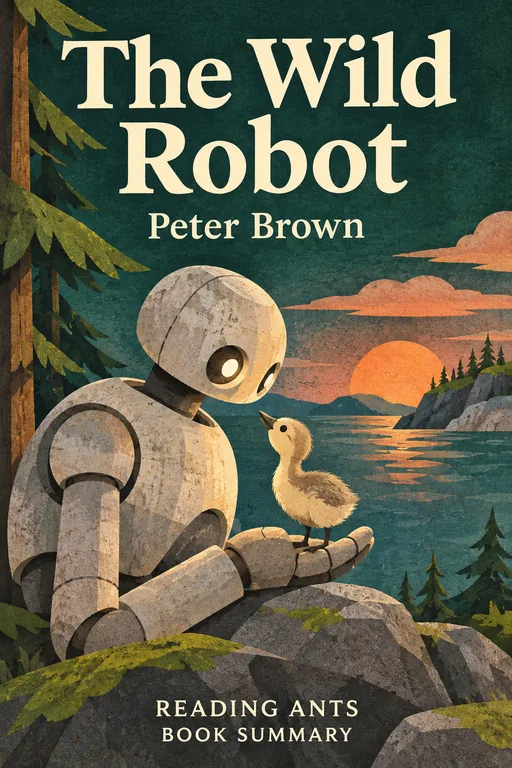
The Wild Robot
A robot named Roz is washed up on a remote island, where she learns to survive among the animals, becomes a mother to an orphaned gosling and discovers what it means to belong.
Overview
The Wild Robot is a children’s novel written and illustrated by Peter Brown, published in 2016. It tells the story of Roz, a robot who is shipwrecked on a wild island. Without people to give her instructions, she must learn how to live in nature, and the animals are at first afraid of her. The book has short chapters, with Brown’s illustrations, and its tone is gentle and thoughtful. It is also an adventure about learning to be part of a community and a story about what makes someone alive and caring. It was followed by two sequels, The Wild Robot Escapes and The Wild Robot Protects, and was made into an animated film in 2024.
Main Characters
- Roz (ROZZUM unit 7134): a robot who learns to live in the wild and discovers love and family.
- Brightbill: a gosling who is adopted by Roz and becomes a strong, brave goose.
- Fink: a sly, clever fox who becomes Roz’s friend.
- Longneck: an old goose who helps Brightbill learn to fly.
- Paddler: a beaver on the island.
- The animals of the island: including bears, geese, beavers, deer, owls and many others.
Full Summary
The Shipwreck
The story begins with a storm that wrecks a cargo ship. A crate with a robot, Roz, washes up on a remote island, where it is battered on the rocks. Roz is accidentally switched on by a group of sea otters, and she begins to look for a task. Because she was built to be useful, she asks the animals for orders, but they are frightened of this strange metal creature, and they call her a monster. Roz does not understand why they only run away. Her metal body makes her look like a creature from another world.
Learning the Language
Roz soon realizes that to survive on the island, she must learn from the animals. She listens to the sounds of the creatures and discovers the language of animals, and starts to talk to them. She also learns how to hide, camouflage herself with mud and moss, and live in the forest. The animals begin to see that she is not dangerous, but they are still unsure.
The Gosling
One day, Roz accidentally causes the death of a goose family, and only an egg survives. A gosling, Brightbill, hatches and sees Roz as his mother. The geese do not expect a robot to be able to raise a gosling, but Roz is determined. With the help of Fink, a fox, and an old goose called Longneck, she teaches Brightbill how to swim, to eat and to find food. Roz gradually becomes a mother figure and discovers that she cares for the little goose.
Winter
As autumn arrives, Brightbill, strong enough to fly at last, joins the other geese for their migration south, and Roz is sad to see him go. The winter on the island is brutal. Roz and Fink help the animals through the cold, and the animals shelter together. In the cold, the animals work together and put aside their fear of Roz and of each other. A bond forms between them, and the island becomes like one family, with Roz at its center.
Brightbill Returns
In the spring, Brightbill returns from his migration with the other geese. Roz knew that letting him go had been right. She lives among the animals, who now call her a friend, and she serves as a protector and a helper to them. She meets new creatures and keeps learning, and over the seasons she helps with many small problems, such as finding food, mending a lodge and calming quarrels, until the animals trust her. She often thinks about the difference between being built and being alive, and she decides that being alive may mean caring for others.
The Robots Return
Later, a group of robots arrives on the island, sent by the company that built Roz to retrieve her. They are cold and efficient, and attack the animals who defend Roz. In the conflict, the animals band together to fight the robots and protect her, and Roz is badly damaged. In the end she returns to the company that built her, in order to keep the island safe, and she promises to come back.
Why It Matters
The Wild Robot was a New York Times bestseller and won several awards, and was widely used in classrooms, as it raises questions about nature, technology and what makes a family. The 2024 animated film by DreamWorks, starring Lupita Nyong’o, introduced the story to a new audience.
The book is valued for its mixture of science fiction and nature writing, and its message that machines, like people, can learn to care. Brown’s illustrations, in black and white, with clear shapes, have been praised, and many readers say they were moved by the way Roz’s feelings are shown through simple actions instead of long explanations. It is often discussed in conversations about artificial intelligence, though it is more about love and community.
Key Takeaways
- Adaptation helps survival. Roz learns to live by observing and listening.
- Family can be chosen. Roz becomes a mother to a goose.
- Cooperation beats fear. The animals unite in the winter.
- Differences can be strengths. Roz’s skills help the community.
- Letting go is part of love. Roz must let Brightbill leave.
What We Can Learn
The story invites us to think about how we treat those who are different. The animals first see Roz as a monster, but they learn that she is helpful and kind.
It also shows that learning to listen and respect others is a way to belong. Roz succeeds not by commanding but by learning from the animals.
Finally, it reminds us that love is about care and letting go. Roz’s relationship with Brightbill shows how a parent or friend can support someone’s growth.
Criticism and Counterpoints
Some readers find the idea of a robot developing feelings and learning animal languages implausible, and the book does not explain how it works. Others say that the robots in the final part are portrayed as villains, which may reinforce fears of technology, and that the portrayal of nature is somewhat idealized, because predators and prey live in harmony in winter.
A few parents worry about the scenes of danger and the deaths of some animals. The pace may seem slow to some. Still, many appreciate the artwork and the warmth of the story.
Who Should Read It
This book suits children from about age seven, and can be read aloud to younger ones. It has short chapters and illustrations, and a few tense moments. It is a good choice for readers who like animals and science fiction.
Want the whole book?
A summary is a taste, not the meal. Here is where to find the full book.
You reached the end 🎉
Nicely done. Mark this one as read, and we will suggest what to read next.
Read this next
The One and Only Ivan
Katherine Applegate
A gorilla named Ivan, who lives in a small cage in a shopping mall, promises to rescue a baby elephant named Ruby and finds his voice through painting.
🧸 Children's Books
Robinson Crusoe
Daniel Defoe
After a shipwreck, an English sailor named Robinson Crusoe survives for twenty-eight years on a remote island, building a life with his own skill and faith, and eventually befriending a man he calls Friday.
📜 Classics
Hatchet
Gary Paulsen
After a plane crash leaves him alone in the Canadian wilderness with only a hatchet, a thirteen-year-old boy must learn to survive, and grows from a frightened city kid into a patient, resourceful young man.
🧸 Children's Books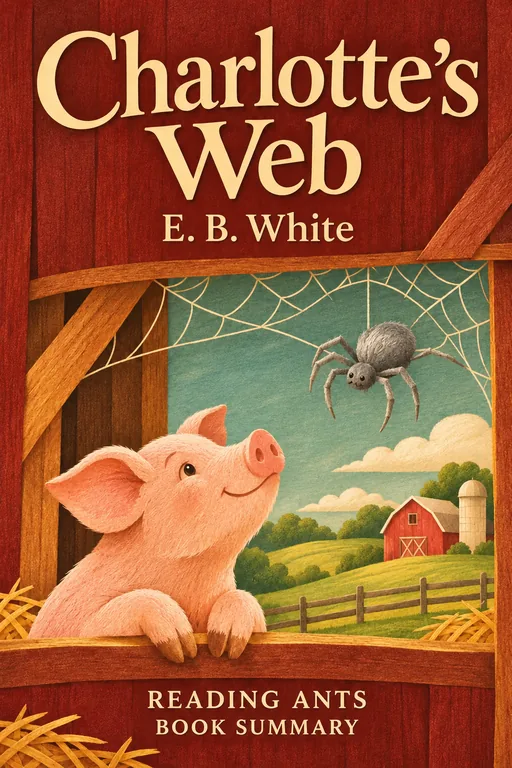
Charlotte's Web
E. B. White
A lonely pig named Wilbur learns he is going to be killed, and his clever friend Charlotte, a spider, comes up with an amazing plan to save his life.
🧸 Children's BooksHarry Potter and the Philosopher's Stone
J. K. Rowling
An unloved orphan boy discovers on his eleventh birthday that he is a famous wizard, and during his first year at a magical school he makes true friends and faces the dark wizard who killed his parents.
🧸 Children's Books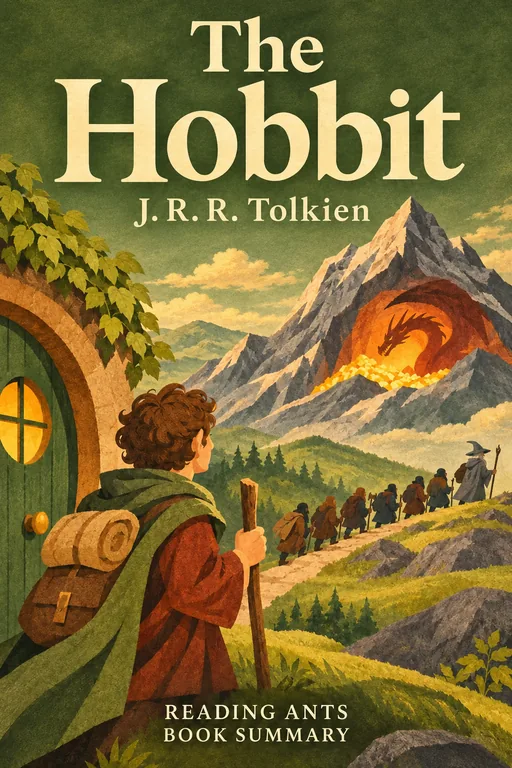
The Hobbit
J. R. R. Tolkien
A comfortable, home-loving hobbit is swept into a dangerous quest with thirteen dwarves to win back their treasure from a dragon, and discovers along the way that he is far braver and cleverer than he ever imagined.
🧸 Children's BooksWant something different?
Pick another topic and we will show you three books to start with.